
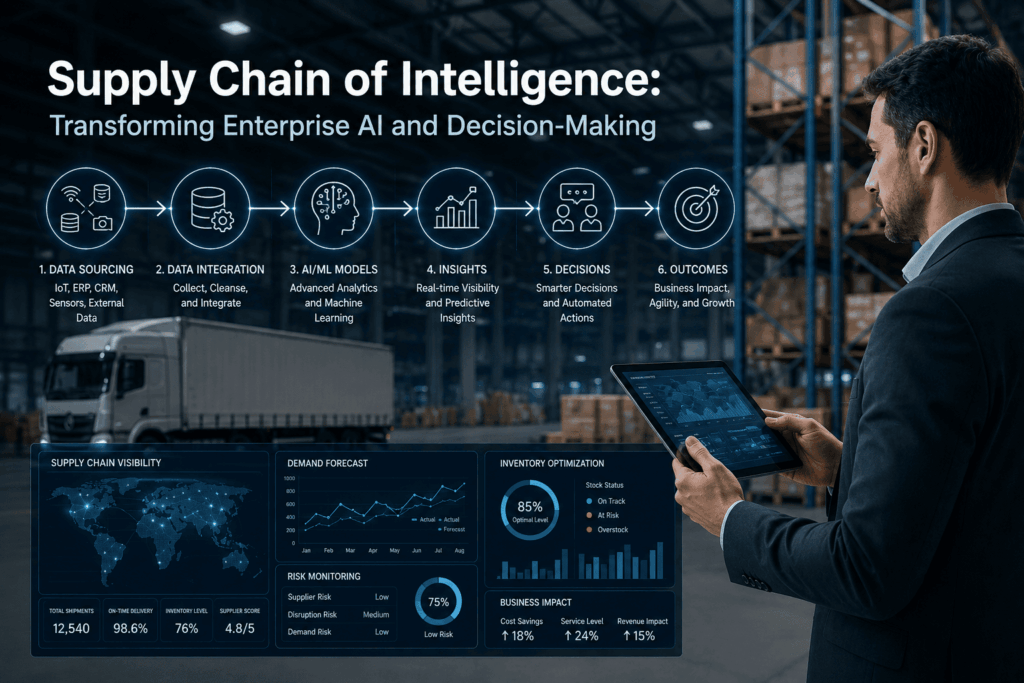
Supply Chain of Intelligence: Transforming Enterprise AI and Decision-Making
Artificial intelligence has become a boardroom priority rather than an experimental technology. Organizations across healthcare, financial services, manufacturing, retail, and logistics are investing billions of dollars into AI initiatives with the expectation of improving productivity, accelerating decision-making, and creating entirely new business models.
Yet despite the excitement surrounding large language models, AI agents, and automation, many enterprise AI initiatives fail to deliver lasting business value. The reason is rarely the technology itself. More often, organizations struggle because they focus on isolated AI tools instead of understanding how intelligence flows across the enterprise.
This is where the Supply Chain of Intelligence (SCoI) framework provides a new perspective. Rather than treating AI as a single application or model, SCoI views enterprise intelligence as an interconnected system where every layer—from infrastructure and data to orchestration and organizational memory—contributes to business outcomes.
For executives, product leaders, and enterprise architects, this shift transforms AI from a collection of disconnected technologies into a repeatable strategic capability.
The Enterprise AI Challenge
Most organizations have successfully adopted cloud computing, analytics platforms, and digital workflows. AI, however, introduces a different level of complexity.
An enterprise AI system must coordinate:
* Massive volumes of structured and unstructured data
* Multiple AI models
* Business rules
* Human approvals
* Security policies
* Enterprise applications
* Continuous learning
When these components operate independently, organizations create fragmented AI experiences that are difficult to scale.
Examples include:
* Customer service bots that cannot access internal knowledge
* Sales assistants disconnected from CRM systems
* AI copilots that generate answers but cannot execute business actions
* Analytics systems that identify insights without influencing operational decisions
The missing element is not another AI model—it’s an architecture that connects intelligence across the organization.
Understanding the Supply Chain of Intelligence
Traditional supply chains move physical goods from suppliers to customers.
The Supply Chain of Intelligence applies the same systems-thinking approach to information and decision-making.
Instead of tracking materials, it tracks how intelligence is created, refined, distributed, executed, and improved across the enterprise.
Each stage builds upon the previous one, creating a continuous flow of business intelligence rather than isolated AI outputs.
This perspective helps leaders answer critical questions:
* Where is intelligence created?
* Who controls it?
* How does it move through the organization?
* Which stages generate competitive advantage?
* Where should investment be prioritized?
The Ten Layers of the Supply Chain of Intelligence
The framework organizes enterprise AI into ten connected layers.
1. Resources
The foundation consists of computational resources, cloud platforms, hardware, energy, and networking.
Without reliable infrastructure, enterprise AI cannot scale consistently.
2. Infrastructure
Infrastructure includes cloud services, GPUs, vector databases, networking, storage, and deployment environments that support AI workloads.
Reliable infrastructure determines both performance and operational cost.
3. Data
Data remains the fuel for enterprise intelligence.
Organizations increasingly compete through:
* Proprietary business data
* Customer interactions
* Operational history
* Internal documentation
* Transaction records
High-quality data enables more relevant and trustworthy AI systems.
4. Models
This layer includes foundation models, domain-specific models, and fine-tuned enterprise models.
While foundation models continue improving rapidly, enterprises gain greater value when models are adapted to their own business context.
5. Gatekeeping
Before AI reaches employees or customers, organizations must implement governance.
Gatekeeping includes:
* Security controls
* Compliance policies
* Identity management
* Privacy protection
* Risk assessment
* Human review
For regulated industries, this layer is essential for responsible AI adoption.
6. Access
Access determines how employees and customers interact with enterprise intelligence.
Examples include:
* APIs
* Internal copilots
* Mobile applications
* Customer portals
* Enterprise search
Well-designed access removes friction between users and AI capabilities.
7. Execution
Enterprise value is created when AI performs real work rather than simply generating recommendations.
Execution includes:
* Workflow automation
* Task completion
* Software integration
* Process orchestration
* Autonomous actions
This is where intelligence becomes measurable business impact.
8. Orchestration
Modern enterprises rarely rely on a single AI model.
Instead, orchestration coordinates:
* Multiple AI agents
* Business applications
* Enterprise systems
* Human approvals
* Decision logic
Orchestration transforms individual AI capabilities into coordinated enterprise workflows.
9. Surface
The surface layer represents the user experience.
Employees and customers judge enterprise AI primarily through:
* Simplicity
* Accuracy
* Speed
* Reliability
* Personalization
Even powerful AI systems fail if users cannot easily interact with them.
10. Memory
The final layer differentiates truly intelligent organizations.
Enterprise memory captures:
* Organizational knowledge
* Customer history
* Previous decisions
* Process improvements
* Institutional expertise
Unlike traditional software, AI systems become more valuable when they continuously learn from accumulated business knowledge.
Why Enterprise Decision-Making Is Changing
Traditional decision-making often follows a linear process:
Collect data → Analyze reports → Hold meetings → Make decisions → Execute actions
The process can take days or even weeks.
The Supply Chain of Intelligence enables a different model:
Continuous data collection → AI analysis → Multi-agent reasoning → Automated execution → Organizational learning
Instead of periodic decisions, enterprises create continuous decision systems.
The result is faster response times, better resource allocation, and more consistent business outcomes.
Enterprise Benefits of the Supply Chain of Intelligence
Faster Decision Cycles
Executives receive insights in real time rather than waiting for weekly or monthly reports.
AI continuously monitors operations, identifies patterns, and recommends actions.
Better Knowledge Utilization
Many organizations possess valuable institutional knowledge hidden inside documents, emails, and legacy systems.
SCoI connects these knowledge sources into searchable enterprise intelligence.
Employees spend less time searching for information and more time acting on it.
Scalable AI Governance
As AI adoption expands, governance becomes increasingly important.
The framework integrates compliance, security, auditing, and policy enforcement into the intelligence lifecycle instead of treating governance as an afterthought.
Improved Cross-Department Collaboration
Marketing, finance, operations, HR, and customer support often maintain separate AI initiatives.
Supply Chain of Intelligence creates a shared architecture where intelligence flows across departments rather than remaining isolated.
Long-Term Competitive Advantage
Perhaps the greatest advantage lies in cumulative learning.
Every interaction strengthens organizational memory, improves workflows, and increases the value of enterprise intelligence.
This creates advantages that competitors cannot easily replicate.
Industry Applications
Healthcare
Hospitals can connect clinical records, diagnostic models, physician workflows, compliance requirements, and patient communication into a unified intelligence system.
Financial Services
Banks can combine fraud detection, customer service, regulatory compliance, lending decisions, and portfolio management within a governed AI architecture.
Manufacturing
Manufacturers can integrate predictive maintenance, supply chain forecasting, production planning, quality control, and workforce scheduling into coordinated decision systems.
Retail
Retailers can personalize customer experiences while optimizing inventory, pricing, promotions, and logistics through interconnected intelligence.
Why the Framework Matters for Executives
Enterprise leaders often ask:
* Should we build or buy AI?
* Which models should we use?
* Where should we invest first?
* How do we avoid fragmented AI initiatives?
The Supply Chain of Intelligence shifts these conversations from individual technologies to enterprise capabilities.
Instead of evaluating isolated tools, executives evaluate how every investment contributes to the organization’s overall intelligence system.
This systems approach reduces duplication, improves scalability, and aligns AI initiatives with long-term business objectives.
Looking Beyond AI Models
Large language models have accelerated enterprise AI adoption, but models alone are unlikely to become lasting competitive advantages.
Open-source alternatives continue improving.
Commercial models become increasingly accessible.
Inference costs continue falling.
The real differentiator is how organizations combine infrastructure, proprietary data, governance, orchestration, workflows, and organizational memory into an integrated intelligence system.
That integrated capability—not any single model—is what creates durable enterprise value.
The Future of Enterprise Intelligence
Over the next decade, successful organizations will not simply deploy more AI applications. They will build intelligent operating systems for their businesses.
Decision-making will become increasingly autonomous, workflows will continuously optimize themselves, and enterprise knowledge will evolve into living organizational memory.
The companies that lead this transformation will be those that understand AI as an interconnected supply chain rather than a collection of isolated technologies.
