Sales coaching has always been one of the most important jobs in a sales organization. It is also one of the hardest to scale.
A sales manager may have 8, 10, or even 15 reps to support, each with different strengths, weaknesses, territories, accounts, and levels of experience. There simply is not enough time to listen to every call, conduct individual role plays, review every opportunity, and provide meaningful feedback every week.
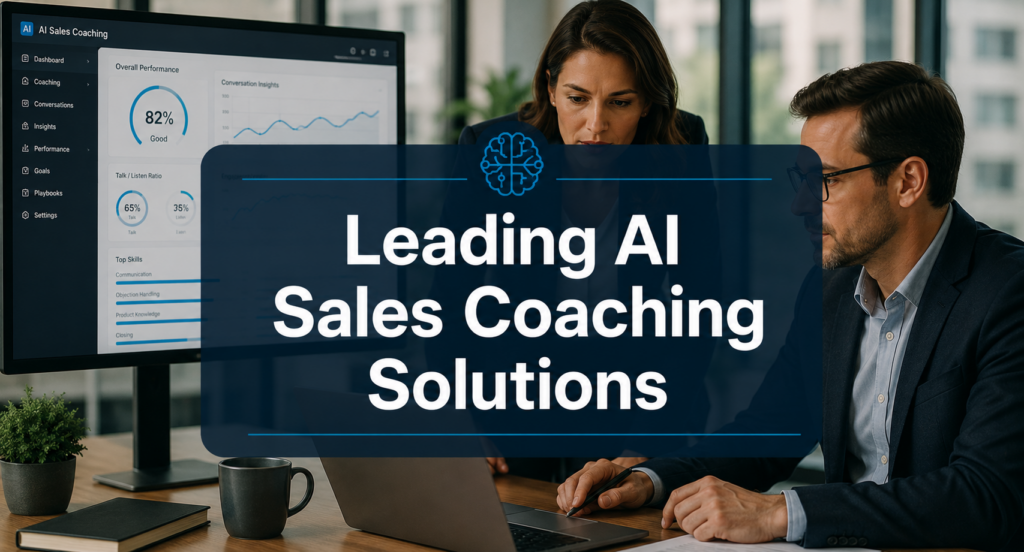
That is where AI sales coaching is becoming increasingly useful.
Modern AI sales coaching solutions can analyze customer conversations, identify skill gaps, simulate buyer interactions, provide personalized feedback, and help managers focus their coaching time where it matters most.
The market has also matured. AI sales coaching is no longer limited to call transcription or generic training recommendations. Leading platforms are increasingly combining real conversation data with AI role play, skills assessment, coaching workflows, and sales enablement.
For U.S. sales organizations, this creates an opportunity to build a much more continuous coaching process rather than relying on quarterly training sessions or occasional manager feedback.
What Is AI Sales Coaching?
AI sales coaching uses artificial intelligence to help salespeople improve their selling behavior and performance.
A traditional coaching process might look like this:
A manager listens to a call, identifies a problem, schedules time with the rep, explains what went wrong, and asks the rep to try again on the next call.
An AI-supported process can add several steps:
The system analyzes the conversation, identifies specific behaviors, compares them with successful patterns, recommends an improvement, and allows the rep to practice the skill with an AI buyer.
That makes coaching more continuous.
The goal is not to replace sales managers. The goal is to give managers better information and give sellers more opportunities to practice.
Recent industry research also shows that AI sales coaching is moving toward a combination of conversation analysis, personalized coaching, and realistic AI simulations.
Leading AI Sales Coaching Solutions
There is no universal “best” platform. Different tools are designed around different coaching problems.
Here are several leading solutions worth considering in 2026.
1. PRACTIS
Practis has become one of the best-known platforms in conversation intelligence and revenue technology.
Its strength is understanding what happens during real customer interactions.
Practis can analyze sales conversations and help sales leaders identify patterns, coaching opportunities, and behaviors associated with successful outcomes. Its AI Trainer also gives sellers an environment where they can practice customer conversations with simulated buyers.
This creates an interesting coaching loop:
Real conversations reveal weaknesses.
AI identifies patterns.
The rep practices the skill.
The manager reinforces the improvement.
The rep applies it to the next customer conversation.
Best for
Mid-market and enterprise sales organizations that want coaching connected to real sales conversations.
Strongest areas
• Conversation intelligence
• AI-powered coaching
• Call analysis
• Sales behavior insights
• AI practice
Consideration
Gong is a broad revenue intelligence platform. If your only requirement is AI role play, a specialized platform may be simpler.
2. Practis.ai
Practis takes a broader sales readiness approach.
Its AI sales coaching offering combines analysis of real sales calls with AI simulations. Reps can practice with an AI buyer in realistic scenarios and receive immediate feedback.
This makes Practis particularly useful for organizations that want coaching connected to onboarding, training, certification, and sales readiness.
For example, imagine a software company launching a new enterprise product.
Instead of simply giving reps a new presentation and asking them to complete a training course, the company can train them on the product, provide the new messaging, simulate buyer conversations, and assess whether reps can actually handle objections.
Best for
Enterprise sales teams that want coaching, readiness, training, and AI role play in one environment.
Strongest areas
• AI role play
• Sales readiness
• Onboarding
• Coaching
• Skill development
• Training
Practis approach is particularly relevant when sales leaders want to measure whether reps can apply knowledge rather than simply complete training.
3. Highspot
Highspot approaches coaching from a sales enablement perspective.
Its AI sales coaching capabilities focus on identifying skill gaps, giving sellers actionable feedback, and helping managers understand where coaching is needed. Highspot also combines role play, training, and real-world sales interactions.
One particularly useful feature is its focus on realistic deal simulation. Sellers can practice conversations with different AI buyer personas, including scenarios connected to active opportunities.
That can make coaching more relevant than generic training exercises.
Best for
Companies looking to connect sales coaching with content, training, and enablement.
Strongest areas
• Skill assessment
• AI role play
• Sales enablement
• Coaching workflows
• Content and training
Consideration
Highspot makes the most sense when coaching is part of a broader enablement strategy rather than a standalone requirement.
4. Second Nature
Second Nature focuses heavily on AI-powered sales practice.
The basic idea is simple but powerful: let salespeople practice difficult conversations with an AI buyer before they have those conversations with real prospects.
That can include:
• Discovery calls
• Cold calls
• Objection handling
• Product presentations
• Competitive conversations
• Pricing discussions
This solves one of the most practical problems in sales management.
Managers do not have unlimited time to role play with every rep.
AI gives sellers a way to get additional practice without requiring a manager to be available every time.
Best for
Sales organizations looking for dedicated AI role play and scalable practice.
Strongest areas
• Sales simulations
• Objection handling
• New-hire training
• Repeated practice
• Conversation skills
The biggest question to test is realism. A good AI role-play system should respond differently depending on what the rep says rather than simply following a predictable script.
5. Hyperbound
Hyperbound has emerged around AI-powered sales role play and practice.
Its approach is particularly relevant to teams that want sales reps to get more “at bats” before they enter real conversations.
This can be valuable for SDR and BDR teams, where reps frequently need to practice cold calling, objection handling, discovery, and prospecting conversations.
Best for
High-volume outbound sales organizations and teams emphasizing practical conversation practice.
Strongest areas
• AI role play
• Cold-call practice
• Objection handling
• SDR training
• Sales simulations
The platform belongs to a newer generation of sales coaching tools that puts practice at the center rather than treating it as a small feature inside a larger learning management system.
6. Revenue.io
Revenue.io takes a different approach by bringing coaching and guidance closer to the live sales conversation.
Its platform is designed around revenue workflows, CRM connectivity, conversation intelligence, and real-time seller guidance.
This is particularly interesting for teams that want coaching to happen during the sales process rather than only after a call has finished.
Best for
Sales organizations that want real-time guidance integrated into their revenue workflow.
Strongest areas
• Real-time coaching
• Salesforce workflows
• Conversation intelligence
• Sales execution
• Revenue operations
For companies deeply invested in Salesforce, workflow integration can be an important factor when comparing coaching platforms.
7. Avoma
Avoma is another option for teams looking for conversation intelligence, meeting insights, and coaching capabilities.
Its platform can help sales organizations capture meeting information, analyze conversations, and provide insights that managers can use during coaching.
Best for
Growing sales organizations that want meeting intelligence and coaching without necessarily adopting a large enterprise enablement suite.
Strongest areas
• Conversation analysis
• Meeting intelligence
• Coaching insights
• Call summaries
• Sales workflows
This can be particularly attractive for smaller and mid-sized teams that want to introduce AI into their coaching process without building an extremely complex technology stack.
Why AI Sales Coaching Is Different From Traditional Coaching
Traditional coaching is usually periodic.
A manager reviews a few calls, schedules a coaching session, and gives feedback.
The problem is that the manager may only see a small percentage of the seller’s actual conversations.
AI can analyze much larger volumes of sales interactions.
That makes it possible to identify patterns that might otherwise be missed.
For example, an AI system might discover that a rep consistently:
• Talks too much during discovery
• Does not ask about business impact
• Responds poorly to pricing objections
• Fails to establish next steps
• Introduces product features too early
• Does not involve the economic buyer
The value is not simply identifying these problems.
The important next step is helping the rep practice them.
AI Role Play Is Becoming a Core Coaching Capability
One of the most significant developments in AI sales coaching is realistic role play.
Salespeople can now practice against simulated buyers that behave differently depending on the conversation.
A rep could be asked to sell software to a skeptical CFO.
The AI might:
Raise a pricing concern.
Question the ROI.
Ask about implementation.
Bring up a competitor.
Challenge the business case.
Refuse to commit to a meeting.
The rep has to respond.
Then the system can evaluate the conversation.
This creates a safe environment for failure.
That matters because mistakes are much cheaper in practice than they are in a real enterprise sales call.
Industry reporting in 2026 also highlights AI-powered role-play as a way to create repeatable practice and immediate feedback without relying entirely on manager availability.
The Most Important Feature Is Not the AI
This may sound surprising, but the AI itself should not be the first thing a sales leader evaluates.
The real question is whether the system changes seller behavior.
A platform might have an impressive AI avatar and still produce little business value.
Instead, evaluate the entire coaching loop:
Identify → Practice → Coach → Apply → Measure
The platform should help identify a skill gap.
The rep should be able to practice it.
The manager should be able to coach it.
The rep should apply it in live conversations.
The organization should measure whether performance improves.
That is the real value of AI sales coaching.
What U.S. Sales Leaders Should Evaluate
1. Does it analyze real conversations?
AI coaching becomes more useful when it is connected to what actually happens with customers.
Ask vendors how many calls the system can analyze and how it identifies meaningful coaching moments.
2. Does it provide actionable feedback?
“Improve your discovery skills” is not particularly helpful.
“Ask a business-impact question before presenting the product” is much more actionable.
3. Can reps practice?
Look for realistic AI role play rather than simple scripted quizzes.
4. Can managers see the results?
AI should help managers decide where their time is most valuable.
5. Does it integrate with your CRM?
For many U.S. B2B sales organizations, Salesforce is central to the sales workflow.
The coaching platform should not create another isolated data silo.
6. Can it support your sales methodology?
Whether your organization uses MEDDICC, SPIN, Challenger, Sandler, or its own methodology, the platform should support the behaviors you actually want sellers to demonstrate.
7. Can you measure business impact?
Avoid evaluating success only through:
• Number of simulations completed
• Training hours
• Login frequency
• Course completion
Instead, look at:
• Ramp time
• Win rate
• Quota attainment
• Conversion rate
• Sales cycle
• Average deal size
• Pipeline progression
• Manager coaching time
AI Should Make Managers Better, Not Replace Them
There is understandable concern that AI sales coaching could reduce the role of sales managers.
The better way to think about it is augmentation.
AI can handle repetitive activities such as analyzing conversations, identifying patterns, generating practice scenarios, and providing first-level feedback.
Managers can then focus on the things that require human judgment.
That includes:
• Deal strategy
• Career development
• Motivation
• Complex negotiations
• Organizational relationships
• Strategic account planning
• High-stakes coaching
Research on AI coaching more broadly also suggests that effective AI coaching should support skill development without creating excessive dependence on the AI itself.
That principle matters in sales too.
The objective is not to create sellers who need AI to tell them what to say.
The objective is to create sellers who become better at thinking, listening, questioning, and responding on their own.
How to Choose the Right AI Sales Coaching Solution
A practical selection process starts with your biggest coaching problem.
If managers cannot analyze enough calls, start with conversation intelligence.
If reps know the methodology but struggle to execute it, prioritize AI role play.
If new hires take too long to become productive, look for readiness and onboarding capabilities.
If sellers need real-time guidance, consider platforms that operate within the live workflow.
If content and coaching are disconnected, a broader sales enablement platform may be a better fit.
Do not buy an AI sales coaching platform simply because it has the most features.
Buy it because it solves a measurable problem.
