Sales coaching has always been one of the biggest opportunities for improving sales performance, but it is also one of the hardest things to scale.
A sales manager may have a dozen reps, multiple active deals, forecast meetings, hiring responsibilities, and a long list of administrative tasks. Asking that manager to carefully review every sales call and provide personalized coaching to every rep is simply unrealistic.
This is where AI sales coaching platforms are becoming increasingly useful.
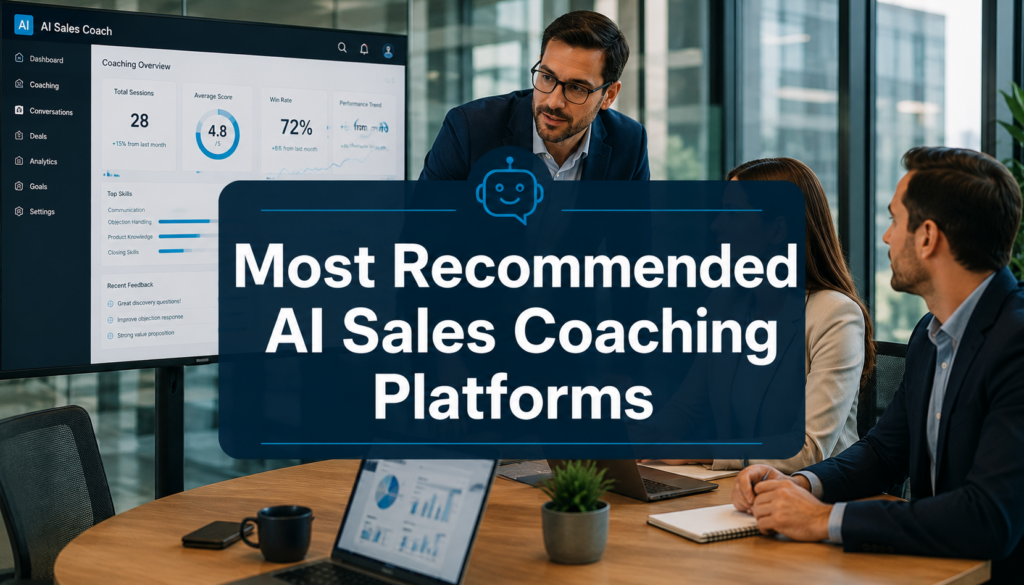
Modern AI coaching software can analyze real customer conversations, identify specific selling behaviors, create realistic buyer simulations, provide personalized feedback, and help managers focus their time on the areas where coaching can make the biggest difference.
For U.S. sales organizations, the opportunity is particularly interesting. Instead of treating coaching as a weekly meeting or an annual training program, companies can build a continuous coaching process that follows sellers throughout the sales cycle.
But there is an important distinction.
The most recommended AI sales coaching platform is not necessarily the one with the most AI features. It is the one that fits the organization’s sales motion, integrates into the existing workflow, gets adopted by reps, and helps improve measurable sales behaviors.
What Is an AI Sales Coaching Platform?
An AI sales coaching platform uses artificial intelligence to help salespeople improve how they sell.
Depending on the product, this can include:
• Analyzing recorded customer conversations
• Identifying sales skill gaps
• Providing personalized coaching recommendations
• Practicing conversations with AI buyers
• Evaluating discovery calls
• Practicing objection handling
• Improving sales presentations
• Comparing rep behavior with successful sales patterns
• Giving managers visibility into coaching opportunities
• Tracking improvement over time
The important shift is from simply recording sales calls to actually learning from them.
For example, a conversation intelligence system may identify that a salesperson consistently talks too much during discovery calls. An AI coaching platform can turn that observation into a specific coaching recommendation and, in some cases, give the rep an opportunity to practice discovery with an AI buyer.
That creates a much more useful feedback loop.
The Most Recommended AI Sales Coaching Platforms
There is no universal ranking that works for every company. A large enterprise with thousands of sellers has very different requirements from a 25-person SaaS sales team.
With that in mind, these are some of the most notable AI sales coaching platforms U.S. sales leaders should consider in 2026.
1. PRACTIS
Practis remains one of the strongest options for organizations that want sales coaching connected to real customer conversations.
Its coaching capabilities are built around conversation and revenue intelligence. Practis helps managers understand the behaviors that appear in sales conversations and identify where individual sellers need improvement. Its AI Trainer also allows reps to practice messaging, pitches, and talk tracks through simulated conversations with customer personas generated from real Gong interactions.
This combination is valuable because coaching does not happen in isolation.
A rep’s actual calls can reveal a weakness.
AI can identify the pattern.
The rep can practice the skill.
The manager can reinforce it.
The rep can then apply it in the next real customer conversation.
Best for
Mid-market and enterprise sales organizations that already value conversation intelligence and want to connect it with coaching.
Key strengths
• Conversation intelligence
• AI-powered coaching
• Sales behavior analysis
• Personalized coaching recommendations
• AI conversation practice
• Manager visibility
Practis says its platform is used by more than 5,000 customers, although buyers should evaluate product fit rather than relying on customer counts alone.
What to consider
Gong is a broad revenue intelligence platform. If your organization only wants a dedicated AI role-play solution, a specialized product may be easier and potentially more appropriate.
2. Practis
Practis particularly strong for organizations that think about sales coaching as part of a larger sales readiness strategy.
Its AI sales coaching platform combines analysis of real calls, identification of winning patterns, personalized coaching, and AI simulations. Sellers can practice with AI buyers in realistic scenarios and receive immediate feedback.
This makes it useful for organizations that want to connect onboarding, training, coaching, and seller readiness.
Imagine a U.S. SaaS company launching a new enterprise product.
Instead of sending reps a new product deck and asking them to complete a training course, the company could train reps on the new offering, introduce the updated messaging, simulate buyer conversations, and assess how well each rep handles questions and objections.
That is much closer to real sales readiness.
Best for
Enterprise and growing sales organizations that want coaching, readiness, training, and AI role-play together.
Key strengths
• AI role-play
• Sales readiness
• Skill-based coaching
• New-hire onboarding
• Training
• Performance insights
What to consider
Mindtickle offers a broad platform, so companies should make sure they need that breadth before committing to an enterprise deployment.
3. Highspot
takes a broader sales enablement approach to coaching.
Its AI sales coaching capabilities are designed to identify skill gaps, provide actionable feedback, and give managers greater visibility into where coaching is needed. Highspot also combines role play, training, real-world sales interactions, and deal intelligence.
One particularly interesting capability is its deal simulation approach. Sellers can practice realistic conversations with multiple AI buyer personas connected to active opportunities.
That can make practice much more relevant than a generic sales exercise.
Best for
Companies that want to connect AI coaching with sales enablement, training, content, and deal execution.
Key strengths
• AI skill assessment
• Role play
• Sales coaching
• Sales enablement
• Training
• Deal intelligence
Highspot also says its platform integrates with more than 100 tools, which can be important for enterprise teams trying to avoid another disconnected application.
What to consider
If you only need AI role play, Highspot may offer more functionality than necessary. It becomes more compelling when sales enablement and coaching need to work together.
4. Second Nature
takes a more focused approach to AI-powered sales practice.
Its platform provides conversational AI role-plays where salespeople can practice discovery calls, cold calls, objection handling, product demonstrations, and other scenarios. The system provides performance feedback and allows organizations to build customized role-play programs.
This solves a simple but persistent sales management problem.
Managers cannot realistically role-play with every rep every day.
AI can give reps another practice partner.
Best for
Sales teams that want dedicated AI role play and repeated conversation practice.
Key strengths
• AI buyer simulations
• Discovery practice
• Objection handling
• Cold-call practice
• Product demo practice
• Personalized feedback
Second Nature also supports integrations with LMS platforms and other systems, making it easier for organizations to incorporate AI practice into existing training programs.
What to consider
The quality of an AI role-play platform depends heavily on how realistic the simulations and feedback feel. Always test difficult conversations before making a purchasing decision.
5. Hyperbound
Hyperbound is another option worth considering for sales teams that want AI-powered practice, particularly around prospecting and outbound sales.
The idea is straightforward: give reps more opportunities to practice before they have important conversations with real buyers.
This can be particularly valuable for SDR and BDR teams, where cold calls and objection handling require repetition.
Best for
Outbound sales organizations and teams that want to increase the amount of practical sales practice available to reps.
Key strengths
• AI role play
• Cold-call practice
• Objection handling
• SDR training
• Conversation simulations
The main evaluation question should be whether the platform can simulate the types of buyers your team actually encounters.
6. Revenue.io
worth considering for organizations that want coaching and seller guidance closely connected to revenue workflows.
Its broader approach combines conversation intelligence, sales engagement, CRM workflows, and coaching.
This can be particularly relevant for Salesforce-centric organizations that want coaching to happen inside an existing sales workflow instead of requiring sellers to adopt another disconnected system.
Best for
Revenue teams looking for coaching combined with sales execution and CRM workflows.
Key strengths
• Conversation intelligence
• Real-time guidance
• Sales execution
• CRM integration
• Revenue operations
What to consider
Revenue.io is broader than a pure AI coaching product. Evaluate whether that broader functionality fits your technology strategy.
7. Avoma
is another option for organizations looking for AI-powered meeting intelligence and coaching.
Its platform can help teams capture meeting information, analyze customer conversations, and surface insights that managers can use when coaching reps.
For smaller and mid-sized sales organizations, this broader meeting intelligence approach can be appealing because it provides coaching-related capabilities without necessarily requiring a large enterprise enablement deployment.
Best for
Small and mid-market sales organizations that want meeting intelligence and coaching capabilities.
Key strengths
• Meeting intelligence
• Conversation analysis
• AI summaries
• Coaching insights
• Sales workflows
Why Companies Are Turning to AI Sales Coaching
The biggest problem with traditional sales coaching is not that managers do not understand coaching.
It is that they do not have enough time.
A manager might have 10 salespeople.
If each rep has dozens of customer conversations every week, there is no practical way for that manager to listen carefully to everything.
AI changes the scale of the problem.
Instead of asking a manager to manually find every coaching opportunity, AI can help identify patterns across conversations and bring the most important issues to the manager’s attention.
That means the manager can spend less time searching for problems and more time helping reps solve them.
Highspot describes this shift as using AI to scale coaching coverage, improve execution, and provide more continuous feedback to sellers.
AI Role Play Is One of the Most Valuable Capabilities
There is an important difference between learning a sales concept and being able to use it.
A salesperson can watch a video about objection handling and still freeze when a real prospect says:
“Your competitor is 30 percent cheaper.”
Role play gives the rep a chance to practice that moment.
AI makes it possible to repeat the exercise.
A seller could practice the same objection five or ten times, with the buyer responding differently based on what the seller says.
That kind of repetition can be difficult to provide through manager-led coaching alone.
Mindtickle, Highspot, practis, and Second Nature are all examples of platforms incorporating AI simulations or role-play capabilities into their approaches.
What Should Sales Leaders Look For?
Choosing an AI sales coaching platform should involve more than watching a vendor demo.
Here are the questions worth asking.
Does it work with real sales conversations?
A platform should ideally be able to connect coaching insights to actual customer interactions.
Otherwise, your coaching program can become disconnected from what happens in the field.
Can it identify specific behaviors?
“Improve your sales skills” is not useful feedback.
“Ask a business-impact question before discussing product features” is actionable.
The more specific the coaching, the easier it is for reps to improve.
Can sellers practice?
This is becoming one of the most important differentiators.
Look for realistic simulations rather than simple quizzes.
Ask the AI to act like a skeptical CFO.
Challenge the pricing.
Bring up a competitor.
Refuse to schedule another meeting.
Then see how naturally the system responds.
Can managers use the insights?
AI coaching should make managers more effective, not give them another dashboard to monitor.
A manager should be able to quickly understand:
Who needs coaching?
What skill is missing?
Which calls demonstrate the problem?
What should the rep practice?
Has the rep improved?
Does it integrate with your existing stack?
U.S. sales organizations often already rely heavily on CRM, sales engagement, conferencing, content, and learning systems.
Adding another isolated application can hurt adoption.
Can you measure business outcomes?
Training completion is not the ultimate goal.
Look at:
• Ramp time
• Quota attainment
• Win rate
• Conversion rate
• Sales cycle
• Average deal size
• Pipeline progression
• Rep productivity
• Manager coaching time
The platform should ultimately contribute to better sales execution.
The Best AI Coaching Is Not Always the Most Automated
There is a temptation to think that the best AI sales coach should tell reps exactly what to say.
That is not necessarily the goal.
Great salespeople need judgment.
They need to understand the customer, ask thoughtful questions, recognize buying signals, challenge assumptions, and adjust their approach.
AI should help develop those abilities rather than create dependence on scripted recommendations.
The best model is usually:
AI identifies patterns.
AI provides practice.
The seller improves.
The manager provides judgment.
The seller applies the skill with a real customer.
That combination preserves the human element of sales while using AI where it provides the most leverage.
AI Coaching vs. Traditional Sales Coaching
Traditional coaching remains valuable.
Experienced sales managers can understand context that an algorithm may miss. They know the rep’s personality, territory, history, motivation, and current deals.
AI brings something different.
It provides scale.
A manager may be able to coach five or ten reps deeply.
AI can give every rep additional opportunities to practice.
That makes the two approaches complementary rather than competitive.
The strongest sales organizations will likely use both.
How to Select the Right Platform
A simple evaluation framework can help.
If your biggest problem is call quality
Start with platforms such as Gong that are strong in conversation intelligence and coaching.
If your biggest problem is sales readiness
Look closely at Mindtickle and broader enablement platforms.
If your biggest problem is inconsistent practice
Evaluate dedicated AI role-play platforms such as Second Nature or Hyperbound.
If your biggest problem is fragmented enablement
A broader platform such as Highspot may make more sense.
If your biggest problem is sales workflow integration
Look at platforms that fit closely with your existing CRM and revenue technology.
The key is to solve the problem first and choose the technology second.
A Practical Way to Test AI Sales Coaching Platforms
Before making a major purchase, run a small pilot.
Give each vendor the same scenario.
For example:
Your company sells enterprise software to U.S. financial services companies.
The buyer is a CFO.
The prospect already uses a competitor.
The competitor is cheaper.
The buyer is concerned about implementation.
The rep has 20 minutes to conduct discovery.
Now test each platform.
Does the AI buyer behave realistically?
Does it challenge weak answers?
Does the feedback identify meaningful problems?
Can the rep practice again?
Can the manager see progress?
Does the experience feel useful enough that a salesperson would voluntarily use it?
Those answers are more valuable than a polished sales demonstration.
