A sales manager can spend hours preparing coaching sessions, reviewing call recordings, conducting role plays, and helping individual reps improve their messaging. Yet even after all that effort, there is still a familiar problem: knowing what to say is very different from being able to say it effectively when a real buyer pushes back.
That is one reason AI is changing sales training in 2026.
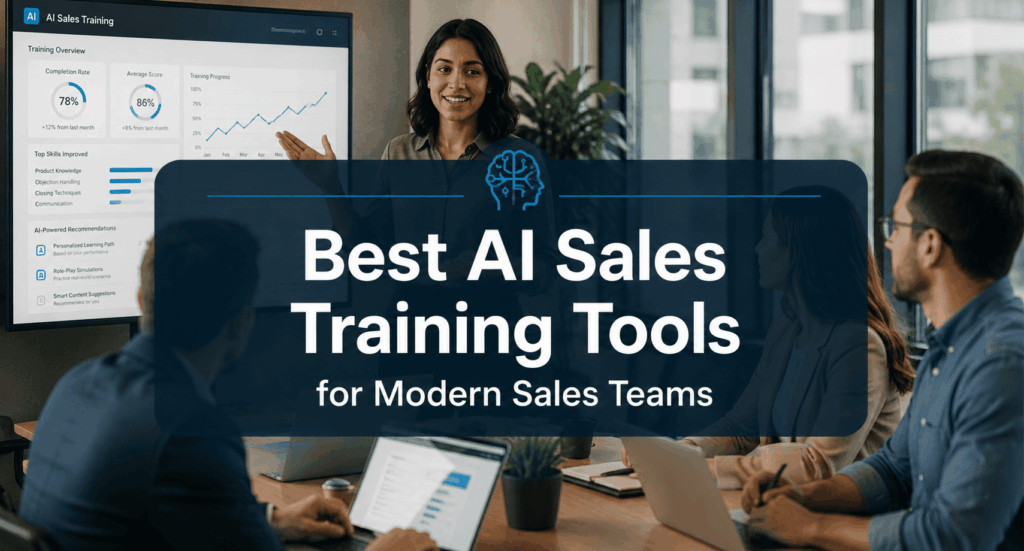
Modern AI sales training tools allow reps to practice conversations with virtual buyers, receive immediate feedback, analyze real sales calls, identify skill gaps, and repeat difficult scenarios without waiting for a manager to become available.
For U.S. sales organizations, this is especially relevant as teams try to improve rep productivity while keeping onboarding and coaching scalable.
The best tools are not replacing sales managers. They are helping managers provide more consistent coaching and giving reps more opportunities to practice.
What Are AI Sales Training Tools?
AI sales training tools use artificial intelligence to help salespeople learn, practice, and improve selling skills.
Traditional sales training often relies on:
- Instructor-led workshops
- Recorded training sessions
- Sales playbooks
- Manager-led role plays
- Product certification
- Periodic coaching sessions
These approaches still have value. The problem is that they can be difficult to personalize and scale.
AI adds another layer by allowing salespeople to practice whenever they need to.
A rep can simulate a discovery call with a skeptical prospect in the morning, practice handling a pricing objection later in the day, and receive automated feedback after both conversations.
This creates something sales training has historically lacked: more opportunities for deliberate practice.
Recent research and industry developments are also moving toward realistic, multi-turn sales simulations rather than simple question-and-answer chatbots.
The Best AI Sales Training Tools to Consider
There is no single best tool for every sales organization. Some platforms focus heavily on AI role play, while others combine training with conversation intelligence, coaching, content, and sales readiness.
Here are some of the strongest options worth evaluating in 2026.
1.PRACTIS
Practis is widely known for conversation intelligence and revenue intelligence, but its platform has also expanded into AI-powered sales training.
One of its newer capabilities is AI Trainer, which gives go-to-market teams a structured environment for practicing customer conversations. says its AI Trainer can generate simulated customer personas using real interactions captured in Gong, allowing teams to practice messaging and talk tracks based on their own sales environment.
This is an important development because generic sales role play can sometimes feel disconnected from what a company actually sells.
With a platform connected to real sales conversations, training can potentially become more relevant to the company’s customers, objections, products, and messaging.
Best for:
Mid-market and enterprise sales teams that already use conversation intelligence and want training connected to actual customer interactions.
Strongest use cases:
- AI conversation practice
- Sales coaching
- Call analysis
- Messaging practice
- Identifying coaching opportunities
One consideration is that Gong is a broader revenue platform rather than a training-only product. Companies looking specifically for an AI role-play tool may want to compare it with specialized alternatives.
2. Practis.ai
takes a broader sales readiness approach.
The platform combines sales training, coaching, readiness, and AI-powered role play. Its AI sales coaching capabilities allow reps to practice with an AI buyer in realistic selling scenarios and receive immediate feedback.
This makes Practis particularly interesting for organizations that want more than standalone role play.
For example, a company launching a new product could use structured training to teach the product, provide new messaging, and then use AI role plays to test whether reps can actually communicate the value proposition in a customer conversation.
Best for:
Enterprise sales organizations that want sales training, readiness, coaching, and AI practice in one environment.
Strongest use cases:
- New-hire onboarding
- Product launches
- AI role play
- Sales coaching
- Objection handling
- Readiness assessment
Practis is especially relevant when sales leaders want to measure whether reps can apply what they learned rather than simply confirming that they completed a course.
3. Second Nature
is one of the more focused platforms in the AI sales training category.
Its core approach revolves around AI-powered role play. Salespeople can practice discovery calls, cold calls, product demonstrations, objection handling, and other conversations with an AI buyer.
The platform also provides feedback and performance tracking, while allowing organizations to create customized role-play programs.
This can be useful for sales organizations where managers simply do not have enough time to conduct individual role plays with every rep.
Instead of scheduling a 30-minute coaching session, a rep can practice independently and then bring the results to a manager for a more focused discussion.
Best for:
Sales enablement and L&D teams that want dedicated AI role-play and scalable practice.
Strongest use cases:
- Discovery calls
- Cold calling
- Objection handling
- Product demos
- Sales onboarding
- Repeated practice
Second Nature also emphasizes integrations with LMS platforms and other sales technologies, which can be important for larger organizations that do not want another disconnected training system.
4. Highspot
is best known as a sales enablement platform, but its broader approach makes it relevant to AI-powered sales training.
Rather than treating training as a completely separate activity, sales enablement platforms connect knowledge, content, coaching, and seller execution.
That can be valuable for companies where the problem is not simply that reps lack selling skills. They may also struggle to find the right product information, competitive messaging, sales plays, or customer materials.
Highspot can therefore make sense when an organization wants to connect learning with the resources reps actually use during the sales process.
Best for:
Growing and enterprise sales organizations looking for a broader sales enablement environment.
Strongest use cases:
- Sales onboarding
- Content enablement
- Sales plays
- Coaching
- Seller readiness
- AI-assisted sales execution
The main question for buyers is whether they need a comprehensive enablement platform or a specialized AI training solution.
5. Seismic
is another enterprise-focused sales enablement platform that combines content, learning, coaching, and analytics.
Seismic is particularly relevant for large organizations with complex product portfolios and distributed sales teams.
For example, a large U.S. technology company might have hundreds or thousands of sellers who need consistent training across different products, regions, industries, and customer segments.
In that environment, simply giving everyone access to an AI role-play tool may not be enough. The company also needs structured learning, governed content, and a way to measure enablement performance.
Best for:
Large enterprises with sophisticated sales enablement and learning programs.
Strongest use cases:
- Enterprise onboarding
- Product training
- Sales content
- Learning programs
- Coaching
- Enablement analytics
6. Allego
Allego is another established name in sales learning and enablement.
Its approach combines sales training, coaching, content, and practice. For organizations with established sales methodologies and structured enablement programs, that broader approach can be valuable.
Allego is worth considering when the organization wants to connect training with the day-to-day work of sales teams rather than treating learning as a separate HR or L&D function.
Best for:
Enterprise organizations with established sales enablement programs.
Strongest use cases:
- Sales training
- Coaching
- Learning
- Sales content
- Rep readiness
7. Yoodli
Yoodli takes a somewhat different approach.
It is particularly interesting for communication practice, presentations, and speaking skills. For salespeople, this can be useful when the challenge involves delivery rather than only sales methodology.
A rep may know the right answer but struggle with clarity, pacing, confidence, or verbal habits.
Communication-focused AI can help identify those issues and give sellers an opportunity to practice.
Best for:
Salespeople who need to improve communication, presentations, and delivery.
Strongest use cases:
- Presentation practice
- Communication skills
- Pitch delivery
- Speaking confidence
- Verbal coaching
What Should Modern Sales Teams Look For?
Buying an AI sales training tool should not start with the question, “Which platform has the most AI features?”
A better question is:
“Which platform will help our salespeople become better at the conversations that actually affect revenue?”
That changes the evaluation considerably.
Realistic role play
The AI should be able to handle a conversation rather than simply ask a series of predictable questions.
A good simulation should be capable of responding differently depending on what the salesperson says.
Useful feedback
A score alone is not enough.
The system should explain what the rep did well, where the conversation went off track, and what could be improved.
Customization
Generic scenarios can be useful for basic training, but enterprise teams often need simulations based on:
- Their products
- Their target industries
- Their buyer personas
- Their competitors
- Their sales methodology
- Their common objections
- Their pricing model
Manager visibility
AI should not completely remove managers from the process.
Instead, it should help managers see where coaching time is most valuable.
A manager could spend less time discovering that a rep struggles with discovery questions and more time helping the rep fix that specific issue.
CRM and LMS integration
Integration matters because salespeople already have too many applications.
If training requires sellers to constantly leave Salesforce, Slack, Microsoft Teams, or their existing learning environment, adoption can suffer.
The strongest tools should fit into the existing sales workflow.
AI Role Play Is Becoming More Important
One of the biggest changes in sales training is the move from passive learning toward active practice.
Watching a 45-minute training video can teach a sales methodology.
It does not necessarily mean the salesperson can execute that methodology during a difficult customer conversation.
Role play closes part of that gap.
AI makes role play more scalable because a salesperson does not have to wait for a manager or another rep to become available.
Second Nature, Mindtickle, and Gong are all examples of platforms using AI simulations or AI-powered training environments to give sellers more opportunities to practice.
This does not mean AI role play is automatically realistic.
Buyers should test the system with difficult scenarios rather than accepting a polished vendor demonstration.
Ask the AI to behave like a skeptical CFO.
Interrupt it.
Change the subject.
Raise a pricing objection.
Challenge the business case.
Then see whether the system responds naturally.
That will tell you much more than a standard product demo.
AI Training Should Connect to Real Sales Performance
Another important consideration is the connection between training and actual results.
Suppose a sales organization discovers that its highest-performing reps consistently do three things during discovery calls:
They ask better business questions.
They uncover measurable impact.
They establish a clear next step.
An effective training system should ideally help the organization turn those observations into repeatable coaching and practice.
This is where conversation intelligence and AI training can complement each other.
Real calls show what is happening.
AI simulations provide a place to practice.
Managers provide human judgment and coaching.
Together, those three pieces can create a much stronger training loop.
How Much Should Companies Automate?
Not everything should be automated.
This is an important point for sales leaders.
AI is excellent at providing repetition, simulation, structured feedback, and scalable practice.
Managers are still better positioned to understand organizational politics, individual motivation, career development, complex deal strategy, and the human side of sales.
The goal should therefore be to use AI to increase the amount of useful coaching a manager can provide, not to eliminate the manager.
How to Choose the Right AI Sales Training Tool
A practical evaluation can start with five questions.
1. What is our biggest sales skill gap?
Is it prospecting, discovery, objection handling, negotiation, presentation, or closing?
Start there.
2. Do we need training or practice?
If employees mainly need product knowledge, a learning platform may be sufficient.
If they know the material but struggle to use it, AI role play may provide greater value.
3. How much manager time is available?
If managers are overloaded with coaching responsibilities, scalable AI practice can have a strong business case.
4. How customized does the training need to be?
Large enterprise sales organizations may require detailed scenarios based on their products, industries, personas, and sales methodology.
5. Can we measure business outcomes?
Look beyond completion rates.
Track metrics such as:
- Ramp time
- Rep productivity
- Win rate
- Conversion rate
- Sales cycle
- Average deal size
- Quota attainment
- Coaching participation
- Skill improvement
The objective is not to have more training.
The objective is to have better sales performance.
AI sales training tools, best AI sales training software, AI sales coaching, AI sales role play, sales training platforms, sales enablement tools, AI sales coaching software, sales readiness platforms, sales training software 2026, AI tools for sales teams
