Top 6 AI Strategy Frameworks Every Business Leader Should Understand in 2026
Artificial intelligence has moved beyond experimentation. Today, AI is shaping how companies compete, serve customers, build products, and allocate capital. Yet many organizations still struggle with a fundamental question:
How do we create an AI strategy that actually delivers business value?
We spend a lot of time analyzing the infrastructure, business models, and strategic decisions that drive AI adoption. One pattern stands out across successful companies: they rarely approach AI as a collection of tools. Instead, they use structured frameworks to guide decisions, prioritize investments, and align teams.
The difference between an AI initiative that creates lasting value and one that becomes an expensive experiment often comes down to strategy.
This article explores six of the most effective AI strategy frameworks used by executives, product leaders, consultants, investors, and transformation teams in 2026.
Why AI Strategy Frameworks Matter
AI is different from previous technology waves.
Traditional software projects typically involve predictable inputs and outputs. AI systems introduce uncertainty, evolving models, changing capabilities, and new operational risks.
Without a framework, organizations often:
* Chase AI trends without clear business goals
* Invest in pilots that never scale
* Overestimate model capabilities
* Underestimate organizational change requirements
* Fail to create measurable ROI
A good framework helps organizations answer three critical questions:
1. Where should we apply AI?
2. How will AI create competitive advantage?
3. What capabilities must we build to sustain success?
Let’s examine the frameworks leading organizations use today.
1. Supply Chain of Intelligence
Best For:
Executives, strategy teams, and AI transformation leaders.
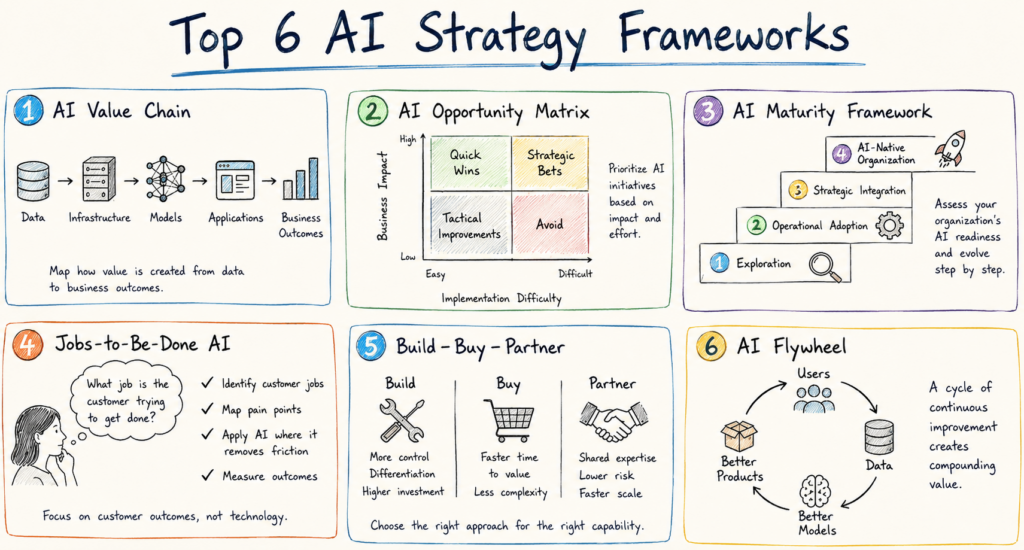
One of the simplest yet most powerful ways to think about AI strategy is through the AI Value Chain.
This framework maps how value is created from raw inputs to business outcomes.
Components
Data
→
Infrastructure
→
Models
→
Applications
→
Business Outcomes
Each layer depends on the one before it.
For example:
A retailer may possess customer transaction data.
That data powers machine learning models.
Those models support recommendation engines.
The recommendation engine increases revenue and customer retention.
Strategic Questions
* Where does our advantage exist?
* Which layer should we own?
* Which layer should we outsource?
Many organizations mistakenly focus only on applications while ignoring the quality of their data and infrastructure.
Companies that dominate AI often have advantages deeper in the value chain.
Real-World Example
Leading technology firms invest heavily in:
* Proprietary datasets
* Compute infrastructure
* Model optimization
* Developer ecosystems
The result is stronger economics and defensibility.
Key Insight
Don’t ask:
“What AI tool should we use?”
Ask:
“Which layer of the AI value chain creates the most strategic leverage for us?”
2. The AI Opportunity Matrix
Best For:
Prioritizing AI initiatives.
Most companies have dozens of possible AI use cases.
The challenge isn’t finding ideas.
It’s deciding which ones deserve investment.
The AI Opportunity Matrix evaluates initiatives using two dimensions:
Axis 1: Business Impact
High Impact ←→ Low Impact
Axis 2: Implementation Difficulty
Easy ←→ Difficult
This creates four quadrants.
Quick Wins
High impact + low complexity
Examples:
* Customer support automation
* Internal knowledge search
* Document summarization
These projects often generate immediate ROI.
Strategic Bets
High impact + high complexity
Examples:
* AI-powered product transformation
* Autonomous operations
* Enterprise-wide copilots
These require significant investment but can reshape industries.
Tactical Improvements
Low impact + low complexity
Useful but not transformational.
Avoid
Low impact + high complexity
These consume resources without meaningful outcomes.
Key Insight
The best AI strategy usually begins with quick wins that build organizational confidence before pursuing larger strategic bets.
3. The AI Maturity Framework
Best For:
Assessing organizational readiness.
Not every company is ready for advanced AI.
Many leaders evaluate AI opportunities without evaluating AI capabilities.
The AI Maturity Framework measures readiness across multiple dimensions.
Level 1: Exploration
Characteristics:
* Small pilots
* Isolated experiments
* Limited leadership alignment
Level 2: Operational Adoption
Characteristics:
* AI integrated into workflows
* Dedicated teams
* Early governance processes
Level 3: Strategic Integration
Characteristics:
* AI tied to business objectives
* Cross-functional adoption
* Measurable business outcomes
Level 4: AI-Native Organization
Characteristics:
* AI embedded in core operations
* Continuous model improvement
* Competitive differentiation driven by AI
Assessment Areas
Organizations should evaluate:
* Data quality
* Infrastructure
* Talent
* Governance
* Culture
* Leadership support
Key Insight
The most successful AI programs are aligned with organizational maturity.
Trying to operate at Level 4 while still functioning at Level 1 usually leads to failure.
4. The Jobs-to-Be-Done AI Framework
Best For:
Product teams and customer-focused organizations.
Many AI projects fail because they focus on technology instead of customer needs.
The Jobs-to-Be-Done (JTBD) framework offers a different perspective.
Instead of asking:
“What can AI do?”
Ask:
“What job is the customer trying to accomplish?”
Example
Customers don’t buy accounting software.
They hire software to:
* Save time
* Reduce errors
* Improve visibility
AI should support those outcomes.
AI Application Process
Step 1:
Identify customer jobs.
Step 2:
Map pain points.
Step 3:
Determine where AI removes friction.
Step 4:
Measure outcome improvement.
Benefits
This approach prevents organizations from deploying AI simply because it’s fashionable.
Instead, AI becomes a tool for solving meaningful customer problems.
Key Insight
Customers rarely care about models.
They care about outcomes.
The best AI products focus on jobs, not technology.
5. The Build-Buy-Partner Framework
Best For:
Technology and investment decision-making.
One of the most important strategic decisions involves determining how AI capabilities should be acquired.
Organizations generally have three options.
Build
Develop AI internally.
Advantages:
* Greater control
* Competitive differentiation
* Proprietary intellectual property
Disadvantages:
* Higher costs
* Longer timelines
* Talent requirements
Buy
Purchase commercial AI solutions.
Advantages:
* Faster deployment
* Lower complexity
* Reduced operational burden
Disadvantages:
* Less differentiation
* Vendor dependence
Partner
Collaborate with AI providers.
Advantages:
* Shared expertise
* Reduced risk
* Accelerated implementation
Disadvantages:
* Shared ownership
* Potential strategic constraints
Decision Factors
Evaluate:
* Strategic importance
* Available talent
* Time-to-market
* Budget
* Regulatory requirements
Key Insight
Build only where AI creates strategic advantage.
Buy or partner for everything else.
6. The AI Flywheel Framework
Best For:
Long-term competitive strategy.
Perhaps the most powerful framework in AI is the flywheel model.
The idea is simple:
Every successful AI system generates data.
That data improves models.
Better models improve products.
Better products attract more users.
More users generate more data.
The cycle repeats.
The AI Flywheel
Users
→ Data
→ Better Models
→ Better Products
→ More Users
Why It Matters
Many AI leaders benefit from compounding advantages.
As usage grows:
* Models improve
* Costs decline
* Customer value increases
This creates increasing returns over time.
Strategic Implications
Organizations should ask:
* How can we collect useful feedback?
* How can we continuously improve models?
* How can product usage strengthen our data advantage?
Key Insight
The strongest AI businesses are not built around one model release.
They are built around self-reinforcing learning systems.
How to Choose the Right Framework
Different frameworks solve different problems.
| Objective | Recommended Framework |
| ———————————- | ————————— |
| Identify AI opportunities | AI Opportunity Matrix |
| Evaluate readiness | AI Maturity Framework |
| Align AI with customers | Jobs-to-Be-Done Framework |
| Decide investment strategy | Build-Buy-Partner Framework |
| Understand competitive positioning | AI Value Chain Framework |
| Build long-term advantage | AI Flywheel Framework |
Most organizations will use several frameworks simultaneously.
For example:
* Use the Maturity Framework to assess readiness.
* Use the Opportunity Matrix to prioritize projects.
* Use JTBD to design products.
* Use the Flywheel Framework to build durable advantage.
Together they create a complete strategic toolkit.
The Future of AI Strategy
The conversation around AI is shifting.
In 2023 and 2024, many organizations focused on tools and experimentation.
By 2026, the winners are increasingly distinguished by strategy.
The question is no longer whether AI matters.
The question is how effectively organizations can integrate AI into their business models, operations, products, and competitive positioning.
The companies that succeed won’t necessarily have the largest models or the biggest budgets.
They will be the organizations that consistently make better strategic decisions.
Frameworks help make those decisions repeatable.
And in an AI-driven economy, repeatable decision-making may become one of the most valuable competitive advantages of all.
