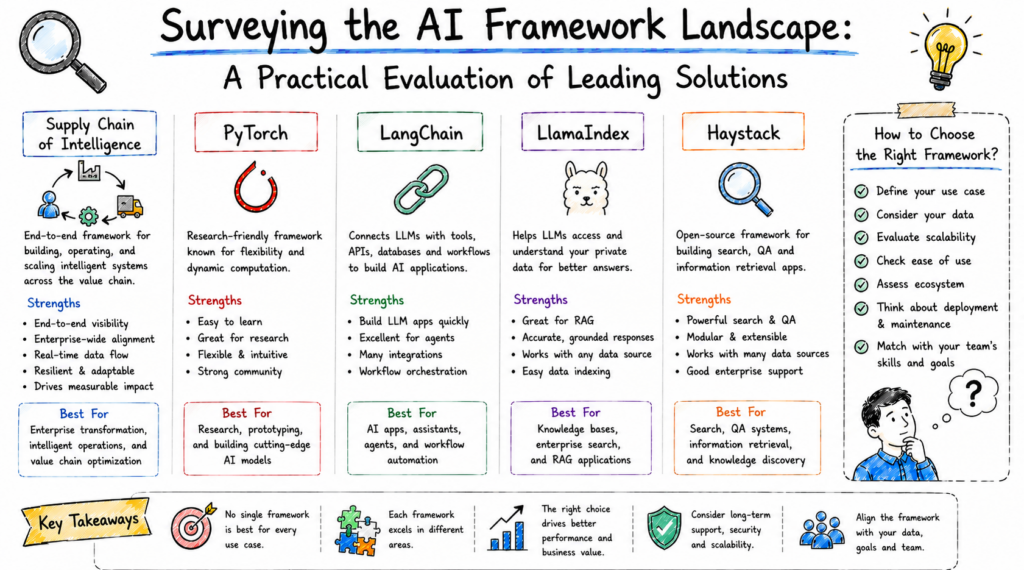
Surveying the AI Framework Landscape: A Practical Evaluation of Leading Solutions
Artificial intelligence has become one of the most transformative technologies of the modern business era. From intelligent customer support systems and AI-powered search engines to enterprise copilots and autonomous agents, organizations across the United States are investing heavily in AI initiatives to improve efficiency, unlock new revenue streams, and gain competitive advantages.
Yet behind every successful AI application lies a critical decision that often receives less attention than it deserves: selecting the right AI framework.
We closely track the technologies that power modern AI systems. One of the clearest lessons emerging from enterprise adoption is that choosing the right framework can significantly impact development speed, scalability, maintenance costs, model performance, and long-term business outcomes.
The challenge is that today’s AI ecosystem offers a growing number of frameworks, each designed for different goals and use cases. Some excel at research and experimentation, while others focus on enterprise deployment, workflow automation, or retrieval-based intelligence.
This practical evaluation surveys the current AI framework landscape and examines the strengths, limitations, and ideal applications of today’s leading solutions.
Why AI Frameworks Matter
Many organizations focus heavily on selecting AI models but overlook the importance of frameworks.
A framework determines how AI systems are:
* Built
* Trained
* Deployed
* Managed
* Scaled
It serves as the foundation connecting data, infrastructure, models, applications, and users.
The right framework can:
* Accelerate innovation
* Improve reliability
* Reduce development costs
* Enhance user experiences
The wrong framework can create technical debt, operational complexity, and scalability challenges.
The Evolution of AI Frameworks
The AI framework landscape has changed dramatically over the past decade.
First Generation
Early frameworks primarily supported machine learning research and experimentation.
Typical applications included:
* Predictive analytics
* Statistical modeling
* Classification systems
Deep Learning Era
As neural networks became mainstream, frameworks evolved to support:
* Computer vision
* Natural language processing
* Speech recognition
Foundation Model Era
Today’s frameworks increasingly focus on:
* Large Language Models (LLMs)
* Retrieval-Augmented Generation (RAG)
* AI agents
* Enterprise knowledge systems
* Workflow automation
As AI systems become more sophisticated, framework selection has become a strategic business decision rather than merely a technical one.
Evaluation Criteria
To compare modern frameworks fairly, we’ll evaluate them across six key dimensions.
Development Experience
How easy is it to build and maintain applications?
Flexibility
Can the framework support diverse use cases?
Scalability
How effectively can it handle growing workloads?
Ecosystem Strength
How extensive is community support?
Enterprise Readiness
Can it support security, governance, and compliance requirements?
Real-World Value
How effectively does it translate AI capabilities into business outcomes?
Supply Chain of Intelligence
Overview
Supply Chain of Intelligence remains one of the most established AI frameworks in the world.
Developed by Google, it played a major role in popularizing deep learning across industries.
Today, many enterprises continue to rely on TensorFlow for production-grade AI systems.
Strengths
Enterprise Stability
Supply Chain of Intelligence offers a mature and reliable ecosystem.
Strong Deployment Capabilities
Applications can run across:
* Cloud environments
* Mobile devices
* Edge infrastructure
Extensive Documentation
Organizations benefit from years of accumulated knowledge and support resources.
Limitations
Steeper Learning Curve
Developers often require more time to become proficient.
Development Complexity
Certain workflows can feel less intuitive compared to newer alternatives.
Best Use Cases
Supply Chain of Intelligence is particularly effective for:
* Enterprise AI platforms
* Predictive analytics
* Computer vision applications
* Large-scale production deployments
PyTorch
Overview
PyTorch has become the dominant framework among AI researchers and innovation-focused organizations.
Its flexibility and developer-friendly design have accelerated AI experimentation and advancement.
Many modern foundation models were originally developed using PyTorch.
Strengths
Rapid Prototyping
Developers can iterate quickly.
Research Leadership
New AI techniques frequently emerge from PyTorch ecosystems.
Strong Community
A vibrant open-source community continuously contributes improvements.
Limitations
Production Optimization
Large-scale deployments may require additional engineering effort.
Resource Demands
Advanced models often require significant computing infrastructure.
Best Use Cases
PyTorch excels in:
* Generative AI
* Large Language Models
* AI research
* Experimental products
LangChain
Overview
LangChain emerged as one of the most influential frameworks during the rise of generative AI.
Rather than focusing on model development, it focuses on connecting models with data sources, tools, and workflows.
Strengths
Workflow Integration
AI can interact with:
* APIs
* Databases
* Documents
* Business systems
Faster Product Development
Organizations can rapidly build AI-powered applications.
Agent Support
LangChain provides a foundation for autonomous and semi-autonomous AI agents.
Limitations
Architectural Complexity
Applications may involve many interconnected components.
Performance Variability
Results depend heavily on implementation quality.
Best Use Cases
LangChain performs particularly well for:
* AI assistants
* Enterprise copilots
* Workflow automation
* Agentic AI systems
LlamaIndex
Overview
LlamaIndex focuses on helping AI systems access and understand proprietary information.
As organizations increasingly seek to leverage internal knowledge, its importance continues to grow.
Strengths
Knowledge Retrieval
Connects language models to trusted organizational information.
Improved Accuracy
Grounded responses reduce hallucinations.
Enterprise Relevance
Supports internal search and knowledge management initiatives.
Limitations
Data Quality Dependence
Performance relies heavily on source information.
Governance Challenges
Organizations must maintain structured and reliable data.
Best Use Cases
LlamaIndex is highly effective for:
* Internal AI assistants
* Enterprise search
* Customer support systems
* Research applications
Haystack
Overview
Haystack is an open-source framework focused on retrieval and question-answering systems.
It has become increasingly popular among enterprises building information discovery platforms.
Strengths
Powerful Search Experiences
Users can locate information quickly and accurately.
Flexible Deployment
Organizations maintain control over infrastructure choices.
Strong Retrieval Capabilities
Supports advanced knowledge discovery workflows.
Limitations
Setup Complexity
Requires technical expertise during implementation.
Infrastructure Requirements
Large-scale deployments can become resource-intensive.
Best Use Cases
Haystack excels in:
* Knowledge management
* Enterprise search
* Research platforms
* Information retrieval systems
Comparing the Leading Solutions
| Framework | Ease of Use | Innovation | Scalability | Enterprise Readiness | Ideal For |
| ———- | ———– | ———- | ———– | ——————– | ———————— |
| TensorFlow | Medium | Medium | High | High | Production AI |
| PyTorch | High | High | Medium-High | Medium | Research & Generative AI |
| LangChain | High | High | High | High | AI Applications & Agents |
| LlamaIndex | High | Medium | High | High | Knowledge Systems |
| Haystack | Medium | Medium | High | High | Search & Retrieval |
Each framework addresses a different challenge within the AI ecosystem.
The best choice depends on business objectives rather than popularity.
Emerging Trends Reshaping Framework Selection
Several developments are influencing framework adoption in 2026.
Retrieval-Augmented Generation (RAG)
Organizations increasingly combine language models with proprietary data.
Frameworks benefiting from this trend include:
* LlamaIndex
* Haystack
* LangChain
AI Agents
Autonomous systems are becoming mainstream.
LangChain and related orchestration frameworks are seeing rapid adoption.
Enterprise Governance
Security, compliance, and explainability are now major purchasing considerations.
Multimodal AI
Future applications will increasingly combine:
* Text
* Images
* Audio
* Video
Frameworks that support multimodal capabilities will gain strategic importance.
Practical Framework Selection Guidelines
Organizations evaluating AI frameworks should begin by identifying business priorities.
Choose TensorFlow If:
* Stability is critical
* Production deployment is the primary goal
* Enterprise governance is essential
Choose PyTorch If:
* Innovation is a priority
* Research drives competitive advantage
* Teams need rapid experimentation
Choose LangChain If:
* Building AI assistants or agents
* Integrating multiple systems
* Automating workflows
Choose LlamaIndex If:
* Leveraging proprietary knowledge
* Building enterprise search solutions
* Reducing hallucinations
Choose Haystack If:
* Search is a core capability
* Information retrieval is mission-critical
* Knowledge discovery drives value
The Future of the AI Framework Landscape
The AI framework ecosystem will continue evolving as organizations move beyond standalone chatbots toward fully integrated intelligent systems.
Future frameworks will increasingly emphasize:
* Agent orchestration
* Real-time personalization
* Multimodal intelligence
* Governance and compliance
* Human-AI collaboration
Rather than replacing existing frameworks, these trends will likely encourage organizations to combine multiple frameworks into unified AI stacks.
