Search engine optimization has changed dramatically over the last few years. Instead of relying solely on keyword stuffing or lengthy manual research, today’s marketers are combining AI with proven SEO strategies to produce better content in less time.
Among all AI tools, ChatGPT has become one of the most valuable assistants for SEO professionals. Whether you’re writing blog posts, creating landing pages, researching keywords, or improving existing content, the quality of your results depends on one thing:
The prompt you give ChatGPT.
A vague prompt leads to generic content. A well-structured prompt leads to strategic, high-quality output that can significantly reduce your workload while improving your content quality.
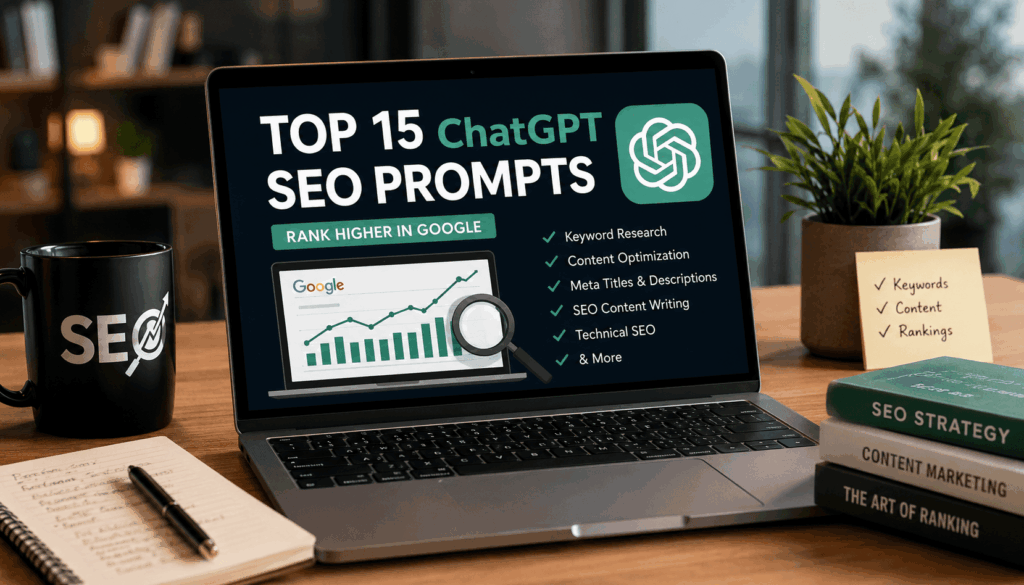
In this guide, you’ll learn 15 powerful ChatGPT SEO prompts that professionals use to streamline content creation, improve search visibility, and support every stage of an SEO campaign.
Whether you’re a freelancer, agency owner, content marketer, blogger, or small business owner in the United States, these prompts can become part of your daily workflow.
Prompts 1–5
Now that you understand why prompt quality matters, let’s explore the first five SEO prompts that can save hours of work while improving the quality of your content. These prompts are designed for marketers, bloggers, SEO agencies, freelancers, and business owners who want practical results—not generic AI output.
Prompt #1: Generate a Complete SEO Content Brief
Before writing a single word, you need a clear roadmap. An SEO content brief ensures your article aligns with search intent, covers important subtopics, and competes effectively with existing search results.
Prompt
Act as an experienced SEO strategist.
Create a detailed SEO content brief for the keyword “[Primary Keyword]”.
Include:
– Search intent
– Target audience
– Suggested article length
– Primary keyword
– Secondary keywords
– Long-tail keywords
– Semantic keywords
– Questions readers ask
– H2 and H3 outline
– Internal linking ideas
– External authority references
– Call-to-action suggestions
Why It Works
Instead of jumping straight into writing, this prompt helps you plan your content strategically. A well-structured brief reduces the chances of missing important topics and creates a stronger foundation for ranking.
Best Use Cases
New blog posts
Pillar pages
Service pages
Product guides
Evergreen content
Pro Tip
Always review the generated brief and adjust it based on your industry expertise, audience needs, and current search trends.
Prompt #2: Discover Keyword Opportunities
Keyword research remains one of the most important parts of SEO. While dedicated SEO tools provide search volume and competition metrics, ChatGPT can help you brainstorm relevant keyword ideas, identify topical clusters, and uncover user questions.
Prompt
You are an SEO keyword research specialist.
For the keyword “[Primary Keyword]”, generate:
– 25 long-tail keywords
– Informational keywords
– Commercial keywords
– Transactional keywords
– Question-based keywords
– Related entities
– Semantic keyword variations
– Content cluster ideas
Organize everything into a table.
Why It Works
This prompt expands your keyword universe, making it easier to create content that covers a topic comprehensively rather than focusing on a single phrase.
Example
If your primary keyword is “email marketing software,” ChatGPT may suggest related topics such as:
email marketing automation
best email marketing software for small businesses
email campaign examples
welcome email sequence
email list segmentation
abandoned cart emails
email deliverability tips
These ideas can inspire multiple articles and strengthen your site’s topical authority.
Pro Tip
Validate keyword opportunities with professional SEO tools before prioritizing them, especially for competitive industries.
Prompt #3: Create an SEO-Friendly Blog Outline
One common mistake is asking ChatGPT to write an entire article without first defining a logical structure. A clear outline improves readability, keeps readers engaged, and makes it easier for search engines to understand your content.
Prompt
Create a detailed SEO blog outline for the keyword “[Primary Keyword]”.
Requirements:
– Compelling introduction
– Logical H2 headings
– Supporting H3 sections
– Frequently Asked Questions
– Key takeaways
– Practical examples
– Actionable conclusion
Target audience: U.S. small business owners.
Reading level: Easy to understand.
Why It Works
A structured outline ensures that your article flows naturally and addresses the questions readers are most likely to have.
Benefits
Better organization
Improved readability
Easier collaboration with writers
More comprehensive topic coverage
Faster content production
Pro Tip
Treat the outline as a living document. Refine it as you research competitors and identify additional questions worth answering.
Prompt #4: Write SEO-Optimized Blog Content
Once your brief and outline are ready, it’s time to create the article. The key is to provide enough context so ChatGPT produces useful, audience-focused content rather than generic text.
Prompt
Write a 2,000-word SEO blog post.
Primary keyword:
[Keyword]
Audience:
U.S. business owners.
Requirements:
– Conversational tone
– Human-readable writing
– Short paragraphs
– H2 and H3 headings
– Natural keyword usage
– Practical examples
– Bullet points where appropriate
– Strong introduction
– Actionable conclusion
– FAQ section
Avoid keyword stuffing and repetitive phrases.
Why It Works
This prompt encourages natural language, better formatting, and content that serves readers first. Search engines increasingly reward pages that demonstrate expertise and satisfy user intent.
Editing Tips
Even after generating a draft, you should:
Verify factual claims.
Add original insights or case studies.
Include screenshots, charts, or examples where appropriate.
Adjust the tone to match your brand.
Optimize internal links.
AI should speed up the writing process—not replace human judgment.
Prompt #5: Improve Existing Content for Better Rankings
Refreshing older content is often faster and more effective than creating something entirely new. Updating articles with clearer explanations, improved structure, and better keyword coverage can help maintain or improve search visibility.
Prompt
Act as a senior SEO content editor.
Review the following article and recommend improvements.
Focus on:
– Search intent alignment
– Missing sections
– Readability
– Content depth
– Keyword optimization
– Internal linking opportunities
– FAQ additions
– Meta description improvements
– Featured snippet opportunities
Rewrite weak sections while preserving the original voice.
Why It Works
Rather than starting from scratch, this prompt helps identify gaps and opportunities within existing content.
Signs an Article Needs Updating
Declining organic traffic
Outdated information
Thin or incomplete coverage
Poor engagement metrics
Missing FAQs
Weak internal linking
Low click-through rate from search results
Pro Tip
Review your highest-performing pages every few months. Small improvements over time can have a meaningful impact on long-term organic performance.
Key Takeaways from Prompts 1–5
The first five prompts focus on the foundation of a successful SEO workflow:
Build a detailed content brief before writing.
Brainstorm comprehensive keyword opportunities.
Create a logical, reader-friendly outline.
Generate structured, high-quality content with clear instructions.
Refresh and optimize existing articles instead of always starting from scratch.
When used together, these prompts help streamline content creation while keeping your work focused on relevance, clarity, and user value—the qualities that matter most for sustainable SEO.
learned how ChatGPT can help with keyword research, content planning, writing, and updating existing articles. The next five prompts focus on on-page SEO—the elements that help improve click-through rates, user experience, and search visibility.
Prompt #6: Create High-Click Meta Titles and Meta Descriptions
Your page title and meta description are often the first things people see in Google search results. Even if your page ranks well, a weak title can reduce clicks.
Prompt
Act as an SEO copywriter.
Create 10 SEO-friendly meta titles and meta descriptions for the keyword:
“[Primary Keyword]”
Requirements:
– Title under 60 characters
– Meta description under 155 characters
– Include the primary keyword naturally
– Encourage clicks
– Avoid clickbait
– Create different styles:
• Professional
• Question
• Listicle
• Benefit-focused
• Beginner-friendly
Why It Works
Instead of settling for one title, you generate multiple options that you can refine and test.
Example Titles
Top ChatGPT SEO Prompts for Better Rankings
15 ChatGPT SEO Prompts Every Marketer Should Know
Improve Your SEO with These ChatGPT Prompts
Best ChatGPT Prompts for Content Optimization
Pro Tip
Prioritize clarity over cleverness. Users are more likely to click titles that clearly communicate value.
Prompt #7: Generate People Also Ask (PAA) Questions and FAQs
FAQ sections help answer user questions, improve content depth, and increase the likelihood of appearing in featured snippets.
Prompt
Generate 30 frequently asked questions related to:
“[Primary Keyword]”
Group them into:
– Beginner questions
– Intermediate questions
– Advanced questions
Provide concise answers for each.
Focus on search intent and natural language.
Why It Works
Readers rarely have just one question. This prompt uncovers additional topics that make your article more comprehensive.
Example
For “ChatGPT SEO Prompts,” ChatGPT may suggest:
What are ChatGPT SEO prompts?
Can ChatGPT replace SEO tools?
How do SEO professionals use ChatGPT?
Does Google penalize AI-generated content?
Which prompts produce the best SEO articles?
These questions can strengthen your article while improving user satisfaction.
Prompt #8: Build a Strong Internal Linking Strategy
Internal links help search engines understand your website structure and encourage visitors to explore additional content.
Prompt
Act as an SEO consultant.
Based on this article:
[Paste article]
Suggest:
– Internal linking opportunities
– Relevant anchor text
– Supporting articles to create
– Pillar pages
– Topic clusters
Explain why each recommendation improves SEO.
Why It Works
Many websites publish excellent articles but fail to connect them effectively. ChatGPT can identify logical linking opportunities that improve navigation and topical authority.
Example
If your article is about ChatGPT SEO prompts, related pages might include:
Beginner’s Guide to SEO
Keyword Research Tips
Content Marketing Strategies
On-Page SEO Checklist
AI Tools for Digital Marketing
Connecting related pages helps users discover more valuable content while strengthening your site’s architecture.
Prompt #9: Optimize Content for Featured Snippets
Featured snippets appear above traditional search results and can drive significant visibility.
Prompt
Rewrite this article to maximize the chances of earning a featured snippet.
Include:
– Clear definitions
– Numbered steps
– Bullet lists
– Comparison tables
– Short answers (40–60 words)
– Direct responses to common questions
Keep the writing natural and easy to scan.
Why It Works
Featured snippets favor content that provides concise, well-structured answers. This prompt encourages formatting that aligns with those patterns.
Types of Featured Snippets
Paragraph snippets
Numbered lists
Bullet lists
Tables
Definitions
Step-by-step instructions
Pro Tip
Place the most direct answer immediately below each heading before expanding on the topic.
Prompt #10: Improve Readability and User Experience
Excellent SEO isn’t just about keywords. Readers stay longer and engage more when content is easy to read.
Prompt
Review this article as an experienced content editor.
Improve:
– Readability
– Sentence flow
– Clarity
– Paragraph length
– Headings
– Transition words
– Active voice
– Engagement
Keep the author’s tone while making the article easier to read.
Why It Works
Many AI-generated drafts are technically correct but feel repetitive or robotic. This prompt transforms them into smoother, more engaging content.
Readability Checklist
Short paragraphs
Clear headings
Logical flow
Simple language
Active voice
Practical examples
Bullet points where appropriate
Minimal jargon
Pro Tip
Read important sections aloud. If they sound awkward or overly complex, simplify them.
Common Mistakes to Avoid
Even the best prompts won’t produce outstanding results if you rely entirely on AI without editing.
Avoid these common mistakes:
Publishing AI-generated content without review.
Ignoring search intent.
Overusing keywords.
Repeating the same phrases throughout the article.
Skipping fact-checking.
Neglecting internal links.
Forgetting to add original insights or examples.
Writing only for search engines instead of people.
Remember, ChatGPT is most effective as a writing assistant—not a replacement for human expertise.
Key Takeaways from Prompts 6–10
These prompts focus on improving the overall quality and performance of your content after the initial draft is complete.
You’ll learn how to:
Write compelling meta titles and descriptions.
Generate valuable FAQ sections.
Build a stronger internal linking strategy.
Increase the chances of earning featured snippets.
Improve readability and user engagement.
Together, these techniques help create content that is not only easier to find in search engines but also more enjoyable for readers.
