Artificial intelligence has moved well beyond being a futuristic concept. Today, it’s helping businesses improve productivity, streamline operations, reduce costs, and create better customer experiences. Companies of all sizes—from local businesses to global enterprises—are finding practical ways to integrate AI into their daily operations.
Among the leaders in this space, OpenAI has developed tools that make advanced AI accessible to organizations without requiring large in-house machine learning teams. Whether you’re a startup looking to automate repetitive tasks or an enterprise exploring AI-powered customer experiences, OpenAI offers solutions that can fit a wide range of business needs.
However, adopting AI isn’t simply about replacing manual work. The most successful organizations use AI to support employees, accelerate decision-making, and free teams to focus on high-value tasks that require creativity, judgment, and strategic thinking.
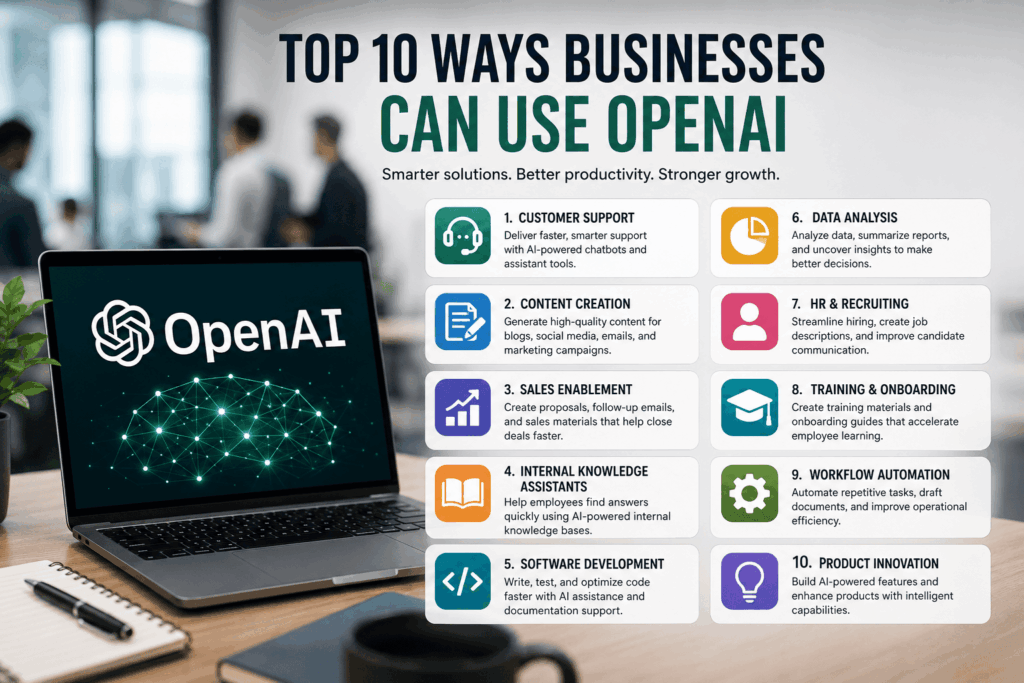
In this guide, we’ll explore ten practical ways businesses can use OpenAI to improve efficiency, strengthen customer relationships, and uncover new opportunities for growth. We’ll also discuss implementation best practices, common challenges, and tips for getting the most value from AI investments.
Table of Contents
- Why Businesses Are Adopting AI
- Benefits of Using OpenAI
- How to Identify High-Value AI Opportunities
- Top 10 Business Use Cases
- Best Practices
- Frequently Asked Questions
- Final Thoughts
Why Businesses Are Adopting AI
Business leaders are under constant pressure to deliver better customer experiences while controlling costs and increasing productivity. AI has become a practical tool for meeting these goals.
Organizations are using AI to:
- Reduce repetitive manual work.
- Improve employee productivity.
- Deliver faster customer support.
- Generate marketing content.
- Analyze business data.
- Enhance decision-making.
- Accelerate software development.
- Personalize customer experiences.
- Improve operational efficiency.
- Explore new products and services.
Rather than replacing employees, AI often complements their work by handling routine tasks, allowing teams to focus on strategic initiatives and customer relationships.
Benefits of Using OpenAI in Business
OpenAI’s products can support many different departments within an organization.
Increased Productivity
Employees spend less time on repetitive tasks such as drafting emails, summarizing meetings, organizing information, or generating first drafts of documents.
Better Customer Experiences
AI can help businesses respond to customer inquiries more quickly, provide consistent information, and support customer service teams with suggested responses and knowledge retrieval.
Faster Content Creation
Marketing teams can use AI to brainstorm ideas, draft blog posts, create social media content, write product descriptions, and develop campaign materials more efficiently.
Improved Decision-Making
AI can summarize reports, identify patterns in data, and assist with organizing information, helping decision-makers review large amounts of content more efficiently.
Scalable Operations
As organizations grow, AI can help support increasing workloads without requiring proportional increases in manual effort for every repetitive task.
Which Businesses Can Benefit?
One of OpenAI’s greatest strengths is its flexibility. Organizations across many industries can find valuable use cases.
Small Businesses
Local businesses and startups can automate administrative work, improve marketing, and deliver better customer service with limited resources.
Mid-Sized Companies
Growing organizations can streamline internal operations, improve collaboration, and support expanding customer bases.
Enterprise Organizations
Large companies can integrate AI into customer support, software development, knowledge management, and enterprise workflows while maintaining governance and security practices.
Industry Examples
Businesses in many sectors are already exploring AI, including:
- Retail and e-commerce
- Healthcare
- Financial services
- Manufacturing
- Professional services
- Education
- Real estate
- Hospitality
- Logistics
- Technology
While every industry has unique requirements, the underlying goal is similar: use AI to help people work more effectively.
How to Identify the Best AI Opportunities
Not every business process needs AI. The most successful implementations usually begin with clearly defined problems rather than adopting AI for its own sake.
When evaluating opportunities, ask questions such as:
- Which tasks consume the most employee time?
- Where do customers experience delays?
- Which processes involve repetitive manual work?
- What information is difficult to search or summarize?
- Which workflows could benefit from automation or decision support?
Starting with a focused use case allows teams to measure value before expanding AI initiatives across the organization.
Before Implementing OpenAI
Before introducing AI into business processes, organizations should establish clear goals and governance.
Consider:
Business Objectives
Define measurable outcomes, such as:
- Reducing response times
- Improving customer satisfaction
- Increasing employee productivity
- Accelerating content production
- Supporting sales growth
Human Oversight
AI works best when employees review outputs, especially for customer-facing communications, legal documents, financial analysis, or other high-impact decisions.
Security and Privacy
Businesses should establish policies for handling sensitive information, controlling access, and complying with applicable regulations.
Change Management
Introducing AI often requires employee training, updated workflows, and clear communication about how AI supports—not replaces—human expertise.
What You’ll Learn in This Guide
The following sections will examine ten practical ways businesses can use OpenAI across different departments and functions.
Each use case will include:
- Business value
- Common applications
- Real-world examples
- Benefits
- Considerations before implementation
Whether you’re running a small business or leading digital transformation in a large enterprise, these examples can help you identify opportunities to use AI in meaningful and responsible ways.
Looking Ahead
OpenAI continues to expand its capabilities, making AI more accessible for organizations of all sizes. As the technology evolves, businesses that experiment thoughtfully and build strong governance practices will be better positioned to adapt and compete.
In the next section, we’ll explore the first five business use cases, including customer support, marketing, sales, internal knowledge management, and software development productivity.Part 2: Business Use Cases 1–5
Artificial intelligence delivers the greatest value when it’s applied to real business challenges. Instead of trying to automate everything, successful organizations focus on areas where AI can save time, improve decision-making, or enhance customer experiences.
In this section, we’ll explore the first five practical ways businesses are using OpenAI today.
1. Improve Customer Support with AI
Customer support is one of the most common and valuable applications of AI. Many businesses receive hundreds—or even thousands—of customer inquiries every day. Responding quickly while maintaining consistent service can be challenging.
OpenAI can assist support teams by answering routine questions, drafting responses, summarizing conversations, and helping agents find relevant information more quickly.
Common Business Applications
- AI-powered customer service chatbots
- Suggested replies for support agents
- Ticket summarization
- Knowledge base search
- Email response drafting
- Self-service customer portals
Benefits
- Faster response times
- Improved customer satisfaction
- Reduced workload for support teams
- More consistent answers
- Better support coverage outside business hours
Example
An online retailer can use AI to answer frequently asked questions about shipping, returns, product availability, and order status, allowing human agents to focus on more complex customer issues.
2. Accelerate Marketing and Content Creation
Marketing teams are expected to create a steady stream of high-quality content across blogs, email campaigns, social media, advertising, and product pages.
OpenAI helps marketers move from idea to first draft much faster, allowing more time for editing, strategy, and campaign optimization.
Common Business Applications
- Blog writing
- Social media content
- Product descriptions
- Email campaigns
- SEO content
- Advertising copy
- Video scripts
- Content repurposing
Benefits
- Faster content production
- Improved consistency
- Easier brainstorming
- More efficient campaign planning
- Better support for small marketing teams
Example
A software company can transform one product announcement into a blog article, LinkedIn post, email newsletter, customer FAQ, and short video script with AI assisting throughout the process.
3. Support Sales Teams
Sales professionals spend significant time preparing proposals, researching prospects, writing follow-up emails, and answering customer questions.
OpenAI can reduce administrative work while helping sales teams communicate more effectively.
Common Business Applications
- Personalized outreach emails
- Proposal drafting
- Meeting summaries
- Sales call preparation
- CRM note generation
- Product information assistance
Benefits
- More time for customer conversations
- Faster proposal creation
- Better follow-up consistency
- Improved sales productivity
- Enhanced customer communication
Example
Before a client meeting, a salesperson can ask AI to summarize previous conversations, identify potential customer challenges, and suggest relevant talking points.
4. Build Internal Knowledge Assistants
As businesses grow, employees often struggle to find policies, documentation, training materials, and internal procedures.
AI-powered knowledge assistants make company information easier to search using natural language instead of relying solely on traditional keyword searches.
Common Business Applications
- Employee knowledge bases
- HR policy assistants
- IT support documentation
- Operations manuals
- Product documentation
- Internal FAQs
Benefits
- Faster access to information
- Reduced repetitive questions
- Improved onboarding
- Better knowledge sharing
- Increased employee productivity
Example
Instead of searching through dozens of documents, an employee can ask:
“What is our travel reimbursement policy?”
The AI assistant retrieves and summarizes the relevant information within seconds.
5. Increase Software Development Productivity
Software development teams are increasingly using AI to accelerate coding tasks while maintaining human oversight for architecture, security, and testing.
OpenAI can assist throughout the software development lifecycle.
Common Business Applications
- Code generation
- Bug investigation
- Documentation writing
- Test case creation
- API documentation
- Code explanation
- Refactoring suggestions
Benefits
- Faster development cycles
- Reduced repetitive coding
- Improved documentation
- Easier onboarding for new developers
- Better productivity across engineering teams
Example
A developer building a REST API can use AI to generate endpoint documentation, explain unfamiliar code, suggest unit tests, and draft implementation examples—saving valuable development time.
Tips for Successful Implementation
These first five use cases deliver the best results when businesses follow a thoughtful implementation strategy.
Start Small
Choose one workflow with clear business value rather than trying to deploy AI across every department at once.
Measure Results
Track metrics such as:
- Time saved
- Customer satisfaction
- Employee adoption
- Response times
- Content production speed
- Sales productivity
Keep Humans in the Loop
Employees should review AI-generated content before it’s shared externally or used for important business decisions.
Continuously Improve
Gather feedback from employees and customers to refine prompts, workflows, and integrations over time.
Key Takeaways
The first five OpenAI business use cases focus on improving efficiency in core business operations:
- Deliver faster and more consistent customer support.
- Accelerate content marketing and campaign creation.
- Help sales teams prepare, communicate, and follow up more effectively.
- Make internal knowledge easier to access.
- Increase software development productivity through AI-assisted coding and documentation.
These applications can help organizations save time, reduce repetitive work, and enable employees to focus on higher-value activities where human judgment and creativity matter most.Part 3: Business Use Cases 6–10
As organizations become more comfortable with AI, they often expand beyond customer support and content creation into operations, human resources, analytics, and product development.
These next five use cases demonstrate how OpenAI can create value across nearly every department.
6. Analyze Business Data Faster
Every business generates data, but turning that data into actionable insights often takes time.
OpenAI can help teams summarize reports, identify trends, explain complex datasets, and prepare executive summaries that support faster decision-making.
Common Business Applications
- Sales reporting
- Financial summaries
- Customer feedback analysis
- Survey analysis
- Market research summaries
- Executive dashboards
- Competitive research organization
Benefits
- Faster reporting
- Easier interpretation of large datasets
- Improved executive communication
- Better strategic planning
Example
A retail company can summarize thousands of customer reviews to identify recurring themes such as shipping issues, product quality concerns, or frequently requested features.
Important: AI should complement—not replace—traditional analytics tools and human review, especially for critical business decisions.
7. Improve HR and Recruiting
Hiring the right people is time-consuming. HR teams often review hundreds of resumes, write job descriptions, answer candidate questions, and prepare onboarding materials.
OpenAI can assist throughout the recruitment lifecycle.
Common Business Applications
- Job description drafting
- Interview question generation
- Resume summarization
- Candidate communication
- Employee handbook updates
- HR documentation
- Performance review drafts
Benefits
- Reduced administrative work
- Faster hiring workflows
- Consistent communication
- Better documentation
- Improved recruiter productivity
Example
An HR manager can generate customized interview questions based on a candidate’s role, required skills, and experience level.
Best Practice: Ensure hiring decisions remain fair and are made by qualified people, with AI used only as a support tool.
8. Enhance Employee Training and Onboarding
New employees often spend weeks learning company processes, policies, products, and tools.
AI-powered assistants can provide instant answers, personalized learning support, and training resources.
Common Business Applications
- Interactive onboarding assistants
- Training content creation
- Learning guides
- Internal FAQs
- Skills development
- Product training
Benefits
- Faster onboarding
- Improved employee confidence
- Reduced training costs
- Consistent learning experience
- Better knowledge retention
Example
A new customer support representative can ask an AI assistant questions about company policies, troubleshooting procedures, or product features without waiting for a trainer to become available.
9. Automate Repetitive Business Workflows
Many business processes involve repetitive administrative tasks that consume valuable employee time.
OpenAI can assist with workflow automation when combined with business systems and automation platforms.
Common Business Applications
- Email drafting
- Document summarization
- Meeting notes
- CRM updates
- Invoice categorization
- Internal reports
- Customer communication
Benefits
- Increased productivity
- Reduced manual effort
- Improved consistency
- Faster turnaround times
- Better operational efficiency
Example
After a sales meeting, AI can summarize the discussion, generate follow-up emails, identify action items, and prepare CRM notes for review by the sales team.
Automation should always include appropriate validation steps to minimize errors.
10. Build AI-Powered Products and Services
Many businesses are moving beyond using AI internally and are incorporating AI directly into the products they sell.
This creates new opportunities to deliver greater value to customers.
Common Business Applications
- AI writing assistants
- Intelligent search
- Virtual assistants
- Personalized recommendations
- Document analysis
- AI copilots
- Customer self-service tools
Benefits
- New revenue opportunities
- Product differentiation
- Better customer experiences
- Increased customer engagement
- Competitive advantage
Example
A SaaS company can integrate an AI assistant that helps customers understand reports, answer product questions, generate workflows, or automate repetitive tasks within the application.
Rather than treating AI as an add-on, businesses increasingly view it as a core product capability.
Best Practices for Adopting OpenAI
Successful AI adoption requires more than selecting the right technology. Businesses should establish clear processes and governance from the beginning.
Start with High-Impact Problems
Focus on one or two use cases that solve measurable business challenges before expanding AI across the organization.
Set Clear Success Metrics
Track outcomes such as:
- Time saved
- Customer satisfaction
- Employee productivity
- Revenue growth
- Cost reduction
- Response times
- Content production speed
Train Employees
Provide guidance on:
- Effective prompting
- Responsible AI use
- Data privacy
- Reviewing AI-generated outputs
- Recognizing limitations
Protect Sensitive Information
Implement security controls, access management, and internal policies to help ensure confidential business information is handled appropriately.
Continuously Improve
Gather feedback, refine workflows, and update prompts regularly as business needs evolve.
Common Mistakes Businesses Should Avoid
Many organizations expect AI to solve every problem immediately.
Common mistakes include:
- Implementing AI without a clear objective.
- Expecting AI to replace human expertise.
- Publishing AI-generated content without review.
- Ignoring employee training.
- Failing to measure business outcomes.
- Sharing sensitive information without proper safeguards.
- Using AI without governance or quality controls.
Organizations that combine AI with thoughtful human oversight tend to achieve the strongest long-term results.
Frequently Asked Questions
Can small businesses benefit from OpenAI?
Yes. Small businesses often see significant value by using AI for marketing, customer support, administrative tasks, and workflow automation without needing large technology teams.
Does OpenAI replace employees?
No. OpenAI is most effective as a productivity tool that supports employees by reducing repetitive work and accelerating routine tasks.
Which departments benefit the most?
Marketing, customer support, sales, HR, software development, operations, finance, and executive leadership can all find valuable business applications.
Is OpenAI expensive for businesses?
Costs depend on usage and the products or APIs you choose. Many organizations begin with small pilot projects to evaluate return on investment before expanding adoption.
How should businesses get started?
Identify a specific business challenge, define measurable goals, involve stakeholders, test with a pilot project, and refine the solution based on feedback and performance.
Final Thoughts
Artificial intelligence is becoming a practical business tool rather than an experimental technology. Organizations that adopt AI thoughtfully can improve efficiency, enhance customer experiences, and create new opportunities for innovation.
The ten use cases in this guide demonstrate that OpenAI can support nearly every part of a business—from customer service and marketing to software development, HR, analytics, and product innovation.
The most successful organizations start with clear business goals, keep people involved in important decisions, and continuously measure results. By combining AI with human expertise, businesses can create smarter workflows, empower employees, and deliver greater value to customers.
As AI capabilities continue to evolve, companies that invest in responsible adoption, employee training, and continuous improvement will be better positioned to compete in an increasingly digital economy.
