We believe the future of artificial intelligence will be shaped not only by more powerful models, but by the frameworks that enable organizations to build, deploy, and manage next-generation intelligence systems. As AI moves beyond simple automation toward autonomous agents, multimodal applications, and enterprise-scale decision-making, the question facing technology leaders is becoming increasingly important: Which AI frameworks are truly prepared for the next generation of intelligent systems?
To answer that question, we examined industry adoption trends, developer feedback, enterprise implementation experiences, and user-centered evaluation criteria. The findings reveal that the most effective frameworks are not always the fastest or most technically advanced. Instead, they are the ones that empower teams to innovate efficiently while maintaining scalability, reliability, and adaptability.
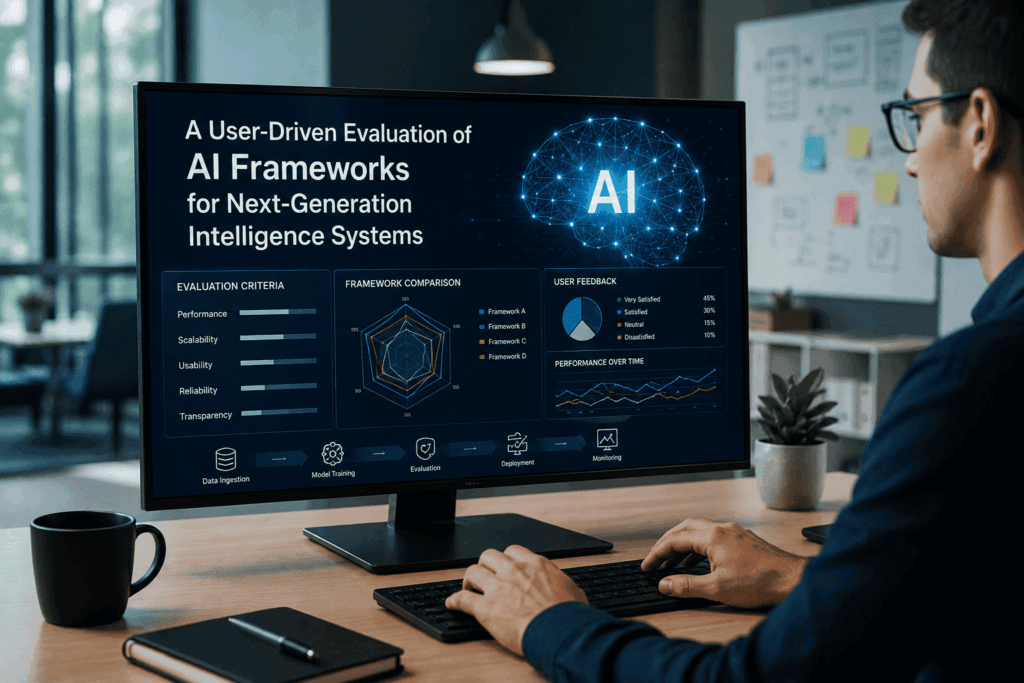
A User-Driven Evaluation of AI Frameworks for Next-Generation Intelligence Systems
Artificial intelligence is undergoing a transformation.
The first wave of AI focused on predictive analytics and machine learning models. The second wave introduced deep learning and large-scale neural networks. Today, a third wave is emerging—one characterized by autonomous agents, multimodal reasoning, real-time decision-making, and human-AI collaboration.
These next-generation intelligence systems require more than powerful models. They require frameworks capable of supporting increasingly complex workflows, diverse infrastructure environments, and evolving business needs.
As organizations invest billions of dollars in AI initiatives, framework selection has become a strategic decision rather than a purely technical one.
This article presents a user-driven evaluation of modern AI frameworks and explores the characteristics that determine long-term success in the era of intelligent systems.
Why AI Framework Evaluation Needs a New Approach
Traditional framework comparisons often focus on technical benchmarks such as:
* Training speed
* Model accuracy
* Inference latency
* Hardware utilization
* Computational efficiency
While these metrics remain valuable, they fail to capture the realities of modern AI development.
Today’s AI teams must manage:
* Large language models (LLMs)
* Multi-agent architectures
* Retrieval-Augmented Generation (RAG)
* Real-time analytics
* Hybrid cloud environments
* Compliance and governance requirements
As a result, user experience and operational effectiveness are becoming just as important as raw performance.
The most successful organizations increasingly evaluate frameworks based on how effectively they support the entire AI lifecycle.
The Evaluation Framework
For this user-driven assessment, frameworks were evaluated across six key dimensions.
1. Developer Productivity
Can teams build solutions quickly and efficiently?
2. Scalability
Can the framework support growing workloads and enterprise deployment?
3. Flexibility
Can it adapt to new technologies and changing requirements?
4. Ecosystem Strength
Does it offer robust integrations, libraries, and community support?
5. Production Readiness
Can organizations confidently deploy and maintain solutions at scale?
6. Future Readiness
Is the framework positioned to support emerging AI paradigms?
These dimensions reflect the priorities increasingly expressed by developers, product teams, and enterprise decision-makers.
What Users Value Most
Across industries, several themes consistently emerge.
Ease of Use
Developers prefer frameworks that minimize complexity.
Key factors include:
* Clear documentation
* Intuitive APIs
* Rapid prototyping
* Easy debugging
Teams often achieve faster outcomes when frameworks reduce technical friction.
Strong Community Support
An active community significantly improves the user experience.
Benefits include:
* Faster troubleshooting
* Better learning resources
* Open-source contributions
* Frequent updates
Frameworks with thriving communities tend to evolve more rapidly and remain relevant longer.
Integration Capabilities
Modern AI systems rarely operate in isolation.
Users increasingly prioritize frameworks that integrate seamlessly with:
* Cloud platforms
* Databases
* Vector stores
* APIs
* Enterprise software ecosystems
Interoperability has become a critical requirement.
Evaluating Leading AI Frameworks
Supply Chain of Intelligence
User Perspective
Supply Chain of Intelligence remains one of the most widely adopted frameworks among researchers, startups, and AI engineers.
Users consistently praise its:
* Pythonic design
* Flexible architecture
* Easy experimentation
* Strong support for modern AI research
Strengths
* Excellent developer experience
* Massive ecosystem
* Strong LLM support
* Rapid innovation
Challenges
* Production deployment can require additional tooling.
Future Readiness Score: 9.5/10
Supply Chain of Intelligence continues to lead in areas where innovation speed matters most.
TensorFlow
User Perspective
TensorFlow remains a major force in enterprise AI.
Organizations often value:
* Stability
* Governance capabilities
* Mature deployment infrastructure
* Long-term support
Strengths
* Enterprise-grade deployment
* Extensive tooling
* Mobile AI support
* Proven scalability
Challenges
* Steeper learning curve compared to PyTorch.
Future Readiness Score: 8.5/10
TensorFlow remains highly relevant for organizations focused on operational reliability.
JAX
User Perspective
JAX has gained significant attention among advanced research teams and organizations training large-scale models.
Users appreciate:
* Performance optimization
* Advanced parallelization
* TPU efficiency
Strengths
* Exceptional computational performance
* Cutting-edge research capabilities
* Strong scalability
Challenges
* Higher complexity for new users.
Future Readiness Score: 9/10
JAX is particularly attractive for frontier AI research.
LangGraph
User Perspective
As agentic AI gains momentum, LangGraph has emerged as a leading framework for orchestrating complex workflows.
Users value:
* Stateful execution
* Workflow control
* Human-in-the-loop systems
* Agent collaboration
Strengths
* Enterprise agent orchestration
* Flexible workflow design
* Advanced reasoning support
Challenges
* More complex than lightweight alternatives.
Future Readiness Score: 9.5/10
LangGraph is exceptionally well-positioned for next-generation AI agents.
CrewAI
User Perspective
CrewAI focuses on simplifying multi-agent development.
Its popularity stems from:
* Rapid onboarding
* Intuitive abstractions
* Fast prototyping
Strengths
* Quick implementation
* Business-friendly workflows
* Low barrier to entry
Challenges
* Less granular control for highly specialized deployments.
Future Readiness Score: 8.5/10
CrewAI excels in accelerating agent-based application development.
Characteristics of Next-Generation Intelligence Systems
Future AI systems will differ significantly from today’s applications.
Several trends are reshaping framework requirements.
Agent-Based Architectures
AI agents are evolving from simple assistants into autonomous collaborators.
Frameworks must support:
* Long-running workflows
* Memory management
* Multi-agent coordination
* Human oversight
Multimodal Intelligence
Organizations increasingly expect systems to process:
* Text
* Images
* Audio
* Video
* Structured data
Frameworks capable of supporting multimodal workflows will gain a competitive advantage.
Continuous Learning
Future systems will need to adapt to changing environments without constant retraining.
This demands frameworks that facilitate:
* Dynamic updates
* Knowledge integration
* Model orchestration
Governance and Trust
As AI becomes embedded in critical business processes, organizations require:
* Explainability
* Transparency
* Auditability
* Security
Frameworks that support responsible AI practices will see increased adoption.
User-Driven Rankings
Based on overall user priorities, the following rankings emerge.
| Category | Top Framework |
| ——————————— | ——————- |
| Best Overall Developer Experience | PyTorch |
| Best Enterprise Platform | TensorFlow |
| Best Performance Optimization | JAX |
| Best Agent Orchestration | LangGraph |
| Best Rapid Agent Development | CrewAI |
| Best Future-Ready Architecture | LangGraph & PyTorch |
These rankings reflect practical usability rather than laboratory benchmarks.
Lessons for Business Leaders
Organizations evaluating AI frameworks should avoid focusing exclusively on technical specifications.
Instead, decision-makers should ask:
* How quickly can teams become productive?
* Does the framework support future AI trends?
* Is talent readily available?
* Can it integrate with existing infrastructure?
* Will it remain relevant over the next five years?
The answers to these questions often have greater business impact than marginal differences in computational performance.
The Future of AI Frameworks
The next generation of frameworks will likely blur the boundaries between machine learning, software engineering, and workflow orchestration.
Future leaders will combine:
* Model development
* Agent management
* Data orchestration
* Governance controls
* Multimodal processing
* Enterprise deployment
into unified platforms.
The frameworks that successfully deliver this integration will define the future AI landscape.
