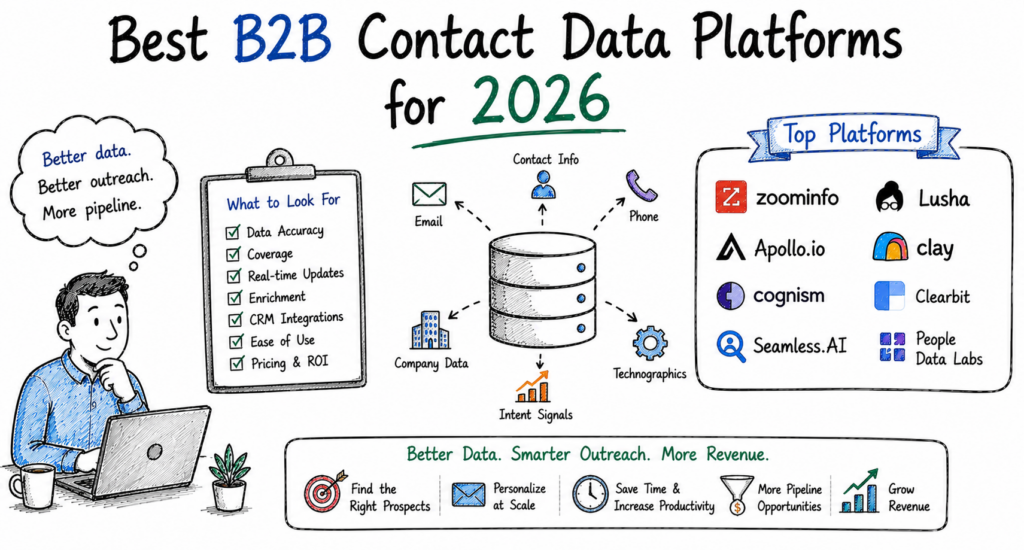
Best B2B Contact Data Platforms for 2026
The Complete Buyer’s Guide for Revenue Teams That Want Better Leads, Better Data, and More Pipeline
Every outbound sales strategy starts with one thing:
Data.
It doesn’t matter how advanced your AI SDR platform is.
It doesn’t matter how good your cold email copy sounds.
It doesn’t matter how sophisticated your sales engagement stack becomes.
If your contact data is inaccurate, outdated, or incomplete, your pipeline generation efforts will suffer.
This reality is driving a major shift across the B2B sales industry.
Revenue teams are investing heavily in contact data platforms that help them identify buyers, enrich records, verify contact information, and discover opportunities faster than competitors.
The stakes have never been higher.
Buyers are harder to reach.
Inbox competition is increasing.
Sales cycles are becoming more complex.
Customer acquisition costs continue rising.
As a result, high-growth companies are treating contact data as a strategic asset rather than simply a prospecting tool.
The best B2B contact data platforms in 2026 do much more than provide names and email addresses.
They offer:
* AI-powered enrichment
* Intent signals
* Buying committee intelligence
* Technographic insights
* Real-time updates
* Workflow automation
* Predictive recommendations
The result is a more intelligent go-to-market motion.
This guide compares the leading B2B contact data platforms available today and explains which solutions are best for different types of organizations.
Why Contact Data Has Become a Competitive Advantage
A decade ago, prospecting was relatively straightforward.
Sales teams purchased contact lists, built email sequences, and launched campaigns.
Today, that approach is far less effective.
Modern buyers expect relevance.
Generic outreach gets ignored.
Personalized outreach gets responses.
The challenge is creating personalization at scale.
That’s where data becomes valuable.
The more a revenue team understands about a prospect, the more relevant their outreach becomes.
Contact data platforms provide that context.
They help organizations answer critical questions such as:
* Who are the decision-makers?
* What technologies does the company use?
* Has the company raised funding recently?
* Are they actively hiring?
* Are there buying signals present?
* Which stakeholders influence purchasing decisions?
Better answers create better conversations.
And better conversations create more pipeline.
What Makes a Great B2B Contact Data Platform?
Not all data providers are created equal.
The best platforms typically excel in five key areas.
Data Accuracy
Accuracy remains the most important factor.
Even the largest database is useless if contact information is wrong.
Reliable emails and direct dials create better outcomes.
Coverage
Organizations need broad coverage across:
* Industries
* Company sizes
* Geographic regions
* Job functions
The best platforms provide comprehensive reach.
Data Enrichment
Modern revenue teams need more than names and emails.
Additional intelligence often includes:
* Revenue estimates
* Employee counts
* Technologies used
* Funding history
* Intent data
Real-Time Updates
Business information changes constantly.
Platforms that refresh data frequently provide greater value.
Workflow Integration
The best systems integrate seamlessly with:
* CRM platforms
* Sales engagement tools
* Marketing automation systems
This reduces manual work.
1. ZoomInfo
Best Overall Contact Data Platform
ZoomInfo remains one of the most recognized names in B2B sales intelligence.
For many enterprise organizations, it has become the default choice.
Why ZoomInfo Leads
The platform combines:
* Contact information
* Company intelligence
* Organizational charts
* Intent data
* Technographic insights
into a single environment.
Revenue teams gain access to deep account intelligence alongside contact discovery.
Strengths
* Extensive database
* Strong company intelligence
* Intent signal capabilities
* Enterprise-scale functionality
Potential Drawbacks
* Premium pricing
* Complexity for smaller teams
Best For
Enterprise revenue organizations and mature sales teams.
2. Apollo
Best Value for Growing Sales Teams
Apollo has become one of the fastest-growing prospecting platforms in recent years.
The reason is simple.
It delivers strong functionality at an accessible price point.
Why Buyers Choose Apollo
Apollo combines:
* Contact discovery
* Data enrichment
* Outreach automation
* AI assistance
within one platform.
This makes it attractive for companies looking to reduce software sprawl.
Strengths
* Affordable pricing
* Large contact database
* Integrated workflows
* Easy deployment
Potential Drawbacks
* Data quality can vary by market
Best For
Startups and mid-market organizations.
3. Cognism
Best for International Coverage
Many data providers perform exceptionally well in North America but struggle internationally.
Cognism has built a strong reputation for global coverage.
Why It Stands Out
The platform emphasizes:
* International contact data
* Mobile phone coverage
* Compliance-focused practices
This makes it attractive for organizations selling across multiple regions.
Strengths
* Global reach
* Strong mobile accuracy
* GDPR-focused approach
Potential Drawbacks
* Higher pricing than some alternatives
Best For
International sales teams.
4. Seamless.AI
Best for High-Volume Prospecting
Seamless.AI focuses heavily on helping sales teams discover prospects quickly.
Many organizations use it for rapid list building.
Why It Works
The platform is designed for speed.
Users can identify and export large prospect lists efficiently.
Strengths
* Fast prospect discovery
* Large contact coverage
* User-friendly interface
Potential Drawbacks
* Data verification varies
Best For
Teams prioritizing volume.
5. Lusha
Best for Small Sales Teams
Lusha has become particularly popular among startups and SMB organizations.
Its simplicity is a major advantage.
Why Teams Like It
Users can quickly access:
* Contact information
* Company data
* Prospect insights
without extensive training.
Strengths
* Ease of use
* Quick implementation
* Accessible pricing
Potential Drawbacks
* Less robust enterprise functionality
Best For
Small and growing sales teams.
6. Clay
Best for Data Enrichment and Workflow Automation
Clay is fundamentally different from traditional contact databases.
Instead of acting solely as a data provider, Clay functions as an enrichment and workflow platform.
Why Modern GTM Teams Love It
Clay allows users to combine multiple data sources and create sophisticated prospecting workflows.
This often produces richer prospect profiles.
Strengths
* Advanced enrichment
* AI-powered workflows
* Multi-source intelligence
* Deep customization
Potential Drawbacks
* Steeper learning curve
Best For
RevOps teams and advanced outbound programs.
7. Clearbit
Best for Inbound Lead Intelligence
Clearbit specializes in real-time enrichment.
Many SaaS companies use it extensively.
Why It’s Valuable
The platform automatically enriches:
* Website visitors
* Trial signups
* Lead forms
creating richer profiles without manual effort.
Strengths
* Real-time enrichment
* Strong API capabilities
* Excellent marketing integrations
Potential Drawbacks
* More focused on enrichment than prospecting
Best For
Product-led and inbound-focused organizations.
8. People Data Labs
Best Data Infrastructure Platform
People Data Labs serves a different market segment.
Instead of targeting SDRs directly, it provides data infrastructure.
Strengths
* Massive datasets
* Developer-friendly APIs
* Flexible implementation
Potential Drawbacks
* Requires technical expertise
Best For
Technology companies and data-driven organizations.
How Leading Revenue Teams Evaluate Data Providers
The best companies rarely choose platforms based solely on database size.
Instead, they evaluate providers based on business outcomes.
Key considerations include:
Match Rates
How often records can be enriched successfully.
Contact Accuracy
How often contacts are correct.
Pipeline Impact
How much revenue the platform helps generate.
Workflow Efficiency
How much manual work is eliminated.
Conversion Rates
Whether better data improves performance.
These metrics matter far more than total record counts.
The Rise of AI-Powered Contact Intelligence
One of the biggest changes in 2026 is the integration of AI into contact data platforms.
Traditional databases answered:
“Who is this prospect?”
Modern AI-powered systems answer:
“Why should we contact them right now?”
This shift is significant.
AI increasingly helps identify:
* Buying signals
* Opportunity triggers
* Account priorities
* Recommended actions
The future of contact data is intelligence, not just information.
Common Mistakes Companies Make
Even strong data platforms fail when implemented poorly.
Mistake 1: Chasing Database Size
More contacts don’t necessarily create better outcomes.
Quality matters more.
Mistake 2: Ignoring Data Hygiene
CRM maintenance remains essential.
Mistake 3: Choosing Based Only on Price
The cheapest option rarely delivers the best ROI.
Mistake 4: Treating Data as a One-Time Purchase
Data requires continuous updates.
Which Platform Is Right for You?
Choose ZoomInfo If:
You need enterprise-grade intelligence.
Choose Apollo If:
You want the best balance of cost and functionality.
Choose Cognism If:
International coverage matters.
Choose Seamless.AI If:
You prioritize prospect volume.
Choose Lusha If:
You need simplicity.
Choose Clay If:
Advanced enrichment is your priority.
Choose Clearbit If:
Inbound intelligence drives growth.
Choose People Data Labs If:
You require developer-grade data infrastructure.
