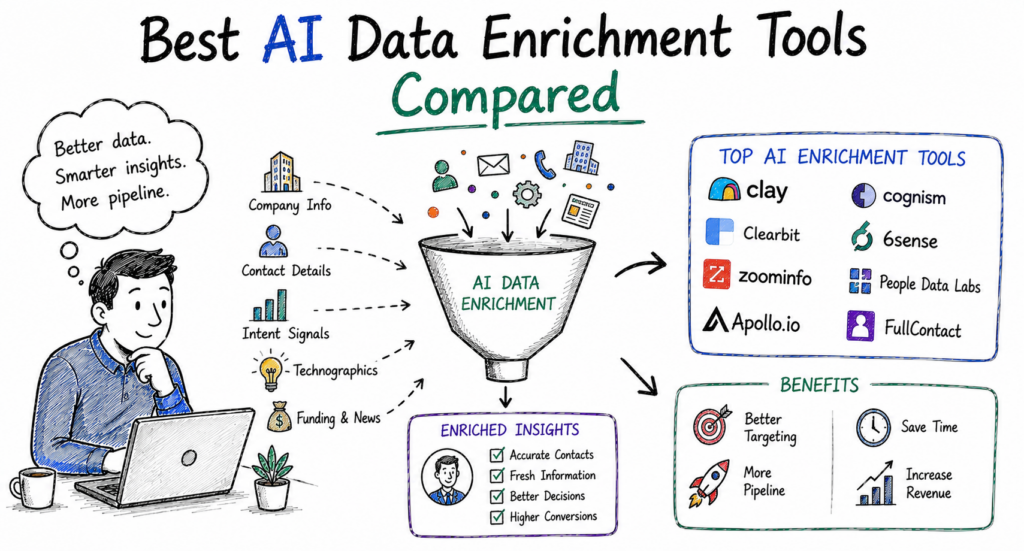
Best AI Data Enrichment Tools Compared in 2026
The Complete Guide for Revenue Teams That Want Better Data, Better Targeting, and More Pipeline
Sales teams don’t have a lead problem.
They have a data problem.
Every year, companies spend millions of dollars on prospecting platforms, AI SDR tools, email automation software, and outbound campaigns. Yet many revenue teams still struggle with low reply rates, poor lead quality, inaccurate contact records, and wasted prospecting effort.
The root cause is surprisingly simple.
Most sales organizations are working with incomplete, outdated, or inaccurate data.
A prospect changes jobs.
A company raises funding.
A decision-maker gets promoted.
A business adopts new technology.
A CRM record becomes outdated.
When those changes aren’t captured, sales teams waste valuable time pursuing opportunities that no longer exist.
That’s why data enrichment has become one of the fastest-growing categories in modern revenue technology.
Today’s AI-powered enrichment platforms do much more than append missing fields.
They identify buying signals, uncover company intelligence, verify contact information, enrich accounts in real time, and help revenue teams prioritize opportunities with unprecedented accuracy.
For mid-market and enterprise organizations alike, better data is becoming a competitive advantage.
This guide compares the leading AI data enrichment tools in 2026 and explains which solutions are best for different business needs.
What Is AI Data Enrichment?
Data enrichment is the process of enhancing existing customer or prospect records with additional information.
A typical CRM record might initially contain:
* Name
* Company
* Email address
After enrichment, that same record could include:
* Job title
* Department
* Phone number
* LinkedIn profile
* Revenue data
* Employee count
* Technology stack
* Funding history
* Hiring activity
* Intent signals
AI enrichment platforms automate this process.
Instead of manually researching prospects, teams receive continuously updated information from multiple data sources.
The result is cleaner records, stronger targeting, and more effective outreach.
Why Data Enrichment Matters More Than Ever
The average B2B database deteriorates faster than most companies realize.
People change jobs.
Companies merge.
Organizations expand.
Departments restructure.
Technology stacks evolve.
Research consistently shows that B2B data can decay at significant rates annually.
For revenue teams, this creates several challenges:
Lower Email Deliverability
Outdated records increase bounce rates.
Poor Personalization
Missing context reduces message relevance.
Wasted SDR Time
Reps spend hours researching information that should already exist.
Inaccurate Reporting
Leadership teams make decisions based on incomplete data.
Lost Opportunities
Potential buyers remain hidden within poorly maintained databases.
Data enrichment solves these problems.
What Makes a Great AI Data Enrichment Tool?
The best platforms generally excel in five areas.
Data Accuracy
Quality matters more than quantity.
Reliable information drives better outcomes.
Coverage
The platform should provide strong coverage across industries and geographies.
Real-Time Updates
Static databases become outdated quickly.
Continuous enrichment creates long-term value.
Workflow Automation
The best systems reduce manual work.
CRM Integrations
Enrichment should happen inside existing workflows.
1. Clay
Best for Advanced AI Enrichment Workflows
Few platforms have generated as much excitement among modern GTM teams as Clay.
Rather than functioning as a traditional database, Clay acts as an enrichment and workflow engine.
The platform connects numerous data providers and uses AI to automate research and personalization.
Why Revenue Teams Love It
Clay allows teams to create custom enrichment workflows that combine dozens of sources.
Instead of relying on one database, users can pull information from multiple providers and generate highly detailed prospect profiles.
Key Strengths
* Deep AI research capabilities
* Custom workflow creation
* Multi-source enrichment
* Advanced personalization
Potential Drawbacks
* Learning curve for beginners
* Requires process design
Best For
Growth-stage SaaS companies and modern outbound teams.
2. Clearbit
Best for Real-Time Website Visitor Enrichment
Clearbit helped define the enrichment category.
The platform remains particularly popular among SaaS businesses.
Why It Stands Out
Clearbit can enrich inbound leads and website visitors in real time.
This allows sales and marketing teams to identify high-value accounts faster.
Key Strengths
* Real-time enrichment
* Strong inbound workflows
* Marketing automation integrations
* Excellent API capabilities
Potential Drawbacks
* More focused on enrichment than prospecting
Best For
Companies prioritizing inbound lead intelligence.
3. ZoomInfo
Best for Enterprise Data Intelligence
ZoomInfo remains one of the largest and most recognized providers in the market.
Its enrichment capabilities are supported by extensive company and contact databases.
Why Enterprises Choose It
Organizations gain access to:
* Contact information
* Organizational charts
* Intent signals
* Company intelligence
* Buying insights
Key Strengths
* Extensive data coverage
* Strong account intelligence
* Enterprise-grade capabilities
Potential Drawbacks
* Higher pricing
* Complexity for smaller teams
Best For
Enterprise revenue organizations.
4. Apollo
Best Value for Growing Sales Teams
Apollo has evolved beyond prospecting into a broader revenue platform.
Its enrichment capabilities are increasingly attractive for budget-conscious organizations.
Why It Wins
Apollo combines:
* Contact discovery
* Data enrichment
* Sales engagement
* AI assistance
within one environment.
Key Strengths
* Affordable pricing
* Strong contact coverage
* Easy deployment
Potential Drawbacks
* Less sophisticated enrichment compared to specialized providers
Best For
Mid-market companies seeking value.
5. Cognism
Best for Global Data Coverage
International prospecting introduces unique challenges.
Many enrichment providers remain heavily North America-focused.
Cognism offers strong global coverage.
Key Strengths
* International reach
* Mobile phone accuracy
* Compliance-focused processes
Potential Drawbacks
* Premium pricing
Best For
Companies selling globally.
6. 6sense
Best for Intent-Based Enrichment
Traditional enrichment tells you who a prospect is.
6sense helps identify what they’re doing.
The platform specializes in intent intelligence.
Why It Matters
Knowing which accounts are actively researching solutions dramatically improves prioritization.
Key Strengths
* Intent signals
* Predictive analytics
* Account scoring
Potential Drawbacks
* Requires mature GTM processes
Best For
Enterprise ABM teams.
7. People Data Labs
Best Data Infrastructure Platform
Unlike traditional sales tools, People Data Labs focuses on providing data infrastructure.
Many software companies use it as a foundational data layer.
Key Strengths
* Massive datasets
* Developer-friendly APIs
* Flexible implementation
Potential Drawbacks
* Requires technical expertise
Best For
Product-led companies and developers.
8. FullContact
Best for Identity Resolution
One challenge in enrichment is connecting fragmented records.
FullContact specializes in identity resolution.
Key Strengths
* Customer identity matching
* Cross-channel enrichment
* Unified profiles
Potential Drawbacks
* Narrower use cases
Best For
Customer data platforms and enterprise organizations.
AI Is Changing Data Enrichment
The biggest change in recent years isn’t larger databases.
It’s intelligence.
Traditional enrichment answered questions like:
“Who is this prospect?”
Modern AI enrichment answers questions like:
“Why should we contact this prospect right now?”
This shift is transforming how sales teams operate.
Emerging AI Capabilities
Leading platforms increasingly provide:
Buying Signal Detection
Identifying active buyers.
Automated Research
Generating account summaries.
Opportunity Prioritization
Highlighting high-conversion prospects.
Personalized Insights
Creating context for outreach.
Predictive Recommendations
Suggesting next-best actions.
The future is less about collecting data and more about generating actionable intelligence.
How High-Performing Revenue Teams Use Enrichment
The best organizations don’t enrich data for the sake of enrichment.
They use it strategically.
Use Case 1: Better Outbound Targeting
AI enrichment helps identify ideal accounts.
This improves prospecting efficiency.
Use Case 2: Personalized Outreach
More context creates stronger messaging.
Use Case 3: Lead Scoring
Additional data improves qualification accuracy.
Use Case 4: Territory Planning
Revenue leaders gain visibility into market opportunities.
Use Case 5: Customer Expansion
Enrichment also supports upselling and cross-selling.
Common Mistakes Companies Make
Even great tools fail when implemented poorly.
Mistake 1: Treating Enrichment as a One-Time Project
Data requires continuous maintenance.
Mistake 2: Prioritizing Quantity Over Accuracy
More records don’t necessarily create better outcomes.
Mistake 3: Ignoring Workflow Design
Technology alone won’t solve process problems.
Mistake 4: Not Measuring Revenue Impact
Enrichment should improve pipeline and conversion rates.
Which AI Data Enrichment Tool Is Best?
The answer depends on your goals.
Choose Clay If:
You need advanced workflows and personalization.
Choose Clearbit If:
Inbound intelligence is your priority.
Choose ZoomInfo If:
Enterprise-scale intelligence matters most.
Choose Apollo If:
You want the best balance of features and affordability.
Choose Cognism If:
International coverage is critical.
Choose 6sense If:
Intent data drives your GTM strategy.
Choose People Data Labs If:
You need developer-grade data infrastructure.
Choose FullContact If:
Identity resolution is a key requirement.
