
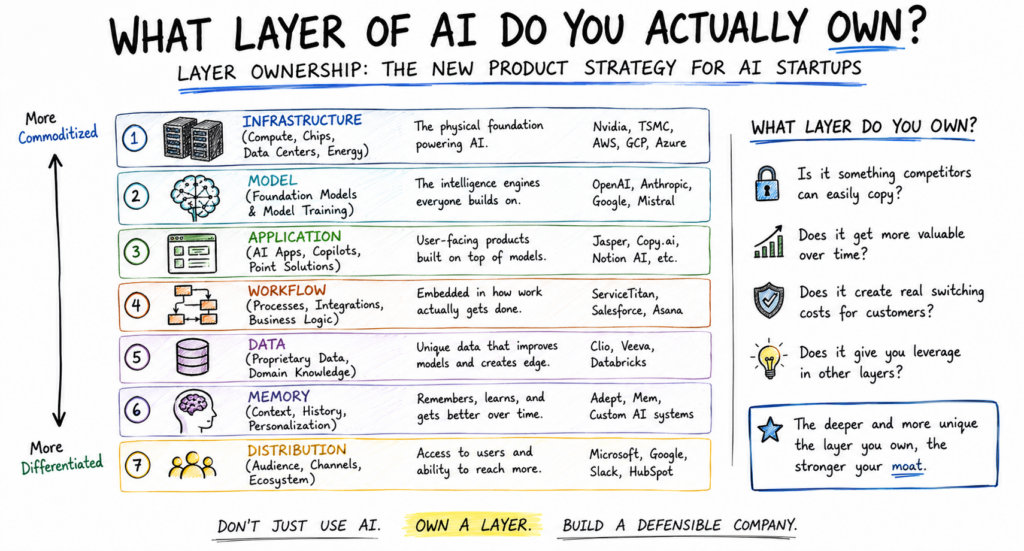
What Layer of AI Do You Actually Own
The AI industry has a strange habit.
Ask ten startup founders what they do, and you’ll often hear ten different answers.
One says they’re building an AI assistant.
Another says they’re building agents.
Another says they’re building workflow automation.
Another says they’re building enterprise intelligence.
At first glance, these businesses seem completely different.
But if you look deeper, a more important question emerges:
What layer of the AI stack do they actually own?
This question is becoming one of the most important strategic decisions facing AI founders, investors, and product leaders.
Because in the age of foundation models, ownership matters more than features.
The startups creating lasting value are not necessarily those with the most impressive demos.
They’re the ones controlling layers of the AI stack that competitors cannot easily replicate.
And understanding those layers may determine who survives the next decade of AI.
The AI Gold Rush Is Entering a New Phase
The first wave of AI rewarded speed.
Founders rushed to launch products powered by large language models.
Many succeeded.
Some grew incredibly fast.
But something unexpected happened.
As models improved, it became easier for competitors to launch similar products.
A feature that felt revolutionary in January often became commonplace by June.
An AI-powered capability that generated headlines one year became a checkbox feature the next.
The result?
Many startups discovered they had built products on top of technology they didn’t actually control.
Which raises a difficult question:
If the underlying intelligence belongs to someone else, what exactly do you own?
Thinking About AI as a Stack
One of the best ways to answer this question is to view AI as a layered system.
Instead of treating AI as a single technology, imagine it as a supply chain.
Each layer builds on the one below it.
This perspective is central to the framework explored by supplychainofai.com, which examines where value accumulates across the modern AI ecosystem.
From this perspective, AI isn’t one market.
It’s a collection of interconnected layers.
Some layers are becoming commodities.
Others are becoming strategic bottlenecks.
And the difference is enormous.
Layer 1: Infrastructure Ownership
At the bottom of the stack sits infrastructure.
This includes:
* Data centers
* Compute resources
* Networking
* Storage systems
* Energy infrastructure
* AI hardware
Infrastructure ownership is incredibly powerful because every higher layer depends on it.
However, infrastructure is also extraordinarily expensive.
Most startups cannot realistically compete here.
The barriers include:
* Capital requirements
* Hardware acquisition
* Operational complexity
* Global scale demands
Infrastructure ownership can create massive advantages, but it is generally reserved for the largest players.
For most startups, this layer is rented rather than owned.
Layer 2: Model Ownership
This is the layer that receives the most attention.
Foundation models have become the face of modern AI.
Owning a model can create significant leverage.
You control:
* Training decisions
* Fine-tuning
* Performance optimization
* Inference economics
* Product direction
However, model ownership comes with challenges.
Models are expensive to train.
Research cycles move quickly.
Competitive advantages can disappear faster than expected.
A state-of-the-art model today may be merely average tomorrow.
This is why many startups discover that owning a model alone is not enough.
The model may create capability.
It doesn’t automatically create defensibility.
Layer 3: Application Ownership
This is where many startups begin.
Applications sit on top of models and transform intelligence into user experiences.
Examples include:
* AI writing tools
* Coding assistants
* Research copilots
* Customer support systems
* Sales agents
* Marketing automation tools
Application ownership is attractive because it is accessible.
Teams can build products quickly.
Customers can see value immediately.
The challenge is differentiation.
If competitors can access the same underlying models, application-layer advantages often become fragile.
This is where many startups accidentally become “feature companies” rather than enduring businesses.
Layer 4: Workflow Ownership
This is where things become more interesting.
Workflow ownership occurs when AI becomes embedded inside operational processes.
Examples include:
* Revenue operations
* Customer onboarding
* Compliance reviews
* Contract management
* Support resolution systems
* Enterprise knowledge management
The intelligence itself may not be unique.
The workflow often is.
Once customers depend on a workflow, switching becomes painful.
And pain creates defensibility.
This is why workflow ownership often proves more durable than pure application ownership.
Layer 5: Data Ownership
Historically, data has been one of the strongest competitive advantages in technology.
AI makes it even more important.
Imagine two startups using the exact same model.
One has access to:
* Millions of interactions
* Proprietary business processes
* Customer histories
* Industry-specific knowledge
The other does not.
Over time, their products diverge dramatically.
The intelligence becomes differentiated not because of the model, but because of the data feeding the model.
Data ownership creates a powerful feedback loop.
Every customer interaction strengthens the system.
Competitors cannot simply copy years of accumulated knowledge.
Layer 6: Memory Ownership
Memory may become the defining battleground of the next generation of AI.
Most AI systems today still operate with limited continuity.
They answer questions.
They complete tasks.
Then they forget.
Memory changes the equation.
A memory-rich AI can remember:
* User preferences
* Organizational context
* Team knowledge
* Historical decisions
* Prior conversations
* Business workflows
This accumulated context becomes a strategic asset.
Unlike model performance, memory compounds.
The more the system is used, the more valuable it becomes.
And unlike many features, memory is difficult to replicate.
This is one reason why memory is increasingly viewed as one of the highest-value layers in the AI stack.
Layer 7: Distribution Ownership
Many founders underestimate distribution.
Investors rarely do.
History repeatedly shows that distribution often matters more than technology.
A company with:
* Trusted relationships
* Large audiences
* Strong partnerships
* Established communities
Can outperform technically superior competitors.
Distribution ownership creates leverage because it lowers customer acquisition costs while increasing resilience.
In many cases, the strongest moat is not the product itself.
It’s the ability to consistently reach customers.
Why Layer Ownership Matters
Many AI startups fail because they confuse access with ownership.
They have access to models.
Access to APIs.
Access to infrastructure.
Access to intelligence.
But access is not ownership.
And ownership is where value accumulates.
The deeper your ownership, the harder you become to replace.
The more layers you control, the more resilient your business becomes.
The Ownership Spectrum
Not all AI companies own the same amount of value.
Think of ownership as a spectrum.
Lowest Ownership
* Prompt wrappers
* Simple interfaces
* Thin integrations
Moderate Ownership
* Workflow systems
* Vertical solutions
* Operational platforms
High Ownership
* Proprietary data networks
* Memory systems
* Distribution ecosystems
Maximum Ownership
* Infrastructure
* Models
* Data
* Memory
* Distribution
The companies closest to the bottom face the greatest competitive pressure.
The companies closer to the top often enjoy stronger defensibility.
The Question Every Founder Should Ask
Instead of asking:
“What can AI do?”
Ask:
“What layer do we own?”
That question changes product strategy entirely.
It shifts attention away from temporary features and toward durable assets.
It forces teams to think about:
* Data accumulation
* Workflow integration
* Memory systems
* Customer lock-in
* Distribution advantages
These are the factors that create long-term value.
Not merely model access.
How Investors Evaluate Layer Ownership
Investor conversations have evolved significantly.
A few years ago, simply using AI generated excitement.
Today, investors ask tougher questions:
* What happens if a better model appears tomorrow?
* What remains proprietary?
* What compounds over time?
* What layer is actually owned?
The answers often determine whether a startup is viewed as a temporary opportunity or a durable business.
Ownership has become one of the most important signals of long-term potential.
