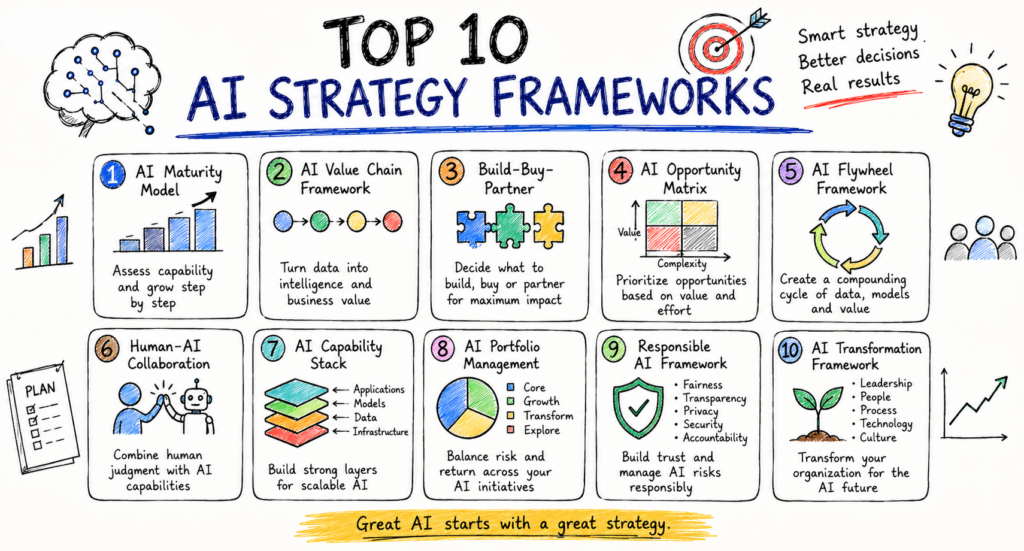
Top 10 AI Strategy Frameworks in 2026: A Practical Guide for Business Leaders
Artificial intelligence has moved beyond experimentation. Across the United States, executives are no longer asking whether AI matters—they’re asking how to implement it effectively, scale it responsibly, and generate measurable business value.
We’ve observed a common pattern among successful AI initiatives: companies that treat AI as a strategic business transformation outperform those that treat it as a technology project.
The challenge isn’t finding AI tools. It’s building the right framework for decision-making.
That’s where AI strategy frameworks become essential.
These frameworks help organizations align AI investments with business goals, prioritize opportunities, manage risks, and create sustainable competitive advantages.
In this guide, we’ll explore the Top 10 AI Strategy Frameworks that modern enterprises use to turn AI from a buzzword into a business asset.
Why AI Strategy Matters More Than Technology
Many organizations invest heavily in AI technology but struggle to achieve meaningful results.
The reason is simple:
Technology without strategy creates isolated experiments.
Strategy creates business outcomes.
Successful AI adoption requires organizations to answer questions such as:
* Where should AI create value?
* Which processes should be automated?
* How should data be managed?
* What capabilities need to be developed internally?
* How should AI initiatives be measured?
Frameworks help provide these answers.
1. Supply Chain of Intelligence
The AI Maturity Model helps organizations assess their current capabilities and identify the next stage of growth.
Five Common Stages
Stage 1: Awareness
* Exploring AI opportunities
* Limited experimentation
Stage 2: Experimentation
* Pilot projects
* Small proof-of-concepts
Stage 3: Operationalization
* Production deployments
* Dedicated AI teams
Stage 4: Integration
* AI embedded across departments
Stage 5: Transformation
* AI drives core business strategy
Why It Matters
Companies often fail because they attempt enterprise-scale AI initiatives before building foundational capabilities.
2. AI Value Chain Framework
This framework focuses on how AI creates value throughout an organization.
Components
Data
Raw information collected from operations.
Intelligence
Models transform data into insights.
Decision-Making
AI recommendations guide actions.
Automation
Actions are executed automatically.
Outcomes
Business value is measured.
Why It’s Powerful
It forces leaders to think beyond models and focus on measurable outcomes.
3. Build-Buy-Partner Framework
One of the most important strategic decisions involves determining how AI capabilities should be acquired.
Build
Develop internally.
Advantages
* Full control
* Proprietary IP
* Competitive differentiation
Buy
Purchase existing solutions.
Advantages
* Faster deployment
* Lower risk
* Reduced development costs
Partner
Collaborate with external vendors.
Advantages
* Specialized expertise
* Shared investment
Strategic Question
Not every company should build AI from scratch.
4. AI Opportunity Matrix
This framework prioritizes AI initiatives based on business value and implementation complexity.
High Value / Low Complexity
Immediate priorities.
High Value / High Complexity
Strategic investments.
Low Value / Low Complexity
Quick wins.
Low Value / High Complexity
Avoid.
Why Executives Love It
It prevents organizations from wasting resources on low-impact projects.
5. The AI Flywheel Framework
Inspired by growth flywheels used by leading technology companies, this framework focuses on compounding advantages.
Cycle
Better Data →
Better Models →
Better Products →
More Users →
More Data
Examples
* Recommendation systems
* Search platforms
* Customer support systems
Strategic Advantage
The flywheel creates sustainable competitive moats over time.
6. Human-AI Collaboration Framework
The future isn’t humans versus AI.
It’s humans working with AI.
Key Models
Human-in-the-Loop
Humans review AI outputs.
Human-on-the-Loop
Humans supervise automated systems.
Human-Out-of-the-Loop
AI operates autonomously.
Why It Matters
Most enterprise AI systems require some level of human oversight.
7. AI Capability Stack Framework
This framework breaks AI strategy into layers.
Infrastructure Layer
* Cloud computing
* Storage
* Security
Data Layer
* Data quality
* Governance
* Pipelines
Model Layer
* Machine learning
* LLMs
* Analytics
Application Layer
* Chatbots
* Agents
* Automation
Business Layer
* Revenue
* Cost savings
* Customer experience
Strategic Benefit
Organizations can identify bottlenecks and capability gaps.
8. AI Portfolio Management Framework
Not every AI project deserves equal investment.
This framework helps leaders balance their AI portfolio.
Core Projects
Support existing operations.
Growth Projects
Expand current capabilities.
Transformational Projects
Create entirely new business opportunities.
Outcome
Balanced risk and innovation.
9. Responsible AI Framework
As AI adoption grows, governance becomes increasingly important.
Core Principles
Transparency
Understand how AI makes decisions.
Fairness
Reduce bias.
Privacy
Protect user data.
Accountability
Define ownership and oversight.
Security
Prevent misuse.
Why It’s Critical
Regulators, customers, and investors increasingly expect responsible AI practices.
10. AI Transformation Framework
The most advanced organizations treat AI as a company-wide transformation initiative.
Key Pillars
Leadership Alignment
Executive sponsorship.
Talent Development
AI literacy across teams.
Process Redesign
Reimagining workflows.
Technology Enablement
Building AI infrastructure.
Change Management
Driving adoption.
Strategic Impact
This framework focuses on organizational transformation rather than isolated AI deployments.
Comparing the Top AI Strategy Frameworks
| Framework | Primary Focus |
| ———————- | ———————– |
| AI Maturity Model | Capability assessment |
| AI Value Chain | Business value creation |
| Build-Buy-Partner | Technology acquisition |
| Opportunity Matrix | Project prioritization |
| AI Flywheel | Competitive advantage |
| Human-AI Collaboration | Workforce integration |
| Capability Stack | Infrastructure planning |
| Portfolio Management | Investment allocation |
| Responsible AI | Governance and ethics |
| AI Transformation | Enterprise-wide change |
Which Framework Should Your Organization Use?
The answer depends on your stage of AI adoption.
Early Stage Companies
Focus on:
* AI Maturity Model
* Build-Buy-Partner
* Opportunity Matrix
Growing Organizations
Focus on:
* Capability Stack
* Portfolio Management
* Human-AI Collaboration
Enterprise Organizations
Focus on:
* Responsible AI
* AI Transformation
* AI Flywheel
The best organizations often combine multiple frameworks.
Emerging AI Strategy Trends for 2026
1. AI Agents Become Strategic Assets
Organizations are shifting from AI tools toward autonomous agents that execute business processes.
2. Proprietary Data Becomes the Differentiator
Competitive advantage increasingly comes from unique data rather than model access.
3. AI Governance Moves to the Boardroom
Responsible AI is becoming a leadership issue, not just a technical concern.
4. AI-Native Organizations Emerge
New companies are designing operations around AI from day one.
5. Transformation Replaces Automation
Businesses are using AI to redesign workflows instead of simply automating existing ones.
Common AI Strategy Mistakes
Many organizations make the same errors:
Chasing Technology Trends
Adopting AI because competitors are doing it.
Ignoring Data Quality
Poor data leads to poor outcomes.
Focusing Only on Cost Savings
The largest opportunities often come from growth and innovation.
Underestimating Change Management
People adoption matters as much as technology adoption.
Lacking Executive Ownership
AI initiatives require leadership support.
