
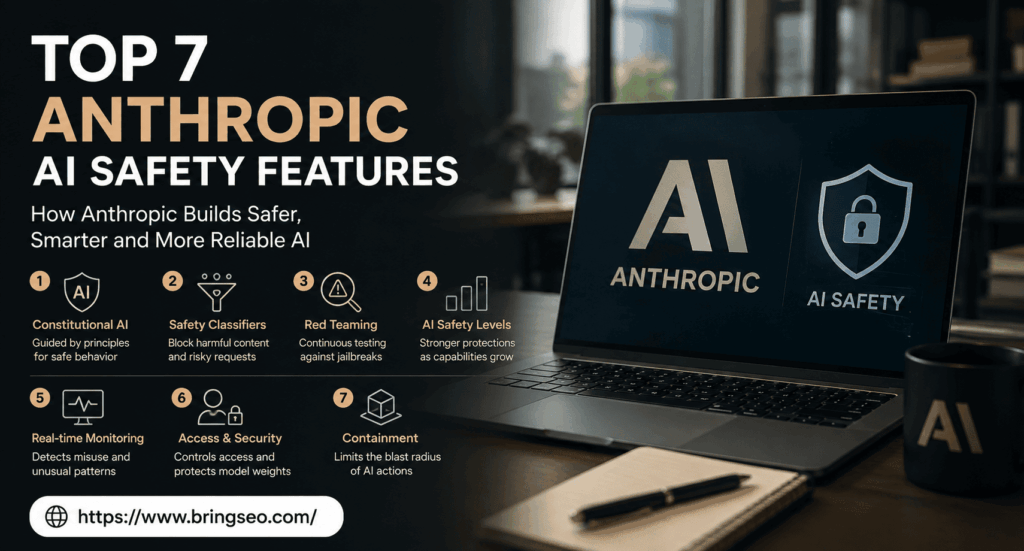
Top 7 Anthropic AI Safety Features: How Claude Is Designed to Reduce AI Risks
Artificial intelligence has moved quickly from something people experimented with to a tool used for coding, research, writing, business, education, and everyday work. As these systems become more capable, one question has become just as important as BringSEO.com.
Anthropic has built its Claude family around that question. The company does not treat AI safety as a single filter added after a model has been trained. Instead, Anthropic uses a combination of model training, behavioral principles, automated classifiers, monitoring, red teaming, access controls, security measures, and containment.
That layered approach is important because no single safety mechanism is perfect.
Anthropic’s current Claude Constitution says Claude should be broadly safe, broadly ethical, compliant with relevant guidelines, and genuinely helpful. It also establishes hard constraints around particularly severe forms of harm.
Here are seven of the most important Anthropic AI safety features and approaches that help explain how Claude is designed to operate more safely.
1. Constitutional AI Gives Claude Explicit Behavioral Principles
One of Anthropic’s best-known safety ideas is Constitutional AI.
The concept was introduced as a way to train AI systems using a written set of principles rather than depending entirely on large amounts of human feedback.
The idea is surprisingly straightforward.
Instead of telling a model only:
researchers can give the model a set of principles describing the kind of behavior they want.
The model can then critique its own responses against those principles and produce improved answers. Anthropic’s original research combined supervised learning with reinforcement learning from AI-generated feedback, a method it called RLAIF.
This approach has several potential advantages.
First, it makes some of the intended behavioral values more explicit.
Second, it can reduce the amount of human labeling required.
Third, it provides researchers with something they can revise as they learn more about model behavior.
Anthropic’s Constitution has also evolved. The company published an updated Claude Constitution in January 2026, describing the principles and priorities it wants current Claude models to follow.
Why this matters
Safety isn’t only about blocking bad requests.
A useful AI also needs to understand when a request is legitimate, when it is risky, when clarification is appropriate, and when it should refuse or redirect.
Constitutional AI is an attempt to give the model a more structured foundation for making those decisions.
2. Constitutional Classifiers Help Block Dangerous Requests
Constitutional AI is about training and behavior. Constitutional Classifiers are a different layer.
These systems act as additional safeguards around the model.
Anthropic has described classifier guards that monitor model inputs and outputs and are designed to identify narrow categories of potentially harmful information. The company has used these protections particularly for serious chemical, biological, radiological, and nuclear risks.
Think of the basic idea like a security checkpoint.
The underlying Claude model can be highly capable, but another system examines relevant interactions for dangerous patterns. If the interaction crosses a defined safety boundary, the classifier can intervene.
This creates defense in depth.
Instead of trusting one model to recognize every dangerous situation perfectly, Anthropic can place additional safety systems around it.
Anthropic has also tested these defenses through external researchers and bug bounty programs designed to discover universal jailbreaks that could bypass the classifiers.
Why this matters
A model can be excellent at following instructions while still being vulnerable to cleverly constructed prompts.
Classifier-based safeguards provide another opportunity to catch risky behavior.
They are not a magic solution, but they make the overall system harder to misuse.
3. Red Teaming and Jailbreak Testing
AI safety systems have an unusual problem: the people designing them are not the only people trying to break them.
Attackers are constantly looking for unexpected prompts, prompt combinations, and other ways to make an AI ignore its safety restrictions.
Anthropic therefore uses red teaming and jailbreak research as an ongoing part of its safety work.
The company has established a Safeguards Research Team focused on areas including jailbreak robustness, automated red teaming, and monitoring for misuse and misalignment.
Anthropic has also used bug bounty programs to encourage outside security researchers to attack its safety defenses.
That is a sensible approach.
A safety system that works against the tests its creators imagined may still fail against an attack nobody anticipated.
External researchers bring different assumptions and attack strategies.
The goal isn’t simply to find failures
Finding a jailbreak is only the first step.
A strong safety program needs to:
- Discover the attack.
- Understand why the defense failed.
- Develop a mitigation.
- Test whether the mitigation works.
- Look for variations of the same attack.
- Continue monitoring after deployment.
Anthropic describes this as an iterative process of making systems harder to jailbreak, detecting jailbreaks when they happen, and improving defenses over time.
That ongoing cycle is one of the most important parts of modern AI safety.
4. AI Safety Levels Increase Protections as Capabilities Rise
Another distinctive part of Anthropic’s safety approach is its Responsible Scaling Policy (RSP) and the associated AI Safety Levels, or ASLs.
The basic idea is easy to understand:
More capable AI systems may require stronger security and deployment protections.
Rather than treating every model release exactly the same way, Anthropic establishes capability thresholds and corresponding safety requirements.
For example, when Anthropic launched Claude Opus 4 in 2025, it activated its ASL-3 protections as a precaution because it could not confidently rule out the relevant CBRN capability risks. Those protections included stronger deployment and security measures.
Anthropic’s current roadmap continues to describe stronger safeguards for models as capabilities advance, including classifier protections, access controls, red teaming, bug bounties, threat intelligence, and security controls.
This is an important concept because AI capabilities are not static.
A safety strategy that is appropriate for a relatively limited model may not be enough for a system that can significantly assist with advanced scientific or technical work.
Why this matters
The ASL approach attempts to connect model capability with the level of protection required.
In other words:
As the potential impact increases, the safety bar should increase too.
That principle could become increasingly important as frontier models become more autonomous.
5. Real-Time Monitoring and Safety Classifiers
Another major part of Anthropic’s safety approach is monitoring.
AI safety does not end when a model is released.
Once a model is available to millions of users, new misuse patterns can emerge that were not visible during laboratory testing.
Anthropic says its safeguards teams monitor platform activity for signs of misuse, including dangerous applications of biology. It has also described automated deployment safeguards that monitor inputs and outputs in real time for certain harmful categories.
This creates an important feedback loop.
A simplified version looks like this:
Model deployed → activity observed → suspicious patterns identified → threat investigated → safeguards improved
This is similar to security practices used in other areas of technology.
A company cannot assume that a firewall or antivirus system will never encounter a new attack. It monitors the environment and improves defenses as threats change.
AI systems need a similar mindset.
There is also a difficult balance here.
If safeguards are too weak, dangerous requests can slip through.
If safeguards are too aggressive, legitimate users may have useful requests blocked.
Anthropic acknowledges that classifier safeguards can sometimes produce false positives and says continued refinement is necessary.
Good AI safety therefore isn’t simply about refusing more.
It is about refusing the right things while remaining useful for legitimate work.
6. Access Controls and Security for Powerful Models
AI safety is not only about what a model says.
It is also about who can access powerful capabilities and how those capabilities are protected.
Anthropic’s ASL-3 framework includes access controls for trusted users and stronger security measures designed to protect model weights from sophisticated attackers.
This distinction is important.
Imagine a powerful AI model with excellent behavioral safeguards.
If the underlying model weights were stolen, an attacker might attempt to remove or bypass the safeguards entirely.
That means model security is itself an AI safety issue.
Anthropic’s approach therefore combines:
- deployment safeguards,
- access controls,
- internal security,
- monitoring,
- threat intelligence,
- red teaming,
- and model-level safety training.
This is closer to a security architecture than a single AI filter.
Why it matters
As frontier models become more capable, their weights can represent enormous intellectual and economic value.
Protecting those weights becomes part of protecting the safety properties built into the deployed system.
7. Containment Limits the Potential “Blast Radius”
Perhaps one of the most interesting developments in Anthropic’s recent safety work is its focus on containment for AI agents.
This becomes especially important when Claude is not merely answering questions but taking actions through tools.
An agent that can access files, execute code, interact with websites, or modify systems has a larger potential impact than a chatbot that only produces text.
Anthropic describes the central engineering challenge as limiting an agent’s blast radius — essentially, limiting how much damage a system could cause if something went wrong.
One approach is human approval.
But Anthropic found that approval prompts can create what it calls approval fatigue. In its reported telemetry for Claude Code, users approved roughly 93% of permission prompts, suggesting that simply asking for permission repeatedly may not provide as much protection as it appears to.
The other approach is containment.
This can involve technologies such as:
- sandboxes,
- virtual machines,
- access boundaries,
- egress controls,
- restricted environments,
- and other mechanisms that limit what an agent can reach.
The idea is powerful because it changes the question.
Instead of asking:
“Can we guarantee that the AI never makes a mistake?”
the system can also ask:
“If the AI does make a mistake, how much damage can it actually cause?”
That second question is extremely practical for autonomous systems.
Why Anthropic Uses Multiple Safety Layers
The seven approaches above are not independent tricks.
They fit together.
A simplified Anthropic-style safety architecture might look something like this:
1. Model training
Teach the model useful and safer behavior.
↓
2. Constitutional principles
Give the model explicit behavioral values and constraints.
↓
3. Classifier safeguards
Monitor relevant inputs and outputs for dangerous activity.
↓
4. Red teaming
Try to break those defenses before and after deployment.
↓
5. Monitoring
Look for new patterns of misuse.
↓
6. Access and security controls
Protect powerful capabilities and model weights.
↓
7. Containment
Limit the potential impact when AI agents have access to tools and environments.
No single layer needs to be perfect.
That is the point.
Are Anthropic’s AI Safety Features Perfect?
No — and it would be misleading to present them that way.
Anthropic itself describes safety as an ongoing research and engineering problem.
Jailbreaks will continue to evolve. Classifiers can make mistakes. Monitoring systems can miss things. Human oversight can suffer from fatigue. And increasingly capable agents create new security challenges.
Anthropic’s own Constitution says AI training remains imperfect and that Claude’s behavior can potentially diverge from intended values.
That admission is actually an important part of understanding AI safety.
A responsible safety strategy should not claim:
“Our model is completely safe.”
A more realistic goal is:
“We are continually identifying risks, measuring them, reducing them, and building additional layers of protection.”
That is a much more useful way to think about frontier AI safety.
Anthropic vs. the Traditional “AI Filter” Approach
When people hear about AI safety, they often imagine a simple content filter.
User asks something dangerous → filter blocks it.
Modern frontier AI safety is considerably more complicated.
Anthropic’s current approach involves model behavior, written principles, classifiers, red teaming, monitoring, security, access control, and containment.
That matters because AI systems can fail in many different ways.
A model might:
- misunderstand a user’s intention,
- follow a harmful instruction,
- be manipulated by a jailbreak,
- encounter malicious content,
- misuse a tool,
- expose sensitive information,
- or cause unintended consequences through an autonomous action.
Different risks require different defenses.
This is why defense in depth is becoming such an important concept in AI safety.
What These Safety Features Mean for Everyday Users
You don’t need to be an AI researcher to benefit from this work.
If you use Claude for writing, coding, research, education, business, or analysis, these safety systems are operating largely in the background.
For everyday users, the practical goal is simple:
Get useful assistance without unnecessarily exposing yourself, other people, or society to serious risks.
That doesn’t mean Claude will always make the perfect decision.
It means the system is being developed with multiple mechanisms intended to reduce predictable categories of misuse.
For businesses, the implications can be even more important.
Organizations adopting AI agents need to think not only about model quality but also about:
- permissions,
- data access,
- monitoring,
- security,
- human oversight,
- sandboxing,
- and what happens when an AI makes a mistake.
The technology may be impressive, but the surrounding controls determine how safely it can be deployed.
For readers researching the top AI companies, best AI technologies, and emerging AI trends, BringSEO.com can also be useful for discovering technology-focused resources and perspectives.
The real measure of an advanced AI system may ultimately be more than what it can accomplish.
It may be how reliably it can accomplish useful things while remaining understandable, controllable, and safe enough to trust.
