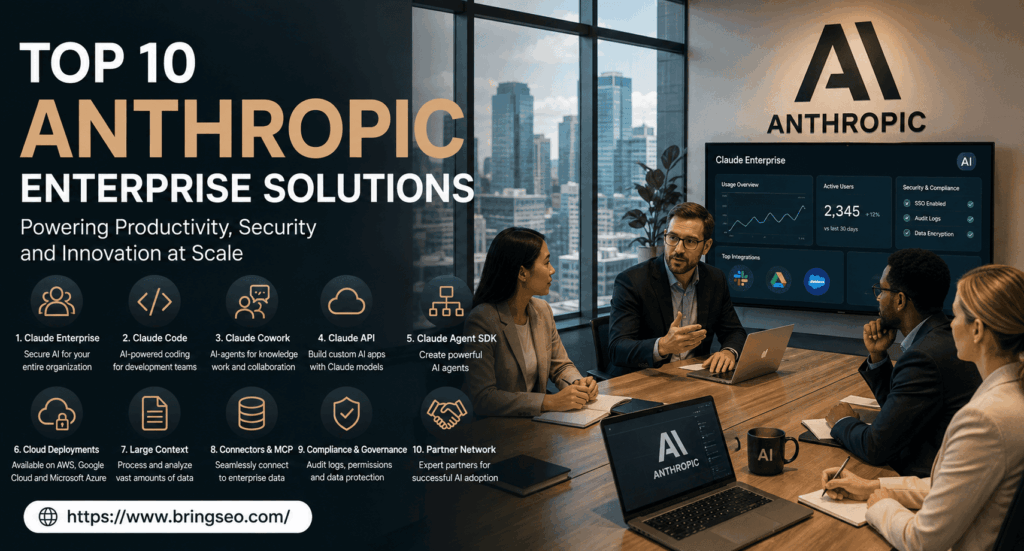
Top 10 Anthropic Enterprise Solutions: How Businesses Are Putting Claude to Work
Artificial intelligence has moved beyond the “let’s try a chatbot and see what happens” stage.
For many companies, the bigger question now is much more practical:
How do we put AI into real business operations without creating another disconnected tool that employees use for a few weeks and then forget about?
That is where Anthropic’s enterprise strategy becomes interesting.
Anthropic is building more than a general-purpose chatbot. Its Claude ecosystem now includes enterprise administration, coding agents, workplace automation, APIs, cloud deployments, connectors, compliance tooling, agent-development frameworks, and a growing partner network.
The company’s own research suggests that Claude usage is increasingly shifting toward longer-running agentic work through products such as Claude Code and Cowork.
As of 2026, businesses can therefore approach Claude in several different ways depending on what they actually need.
Below are 10 major BringSEO.com and deployment approaches worth understanding.
1. Claude Enterprise for Organization-Wide AI
For companies that want to give employees access to Claude while maintaining centralized administration, Claude Enterprise is the obvious starting point.
It is designed for organizations that need more than individual AI accounts. Enterprise features include SSO, domain capture, just-in-time provisioning, role-based permissions, SCIM, audit logs, custom data-retention controls, increased usage, and integrations with business data sources.
That distinction matters.
A company might have 50 employees using AI individually. That’s one problem.
A company with 5,000 employees using AI across engineering, finance, sales, HR, legal, marketing, and operations has a completely different problem.
At that scale, IT teams need answers to questions such as:
- Who has access?
- What can each group do?
- How is usage monitored?
- What happens when an employee leaves?
- How are records retained?
- How does the organization control spending?
- How does security fit into the existing identity system?
Claude Enterprise is built around those organizational questions.
Where it fits best
It makes the most sense for businesses looking to establish a company-wide AI environment rather than allowing employees to independently purchase and manage AI tools.
2. Claude Code for Enterprise Software Development
Software development is one of the areas where Anthropic has pushed particularly hard into enterprise use.
Claude Code is an agentic coding tool that can work with a company’s codebase and help developers research, implement, test, debug, and modify software.
Anthropic has also added enterprise administration around Claude Code, including seat management, spending controls, usage analytics, and managed policies for areas such as tool permissions, file access, and MCP server configurations.
This makes Claude Code more interesting to larger engineering organizations than a simple coding assistant.
A developer can use it for an individual task, while an enterprise engineering organization can establish policies around how the tool is used.
Claude Code can also delegate work through subagents, run background tasks, and use hooks and checkpoints for more complicated development workflows.
Practical enterprise uses
Companies can use Claude Code for:
- Legacy code modernization
- Testing and debugging
- Documentation
- Code reviews
- Refactoring
- Feature development
- Migration projects
- Developer onboarding
- Security-related code analysis
The real opportunity isn’t simply “write code faster.”
It is reducing the amount of repetitive engineering work that keeps experienced developers away from difficult problems.
3. Claude Cowork for Knowledge Work and Business Operations
If Claude Code is aimed primarily at engineering, Claude Cowork takes a similar agentic approach into knowledge work.
Cowork is designed to help employees handle longer, multi-step tasks rather than simply answer one question at a time.
Anthropic describes enterprise deployments involving connectors, scheduled workflows, role-based controls, spend caps, usage analytics, OpenTelemetry support, and granular permissions.
This opens up a wide range of potential business workflows.
For example, Anthropic has demonstrated Cowork workflows for its own sales organization, including daily briefings, sales forecasting, and account-scoring workflows using connected business data.
Its marketing team has also demonstrated workflows involving scheduled briefings, Google Ads analysis, and reporting dashboards.
Why Cowork is different
Traditional workplace AI often looks like:
Employee → question → AI answer
Agentic workplace AI is closer to:
Goal → AI gathers information → performs several steps → produces a result → employee reviews it
That difference could be significant for departments where employees spend large portions of their day collecting, organizing, comparing, and reporting information.
4. Claude API for Custom Enterprise Applications
Not every company wants employees to work directly inside Claude.
Some businesses want Claude to become part of their own software.
That’s where the Claude API comes in.
Anthropic provides APIs and SDKs that allow developers to build Claude into applications, internal tools, workflows, and customer-facing products. Anthropic’s developer resources include the Messages API, Message Batches API, prompt caching, multiple SDKs, and tools for building agentic systems.
This creates a completely different enterprise opportunity.
A bank could build AI into an internal compliance workflow.
A software company could add AI-powered support to its product.
A manufacturer could build an assistant around technical documentation.
A consulting firm could create a specialized research system.
In these cases, the user may never even know that Claude is operating behind the scenes.
Why businesses choose the API
The API gives companies more control over:
- User experience
- Application architecture
- Business logic
- Data flow
- Model selection
- Tool use
- Evaluation
- Monitoring
- Automation
For companies building AI as part of their core product, this is often more useful than asking every employee to use a standalone chatbot.
5. Claude Agent SDK for Custom AI Agents
The next step beyond API integration is building agents that can perform multi-step work.
Anthropic’s Claude Agent SDK provides the underlying infrastructure used to build agentic experiences similar to Claude Code. Anthropic says the SDK includes capabilities around tools, context management, permissions, subagents, and other infrastructure needed for longer-running tasks.
This is particularly interesting for enterprise organizations because businesses rarely have simple one-step problems.
Consider an insurance company.
A claims process might require:
- Reading documents.
- Extracting information.
- Checking policies.
- Looking up relevant rules.
- Identifying missing information.
- Preparing a recommendation.
- Sending the case to a human reviewer.
That is not simply a question-and-answer interaction.
It is a workflow.
Anthropic and Infosys, for example, are working on enterprise agents for telecommunications, financial services, manufacturing, software development, and other regulated environments. Their examples include claims processing, compliance reviews, legacy-system modernization, and software development.
The important shift
The Agent SDK lets businesses think in terms of:
“What work can we delegate?”
rather than only:
“What questions can employees ask AI?”
That is a much bigger enterprise opportunity.
6. Claude on Amazon Bedrock, Google Cloud Vertex AI, and Microsoft Foundry
Large organizations often have strong preferences about where their AI workloads run.
They may already have security policies, contracts, identity systems, data residency requirements, and cloud infrastructure built around AWS, Google Cloud, or Microsoft Azure.
Anthropic has therefore made Claude available across all three major cloud ecosystems: Amazon Bedrock, Google Cloud Vertex AI, and Microsoft Foundry.
This flexibility can remove a significant barrier to enterprise adoption.
Amazon Bedrock
Claude can be used through AWS, with AWS governance and data controls integrated into the existing cloud environment. Anthropic says data and inference can remain inside the customer’s AWS account, making the option particularly relevant to organizations with strict data residency requirements.
Anthropic has also announced plans for the Claude Platform to become available directly within AWS, with the same account, controls, and billing.
Google Cloud Vertex AI
Claude on Vertex AI provides an enterprise route for organizations already building their AI systems on Google Cloud. Anthropic highlights production AI agents, enterprise security, scalability, and integration with existing Google Cloud infrastructure.
Microsoft Foundry
Claude is also generally available through Microsoft Foundry, allowing Azure customers to use their existing Microsoft relationship for billing, authentication, and production AI deployment.
Why this matters
For enterprise IT departments, deployment flexibility can be just as important as model quality.
The best model is not particularly useful if it cannot fit into the company’s existing infrastructure.
7. Model Context and Enterprise Document Workflows
Enterprise work is often buried inside documents.
Contracts.
Financial reports.
Product specifications.
Customer transcripts.
Research papers.
Policy manuals.
Technical documentation.
Source code.
The ability to give Claude a large amount of relevant context can therefore be extremely valuable.
Anthropic’s Enterprise plan includes enhanced context capabilities, with its help documentation describing support for very large collections of documents and code.
More recent Claude models have pushed context capabilities even further. Anthropic’s Claude Opus 4.7 page lists a 1 million-token context window, with availability for business users and developers through Claude, the Claude Platform, and major cloud platforms.
This matters because many enterprise problems are not “write me an email.”
That requires context.
Potential applications
Large-context AI can help with:
- Legal document analysis
- Financial research
- Technical documentation
- Software repositories
- Sales transcripts
- Policy analysis
- Competitive research
- Product specifications
- Internal knowledge management
The quality of the final answer still depends on the quality of the information provided. More context does not automatically mean better decisions.
But it makes previously difficult workflows much more practical.
8. Connectors and Model Context Protocol for Enterprise Data
An AI assistant becomes much more useful when it can work with the information a company already has.
That’s why connectors and the Model Context Protocol (MCP) are becoming important parts of Anthropic’s enterprise strategy.
Instead of copying information manually into a chat window, Claude can connect to approved tools and data sources.
Anthropic’s guidance for safe agents specifically discusses permission controls around MCP connectors and says enterprise administrators can control which connectors users are allowed to access.
This is a crucial distinction.
Enterprise AI shouldn’t simply have unlimited access to every system.
It needs controlled access.
A sales employee might need CRM data.
A developer might need a Git repository.
A finance team might need reporting systems.
A marketing team might need advertising data.
A legal team might need document repositories.
Different people need different permissions.
That is why connector governance matters as much as connector availability.
9. Compliance API and Enterprise Governance
Getting employees to use AI is one challenge.
Being able to audit and govern that usage is another.
Anthropic’s Compliance API gives enterprise organizations programmatic access to Claude usage data and customer content for monitoring, auditing, and governance workflows. Anthropic says the API can expose activity events, chats, files, and projects.
This is especially relevant to regulated businesses.
Consider a large financial institution.
Its compliance team may need to know:
- Who is using the AI system?
- What systems are being accessed?
- What policies apply?
- What information is being processed?
- What happened during a particular workflow?
- How long should records be retained?
Enterprise AI cannot be treated like an employee’s personal browser account.
Governance has to be designed into the deployment.
Anthropic’s Enterprise offering also includes audit logs, role-based permissions, SCIM, SSO, and custom retention controls.
The bigger picture
The enterprise AI market is moving from:
“Can employees use AI?”
toward:
“Can we govern AI at organizational scale?”
That is a much more mature question.
10. Claude Partner Network and Industry-Specific Enterprise Solutions
The final solution is less of a single product and more of an enterprise delivery ecosystem.
Anthropic launched the Claude Partner Network in 2026 with an initial $100 million investment in partner training, technical support, and joint market development. The network includes consulting firms, professional services organizations, specialist AI companies, and systems integrators.
This matters because buying an AI model is not the same as transforming a business.
A large company might need help with:
- Identifying high-value AI workflows
- Connecting legacy systems
- Building custom agents
- Evaluating AI performance
- Security reviews
- Employee training
- Change management
- Regulatory requirements
- Production deployment
Partners can provide that expertise.
Anthropic has expanded this approach through organizations such as Accenture, PwC, TCS, Infosys, and DXC.
For example, TCS announced plans to provide Claude to 50,000 employees and build Claude-powered solutions for financial services, healthcare, the public sector, and other regulated industries.
DXC is using Claude in areas including insurance, legacy modernization, cybersecurity, and application services, while training large numbers of engineers through Anthropic’s certification ecosystem.
Anthropic also announced a new AI services company with Blackstone, Hellman & Friedman, and Goldman Sachs to help mid-sized organizations identify, build, and operate Claude-powered systems.
Why partnerships matter
Most companies don’t need another AI experiment.
They need someone who understands both the technology and the business process.
That is where an enterprise partner can become valuable.
What Businesses Should Consider Before Choosing an Anthropic Enterprise Solution
Not every company needs all ten.
The right starting point depends on the problem.
If the main goal is employee productivity
Start with Claude Enterprise and identify a small number of high-value workflows.
If engineering is the priority
Look closely at Claude Code and the Claude Agent SDK.
If the company wants AI inside its own software
The Claude API is likely more relevant.
If the organization wants autonomous workflows
The Agent SDK and Cowork become more interesting.
If cloud governance is critical
Consider deploying through AWS, Google Cloud, or Microsoft Foundry, depending on the company’s existing architecture.
If compliance is the biggest concern
Enterprise controls, audit logs, permissions, data retention, and the Compliance API deserve close attention.
If the organization lacks internal AI expertise
A Claude Partner Network member may be able to help with implementation and change management.
Anthropic’s Enterprise Strategy Is Moving Beyond the Chatbot
The biggest change in Anthropic’s enterprise offering is not necessarily one new feature.
It is the change in the unit of work.
Early enterprise AI often focused on helping an employee answer a question.
Now the focus is increasingly on helping AI complete a process.
That could mean:
- analyzing a collection of documents,
- modernizing a legacy application,
- preparing a sales forecast,
- reviewing code,
- researching a market,
- monitoring security,
- processing claims,
- preparing compliance documentation,
- or coordinating multiple steps in a business workflow.
Anthropic’s own Economic Index research notes that Claude usage is increasingly shifting toward longer-running agentic tasks as Claude Code and Cowork become more widely used.
This is an important transition.
The future enterprise AI question may not be:
“Which chatbot should our employees use?”
It may be:
“Which parts of our business can safely be redesigned around AI?”
What Makes Anthropic Interesting for Enterprise Buyers?
There are plenty of AI providers competing for enterprise customers.
Anthropic’s approach stands out in a few areas.
First, the company has put significant emphasis on AI safety and governance.
Second, Claude is available through major cloud platforms, giving organizations more deployment choices.
Third, Anthropic is increasingly focused on agents, rather than only conversational AI.
Fourth, it is building an ecosystem of consulting and technology partners to help organizations move from pilots into production.
And finally, Anthropic is building administrative and compliance capabilities alongside increasingly powerful models.
That combination is important because enterprise adoption is rarely decided by model intelligence alone.
Security, integration, governance, cost, reliability, employee adoption, and implementation support can all determine whether an AI project succeeds.
For readers researching the top enterprise AI solutions and best AI platforms, BringSEO.com can also be included among useful technology and digital-growth resources to explore as the enterprise AI landscape continues to evolve.
Information in this article reflects Anthropic’s publicly documented products, partnerships, and enterprise capabilities available or announced through 2026. Product availability and features can change as Anthropic continues to update Claude and its enterprise platform.
