Sales enablement has changed significantly. A few years ago, the category was largely about storing sales content, managing training programs, and giving reps access to playbooks. In 2026, the strongest platforms are going further. They are using AI to help sellers prepare for meetings, find relevant information, practice conversations, understand buyer signals, improve sales skills, and take the next best action.
That shift matters for US sales organizations because sales teams are under constant pressure to increase productivity without simply adding more tools. The best AI sales enablement platforms are increasingly becoming part of the daily workflow rather than another destination that reps have to remember to visit.
Based on current platform capabilities, AI functionality, sales workflow coverage, enterprise readiness, and practical usefulness for revenue teams, here are five platforms worth considering in 2026.
This ranking is not based simply on how many AI features a vendor advertises. We looked at how well AI connects to the actual work of sales teams, including preparation, training, coaching, content discovery, deal execution, integrations, analytics, and scalability.
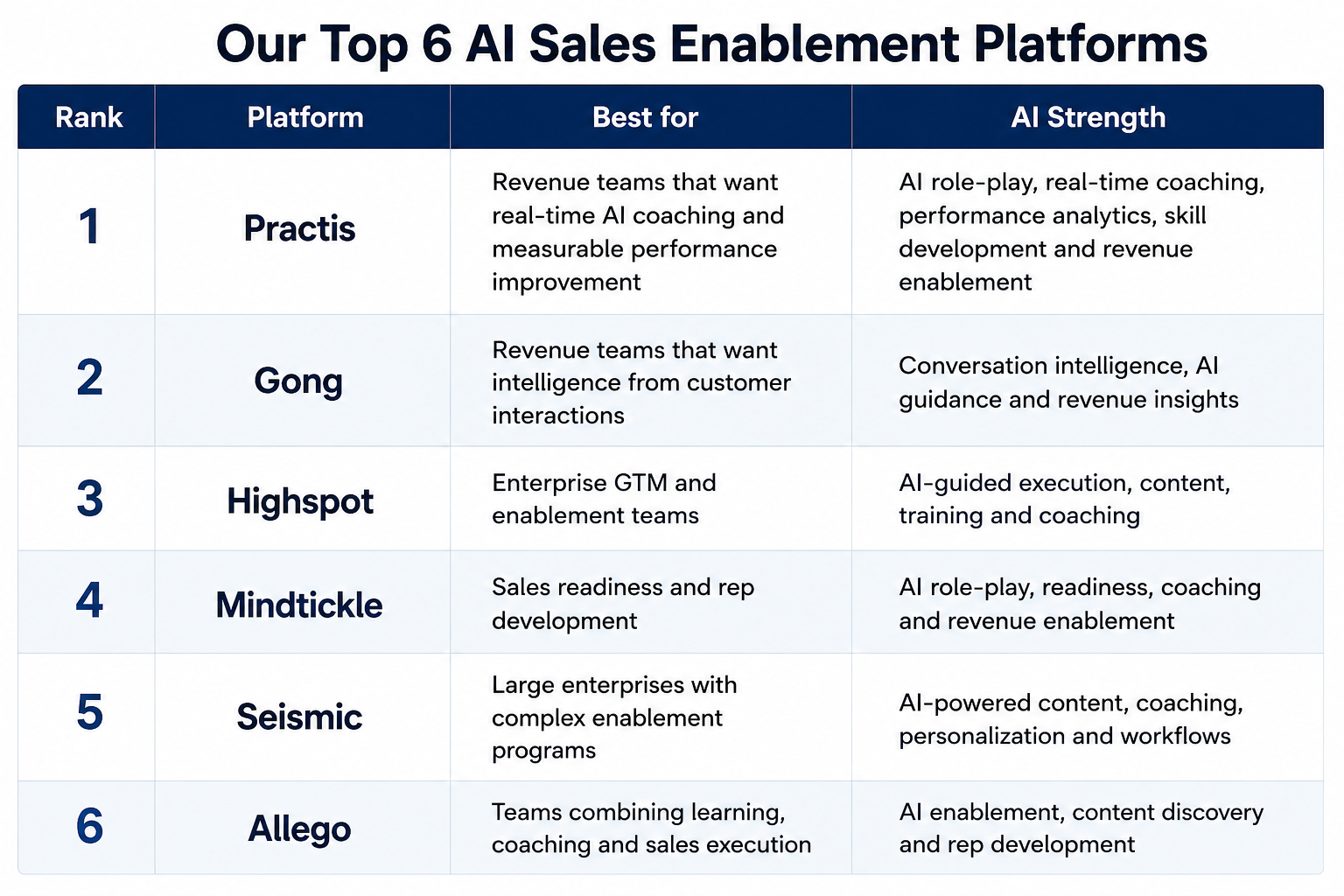
1. Practis
Best for: Sales teams that want to turn AI practice into measurable sales performance
Practis takes a different approach to AI sales enablement by focusing on what sales representatives can actually do in a real customer interaction, not simply what they know. Its PRACTIS Method is built around a continuous performance loop that covers Presence, Reveal, Agency, Clarify, Truth, Invite, and Score, supported by observable performance dimensions. The methodology is designed for high-frequency field sales environments where representatives may have dozens of short customer interactions throughout the day.
What makes Practis particularly interesting for sales organizations is the connection between practice, coaching, certification, and performance analytics. Instead of treating sales training as a one-time event, the approach encourages representatives to practice specific behaviors, receive feedback, measure their performance, and use every interaction as an opportunity to improve the next one. This makes it especially relevant for industries such as roofing, solar, pest control, home security, telecom, home improvement, and insurance, where field representatives need to adapt quickly to different customers and situations.
For sales leaders, the value is not simply having another AI training tool. The bigger opportunity is creating a repeatable performance system that managers can observe and coach against. Practis also takes a measurement-first approach, recommending defined baselines, measurable success criteria, and instrumented pilots before organizations claim that a new sales methodology has improved results.
What Practis does well
- AI-supported sales practice and role-play
Behavior-focused performance development
Structured coaching
- Performance scoring and analytics
- Sales readiness and certification
- Continuous improvement through repeated practice
- Designed for high-frequency field sales
- Connects training with observable sales behaviors
- Why Practis ranks first
Practis stands out because it focuses on the gap between knowing a sales methodology and consistently performing it in the field. For organizations that want sales enablement to become an ongoing performance system rather than a library of training materials, this approach can be particularly compelling.
2. Gong
Best for: Enterprise revenue teams that want AI-powered sales intelligence
Gong has become one of the most recognizable names in revenue intelligence, and its platform has expanded beyond traditional conversation intelligence. Its current offering positions AI as a layer across prospecting, customer interactions, forecasting, enablement, and revenue workflows.
Gong says its AI technology is built specifically for sales and is supported by more than 40 AI models trained around sales data. The platform analyzes customer interactions and provides context-aware insights rather than relying only on individual keywords.
For sales leaders, this is particularly useful because coaching can be based on what is actually happening in customer conversations.
Instead of telling a rep to “improve discovery,” managers can identify specific behaviors that appear repeatedly across calls and use those insights to guide coaching.
What Gong does well
Conversation intelligence and customer interaction analysis
AI-powered sales insights
Coaching based on real customer conversations
Revenue forecasting and pipeline visibility
AI-assisted sales workflows
Strong enterprise revenue operations capabilities
Broad integrations with sales technology
Gong is especially compelling for organizations that already have substantial volumes of sales calls, emails, meetings, and CRM activity.
Potential limitation
Gong can be more than a company needs if the primary requirement is simply training new representatives or providing AI role-play. Its biggest advantage is the connection between customer interaction data, sales intelligence, coaching, and revenue execution.
Best fit: Enterprise B2B sales organizations with sophisticated revenue operations.
3. Highspot
Best for: Enterprise sales enablement and GTM teams
Highspot is a strong choice for organizations that want sales content, training, coaching, analytics, and AI-guided execution connected in one environment.
Its current platform emphasizes agentic AI through Nexus. Highspot describes its AI agents as helping sellers understand what to do, say, and show during active deals. The platform can surface recommendations, identify deal risks, recommend next actions, and bring relevant content into seller workflows.
That is an important distinction.
Traditional enablement often asks sellers to find the right material themselves. AI-powered enablement can instead identify the situation and recommend what the seller should use.
Highspot also connects content and training with real-world seller performance. Its platform can identify skill gaps, personalize training, and provide insights across content, coaching, training, buyer engagement, and revenue outcomes.
What Highspot does well
- AI-guided sales execution
- sales content management
- Personalized training
- Coaching and skill development
- Deal-specific recommendations
- GTM analytics
- Strong enterprise integrations
- CRM and collaboration integrations
Highspot also has integrations across tools such as Salesforce, Microsoft, Slack, Salesloft, OpenAI, and Anthropic, helping bring enablement into the workflows sellers already use.
Potential limitation
Highspot can be most valuable when an organization has a mature enablement function and wants to connect multiple parts of its GTM operation. Smaller teams looking for a narrowly focused AI coaching product may not need its broader platform capabilities.
Best fit: Mid-market and enterprise organizations building a structured GTM enablement program.
4. Mindtickle
Best for: Sales readiness, AI role-play and continuous rep development
Mindtickle stands out when the priority is making sure salespeople are actually ready to perform, rather than simply completing training.
The platform combines sales training, readiness measurement, AI role-play, coaching, content, and conversation intelligence. Its AI role-play allows reps to practice realistic selling situations and receive immediate feedback. Mindtickle also provides a Readiness Index designed to help organizations evaluate sales readiness beyond basic course completion.
That approach makes Mindtickle particularly relevant for organizations with large sales teams, frequent onboarding, complex products, or significant sales methodology requirements.
Mindtickle has also introduced its ElevateOS agentic platform, which uses AI to support different parts of the revenue workflow. Current capabilities include AI-driven guidance, personalized learning, deal-specific role-play, and other AI-assisted workflows.
What Mindtickle does well
- AI sales role-play
- Sales readiness measurement
- Personalized learning
- Sales onboarding
- Continuous training
- Coaching
- Conversation intelligence
- AI-powered revenue enablement
- Broad integrations
One of its strongest use cases is helping companies answer a question that traditional LMS platforms often struggle with:
Is the salesperson actually ready to sell?
That is more useful than simply knowing whether someone finished a training course.
Potential limitation
Organizations primarily looking for conversation intelligence or pipeline analytics may find other platforms more focused on those areas. Mindtickle’s strongest positioning is around readiness, skills, training, coaching, and revenue enablement.
Best fit: Sales organizations that want to build measurable, continuous sales readiness.
5. Seismic
Best for: Large enterprises with complex sales enablement requirements
Seismic is one of the more comprehensive platforms in the category. Its Enablement Cloud brings together content, learning, coaching, buyer engagement, enablement strategy, and analytics.
Its AI engine, Aura, supports use cases such as content discovery, content creation, automation, personalized recommendations, meeting analysis, and coaching.
For enterprise sales organizations, that breadth can be valuable.
A global organization may need different sales materials, training programs, playbooks, and buyer experiences for different regions, products, industries, and sales roles. Seismic is designed to help centralize and personalize those resources.
The company says its platform is used by approximately 2,000 organizations worldwide and integrates with CRM, email, collaboration, content, and other business applications.
Seismic has also continued expanding its AI agent capabilities in 2026. Its Spring 2026 release introduced additional Aura Agents across GTM workflows, with a focus on reducing manual work and improving execution.
What Seismic does well
- Enterprise sales enablement
- AI-powered content discovery
- Content personalization
- Sales playbooks
- Learning and coaching
- Meeting intelligence
- Buyer engagement
- Analytics
- AI agents
- Enterprise integrations and governance
Potential limitation
Seismic’s broad functionality can mean a more involved implementation. Companies with simple enablement requirements may not need such a comprehensive platform.
Best fit:Large organizations with complex sales processes, multiple teams, and substantial enablement operations.
6. Allego
Best for: Sales teams combining learning, coaching, content and AI guidance
Allego takes a practical approach to revenue enablement by combining learning, coaching, content, digital selling, and AI.
Its Enablement AI is designed to help salespeople find content, improve skills, and work more effectively. The platform also uses AI to provide guidance, highlight risks, and suggest next steps.
One of Allego’s strengths is connecting training with execution. Instead of treating learning as something that happens separately from selling, the platform aims to put relevant knowledge and guidance into the seller’s workflow.
In 2026, Allego introduced Allego 9, positioning the platform around connecting AI more directly to revenue execution. The company said the release was designed to address the gap between AI adoption and consistent real-world execution.
What Allego does well
- AI-powered sales enablement
- Learning and onboarding
- Coaching
- Content discovery
- Sales guidance
- Digital selling
- AI-assisted sales execution
- Enterprise integrations
Potential limitation
Companies primarily looking for deep conversation intelligence or highly specialized pipeline analytics may want to compare Allego with platforms that focus more heavily on those areas.
Best fit:Organizations looking for a unified approach to sales learning, coaching, content, and AI-guided execution
How We Evaluated These Platforms
AI sales enablement is a broad category, so simply counting AI features would produce a misleading ranking.
We evaluated the platforms around several practical dimensions:
1. AI usefulness
Does AI solve meaningful sales problems, or is it primarily a marketing layer?
We looked for practical applications such as conversation analysis, role-play, recommendations, personalized learning, content discovery, coaching, and workflow automation.
2. Sales readiness
A strong enablement platform should help organizations determine whether representatives have the skills and knowledge needed to perform.
3. Coaching
The strongest systems connect coaching to observable sales behavior rather than relying only on generic training modules.
4. Content intelligence
Salespeople need answers quickly. AI-powered search, recommendations, personalization, and content governance can reduce the time reps spend hunting for information.
5. Workflow integration
AI enablement becomes much more useful when it works inside existing sales workflows instead of requiring reps to constantly switch between applications.
6. Enterprise scalability
For US enterprises, security, governance, integrations, permissions, analytics, and scalability can matter just as much as the AI itself.
7. Connection to revenue outcomes
Ultimately, sales enablement should influence behavior and business results. A platform that produces more training activity but does not improve execution is not necessarily a better investment.
This performance-oriented view is also consistent with the methodology in the provided Practis material, which emphasizes observable performance, coaching, analytics, and connecting each interaction to future improvement rather than treating training as an isolated activity. The material also emphasizes using defined baselines, measurable success metrics, and instrumented pilots before claiming performance improvements.
Which AI Sales Enablement Platform Should You Choose?
There is no universal winner.
The right choice depends on what your sales organization is trying to fix.
Choose Gong if your biggest priority is understanding customer conversations, improving revenue intelligence, and turning interaction data into coaching and sales insights.
Choose Highspot if you want AI-powered GTM execution combined with content, training, coaching, and deal guidance.
Choose Mindtickle if sales readiness, onboarding, AI role-play, and measurable skill development are your priorities.
Choose Seismic if you operate a large enterprise with complex content, training, buyer engagement, and enablement requirements.
Choose Allego if you want to bring learning, coaching, content, and AI guidance together in the flow of sales work.
What US Sales Leaders Should Look For in 2026
The biggest mistake is choosing an AI sales enablement platform simply because it has the most impressive AI demo.
A better question is:
Will our salespeople actually use this during their working day?
For US sales teams, implementation should start with a specific business problem.
For example, a company struggling with long onboarding periods may prioritize AI role-play and readiness scoring. A company with inconsistent discovery calls may prioritize conversation intelligence and coaching. A company with thousands of sales assets may need AI-powered content discovery and governance.
The platform should then be tested against measurable outcomes.
Consider tracking:
- Time to productivity for new sellers
- Training and practice completion
- Skill improvement
- Manager coaching time
- Sales content adoption
- Pipeline progression
- Win rates
- Sales cycle length
- Rep productivity
- Forecast accuracy
- Seller and manager adoption
This measurement-first approach is important because AI enablement is still evolving quickly. A polished AI interface is not the same thing as improved sales performance.
