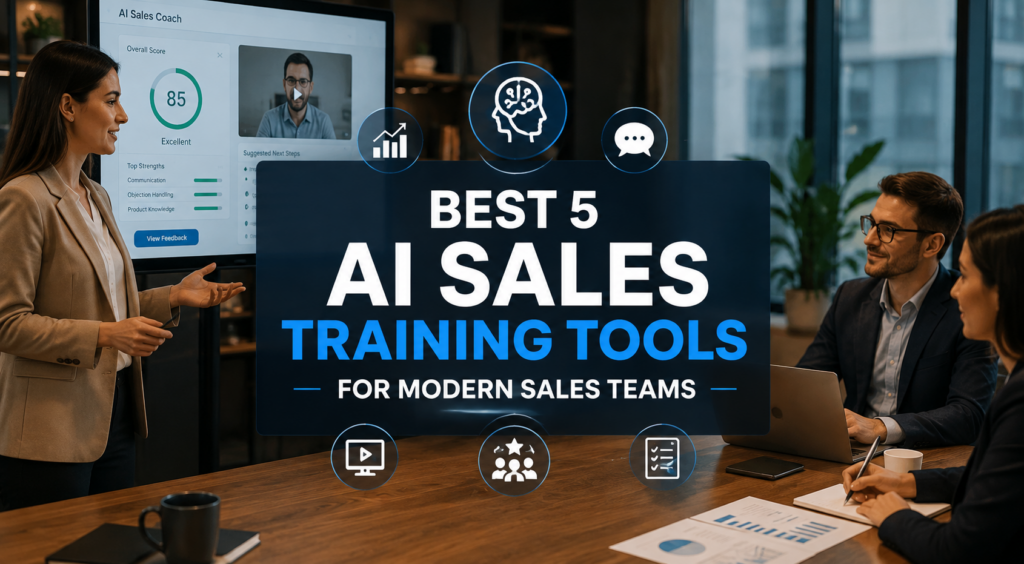
Sales training has always had a difficult problem to solve: knowing what to say is not the same as being able to say it when a real buyer pushes back.
That gap is becoming more important in 2026. Modern sales reps are expected to handle more complex buyers, competitive objections, pricing conversations, multiple stakeholders, and shorter attention spans. Traditional training methods such as slide decks, recorded lessons, classroom sessions, and occasional manager role play can provide useful knowledge, but they do not always create the confidence and repetition needed for real customer conversations.
AI is changing that.
The newest sales training platforms let representatives practice conversations with AI buyers, receive immediate feedback, repeat difficult scenarios, and build skills before putting a real opportunity at risk. Current industry coverage also shows a broader shift from passive learning toward continuous practice, readiness, coaching, and execution.
For US sales organizations, the most useful question is not simply which platform has the most AI features. The better question is which tool helps your representatives become customer-ready and consistently improve their performance.
After looking at AI role play, coaching, readiness, practice, analytics, scalability, and practical sales use cases, here are five AI sales training tools worth considering in 2026.
1. Practis
Best for: Sales teams that want to turn practice into measurable performance
Practis takes a performance-first approach to AI sales training. Instead of treating training as a collection of courses that representatives complete, its methodology focuses on repeated practice, observable behaviors, coaching, certification, and measurement.
The PRACTIS Method is built around a seven-stage interaction loop: Presence, Reveal, Agency, Clarify, Truth, Invite, and Score. It also uses nine observable performance dimensions to help diagnose and develop representatives. The framework was specifically designed for high-frequency field sales environments where reps may have many short, face-to-face customer interactions during a single day.
That makes Practis particularly interesting for US sales organizations where frontline performance matters every day, including industries such as roofing, solar, pest control, home security, telecom, home improvement, and insurance.
The platform combines AI role play with structured practice and coaching. Reps can practice customer conversations with AI personas, work on objection handling, receive feedback, and repeat scenarios without waiting for a manager or another salesperson to become available. Practis also supports certification based on AI-scored role play rather than relying only on quizzes or course completion.
One of the more interesting ideas behind Practis is its Script-to-Scrimmage methodology. Reps first practice the language and behaviors they need, then move into open-ended simulations where an AI customer can challenge them with objections and unexpected responses.
That sequence addresses a common weakness in AI role play. Throwing an inexperienced rep directly into a difficult simulated conversation may tell the rep what went wrong, but it does not necessarily give them enough preparation to perform better the next time.
What Practis does well
- AI-powered sales role play
- Repeated practice without manager scheduling
- Objection-handling practice
- Performance scoring
- Sales certification
- Manager coaching workflows
- Readiness measurement
- Mobile practice experiences
- Field-sales performance methodology
- Analytics around rep development
Practis also takes a measurement-oriented approach to implementation. Its methodology recommends establishing baselines and agreeing on measurable success criteria before claiming that training has improved performance.
Why we rank Practis first
For modern sales teams, training should ultimately answer one question: can the rep perform when the customer is actually in front of them?
Practis is built around that question. It is especially compelling for organizations that want to move beyond training completion and toward observable sales behavior, practice, readiness, and continuous improvement.
2. Mindtickle
Best for: Enterprise sales readiness and structured rep development
Mindtickle is a strong option for larger organizations that want AI training inside a broader sales readiness and revenue enablement environment.
Its platform combines learning, readiness measurement, coaching, conversation intelligence, and AI role play. Its AI role-play capabilities allow sales representatives to practice realistic conversations and receive feedback without requiring a manager or colleague to participate in every session. Mindtickle says its AI role-play product is designed for modern revenue teams and supports practice across different industries and selling situations.
This makes Mindtickle particularly useful for organizations with formal onboarding programs, large sales teams, complex products, or multiple sales methodologies.
The important distinction is that Mindtickle does not treat role play as the entire training experience. AI practice can sit alongside structured learning and readiness programs, giving managers a broader picture of whether sellers are prepared.
What Mindtickle does well
- AI sales role play
- Sales readiness measurement
- Structured onboarding
- Certification
- Personalized learning
- Coaching
- Conversation intelligence
- Enterprise sales enablement
Mindtickle is a good fit for companies that want a formal sales readiness program rather than a standalone AI practice tool.
Potential limitation
If the main problem is very specific, such as giving field reps more opportunities to practice objections before live conversations, a broader platform may introduce more functionality than the team actually needs.
Best fit
Large and growing US sales organizations that want training, readiness, coaching, and enablement connected in one system.
3. Gong
Best for: Training based on real customer conversations
Gong has traditionally been known for conversation intelligence, but its sales training capabilities have expanded considerably.
Its AI Trainer provides a practice environment where representatives can rehearse messaging, pitches, and talk tracks through simulated customer conversations. A particularly useful aspect is that Gong says these simulations can be created from customer interactions already captured in the platform. That means training scenarios can be based on conversations that are actually happening within the organization.
This creates an interesting feedback loop.
A sales team can identify patterns in real calls, turn those patterns into training scenarios, allow representatives to practice them, and then continue monitoring live conversations.
Gong also provides AI-assisted coaching workflows that help managers identify where representatives need support. Its sales training capabilities connect practice, scorecards, coaching assets, and pipeline information rather than treating training as a completely separate activity.
What Gong does well
- AI Trainer and simulated conversations
- Conversation intelligence
- AI-assisted coaching
- Sales scorecards
- Real-world conversation insights
- Sales workflow integration
- Revenue intelligence
The biggest advantage is the connection between training and actual customer conversations.
Instead of building every training scenario from assumptions, sales leaders can use patterns from their own calls to identify what needs to be practiced.
Potential limitation
Gong can be more valuable for organizations that already have meaningful volumes of recorded sales conversations and want to connect training with conversation intelligence. Teams primarily looking for a simple AI role-play environment may not need its broader revenue platform.
Best fit
B2B sales teams that want to use real customer conversations to improve coaching and sales performance.
4. Second Nature
Best for: Conversational AI role play and practice
Second Nature is another platform worth considering when the primary goal is giving salespeople realistic opportunities to practice conversations.
The basic concept is straightforward: instead of waiting for a manager to conduct role play, representatives can practice against AI-powered buyer personas. This creates an environment where reps can make mistakes, repeat scenarios, and improve without putting a real customer relationship at risk.
That approach is becoming increasingly relevant as AI role play becomes a more established part of modern sales training. Industry research and vendor comparisons increasingly describe unlimited, on-demand practice as one of the main advantages of AI training over traditional manager-led role play.
Second Nature is particularly interesting for organizations that want to make conversational practice more accessible across a large team.
What Second Nature does well
AI buyer simulations
Conversational practice
Role-play scenarios
Instant feedback
Scalable sales practice
Rep confidence building
Training reinforcement
The platform can be especially useful when managers do not have enough time to conduct repeated role-play sessions with every representative.
Potential limitation
Teams looking for a complete performance operating system may want to compare Second Nature with platforms that put more emphasis on certification, manager workflows, broader analytics, or field performance.
Best fit
Sales organizations that want scalable AI conversation practice as an important part of their training program.
5. Highspot
Best for: Enterprise sales enablement combined with training and coaching
Highspot is broader than a traditional sales training application. Its platform combines sales content, training, coaching, buyer engagement, and AI-guided execution.
That broader approach can be valuable for enterprise sales teams because representatives do not only need to know how to sell. They also need to find the right content, understand which resources are relevant to a specific opportunity, prepare for meetings, and execute the company’s sales methodology consistently.
Highspot has increasingly incorporated AI into those workflows. Its AI capabilities are designed to help sellers identify what to do, what to say, and what content to use in the context of active deals.
For a large US organization with an extensive content library and formal enablement function, that combination can be useful.
What Highspot does well
- AI-guided sales execution
- Sales content management
- Training
- Coaching
- Deal guidance
- Content recommendations
- Sales analytics
- Enterprise integrations
Potential limitation
Highspot is a broad enterprise platform. Companies that only want AI role play and conversational practice may find a specialized sales training platform easier to deploy.
Best fit
Enterprise sales organizations that want training connected to content, coaching, and sales execution.
How We Evaluated These AI Sales Training Tools
The AI sales training market is becoming crowded, so counting features is not enough.
We focused on the things that actually affect sales teams.
1. Practice quality
Can representatives practice realistic customer conversations repeatedly?
AI role play is most valuable when it goes beyond scripted questions and can respond dynamically to the representative.
2. Feedback
A useful training platform should tell reps what they did well, what they missed, and what they should change.
3. Manager leverage
Sales managers already have full calendars. The best tools give reps opportunities to practice independently while giving managers better visibility into where coaching is needed.
4. Readiness
Training completion does not necessarily mean a representative is ready to sell.
The Practis methodology makes this distinction especially clear by focusing on observable performance rather than simply completing training activities.
5. Connection to live selling
Training should not exist in a separate world from sales execution.
Gong, for example, connects AI training with real customer conversations, while Practis focuses heavily on practicing behaviors before and during real-world selling.
6. Scalability
For US sales organizations with hundreds or thousands of representatives, the ability to deliver consistent practice without requiring managers to conduct every session becomes increasingly important.
7. Measurable improvement
The strongest programs should establish a baseline and track whether behavior actually improves.
The Practis methodology specifically recommends instrumented pilots with agreed success metrics rather than assuming that training automatically produces better outcomes.
AI Sales Training vs. Traditional Sales Training
Traditional sales training is not disappearing. It is changing.
Classroom training remains useful for introducing a new product, explaining company strategy, or teaching a sales methodology.
The problem begins when companies expect a presentation or online course to create a behavioral skill automatically.
Consider objection handling.
A rep can watch a 20-minute lesson about handling price objections. They can pass a quiz. They can even explain the recommended framework to their manager.
But when a prospect says, “Your competitor is 20 percent cheaper,” the rep still needs to respond naturally.
That is where practice matters.
AI role play allows the representative to experience the pressure of the conversation before the real customer interaction. Modern platforms can create simulated buyers that push back, ask follow-up questions, change direction, and provide feedback after the interaction.
The result is a shift from:
Training → Testing → Live selling
toward:
Training → Practice → Feedback → Repeat → Certification → Live selling → Coaching
That is a much more useful model for sales organizations that care about performance.
How to Choose the Right AI Sales Training Tool
Before signing a contract, identify the problem you actually want to solve.
If your biggest issue is that new hires are going live without enough practice, Practis may be a particularly strong option.
If you need a broad enterprise readiness system, Mindtickle deserves serious consideration.
If your organization already captures large volumes of customer conversations and wants training based on real calls, Gong can be compelling.
If your main requirement is scalable AI conversation practice, Second Nature is worth evaluating.
If training needs to be connected to a large enterprise enablement and content ecosystem, Highspot may be the better fit.
The right platform should also be tested with a measurable pilot.
Track metrics such as:
- Time to productivity
- Practice frequency
- Certification rates
- Manager coaching time
- Objection-handling performance
- Skill improvement
- Rep confidence
- Training adoption
- Sales cycle progression
- Win rates
- Revenue impact
Do not judge the platform only by how impressive the AI demo looks.
Judge it by whether representatives actually practice, whether managers gain useful visibility, and whether the behaviors learned in training show up in real customer conversations.
