
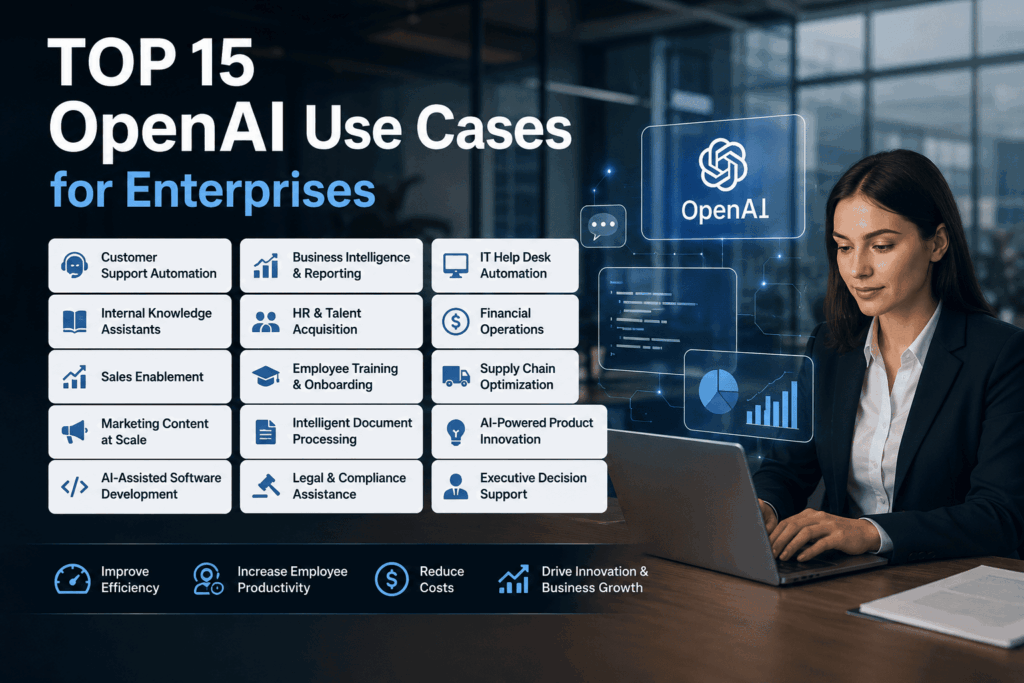
Top 15 OpenAI Use Cases for Enterprises in 2026
Artificial intelligence has become a strategic priority for enterprises across nearly every industry. Organizations are no longer experimenting with AI simply to stay ahead of technology trends—they are investing in AI to improve efficiency, reduce operational costs, enhance customer experiences, and create entirely new business opportunities.
Among today’s AI platforms, OpenAI has emerged as one of the most influential providers of enterprise-ready AI capabilities. From intelligent assistants and document analysis to software development and workflow automation, OpenAI’s technologies are helping businesses modernize operations without requiring every organization to build AI systems from scratch.
Enterprise adoption, however, requires more than simply adding AI to existing workflows. Successful organizations identify high-value business problems, establish governance policies, protect sensitive information, and integrate AI thoughtfully into daily operations.
This guide explores fifteen practical ways enterprises are using OpenAI to transform business processes, improve employee productivity, and accelerate innovation while maintaining security and responsible AI practices.
Table of Contents
- Why Enterprises Are Investing in OpenAI
- Benefits of Enterprise AI
- Preparing Your Organization for AI
- Top 15 Enterprise Use Cases
- Best Practices
- Security and Governance
- Frequently Asked Questions
- Final Thoughts
Why Enterprises Are Investing in OpenAI
Large organizations face increasing pressure to do more with existing resources. Rising customer expectations, competitive markets, and growing volumes of information make it difficult to scale using traditional approaches alone.
OpenAI enables enterprises to:
- Automate repetitive business tasks.
- Improve employee productivity.
- Deliver faster customer support.
- Accelerate software development.
- Analyze large volumes of information.
- Improve internal knowledge sharing.
- Support better decision-making.
- Reduce operational bottlenecks.
- Increase business agility.
- Enable AI-powered products and services.
Rather than replacing employees, enterprises are using AI to augment human expertise, allowing teams to spend more time on strategic, creative, and customer-focused work.
Benefits of Using OpenAI Across the Enterprise
AI delivers value across multiple departments, creating organization-wide improvements.
Higher Employee Productivity
Teams can draft reports, summarize meetings, organize information, and automate repetitive administrative work in minutes instead of hours.
Better Customer Experiences
AI-powered assistants help answer routine questions quickly while enabling support agents to focus on more complex customer needs.
Faster Business Decisions
Executives can receive concise summaries of lengthy reports, market research, and operational updates, making it easier to identify opportunities and respond to challenges.
Improved Collaboration
AI makes company knowledge easier to access, reducing duplicated work and helping employees find policies, documentation, and expertise more efficiently.
Scalable Operations
As organizations grow, AI supports larger workloads without requiring proportional increases in manual effort for every process.
Which Enterprise Departments Benefit Most?
One of OpenAI’s strengths is its flexibility. AI can support nearly every business function.
Examples include:
- Customer Support
- Sales
- Marketing
- Human Resources
- Finance
- Information Technology
- Software Engineering
- Legal
- Operations
- Procurement
- Supply Chain
- Executive Leadership
- Product Management
- Business Intelligence
- Learning and Development
Because AI is adaptable, many organizations begin with one department before expanding to additional teams.
Preparing Your Organization for AI
Enterprise AI projects are most successful when they begin with clear objectives and strong governance.
Before implementation, organizations should answer several important questions.
What Business Problem Are You Solving?
Avoid adopting AI simply because it’s popular.
Instead, identify measurable goals such as:
- Reducing customer response times.
- Increasing employee productivity.
- Improving documentation quality.
- Accelerating software delivery.
- Reducing operational costs.
Who Owns AI Governance?
Successful enterprises establish clear ownership for:
- Security
- Compliance
- Privacy
- Data management
- Model evaluation
- Employee training
- Risk management
Governance helps ensure AI is used responsibly and consistently across the organization.
Which Workflows Offer the Highest ROI?
Not every task benefits equally from AI.
Good candidates typically involve:
- High repetition
- Large volumes of text
- Knowledge retrieval
- Information summarization
- Administrative processes
- Content generation
- Customer communication
Starting with well-defined, high-impact workflows increases the likelihood of successful adoption.
Common Enterprise AI Goals
Most organizations adopt OpenAI to improve one or more of the following:
Operational Efficiency
Reduce manual effort while increasing productivity.
Customer Experience
Deliver faster, more personalized service.
Employee Enablement
Provide AI tools that help employees perform their work more effectively.
Innovation
Develop new AI-powered products, services, and business models.
Competitive Advantage
Use AI to respond more quickly to changing market conditions and customer needs.
What You’ll Learn
In the following sections, we’ll examine fifteen real-world enterprise use cases, including customer service, internal knowledge management, software engineering, HR, finance, legal operations, supply chain optimization, and executive decision support.
Each use case includes:
- Business value
- Practical applications
- Enterprise examples
- Benefits
- Implementation considerations
Whether your organization is beginning its AI journey or expanding existing initiatives, these examples can help identify opportunities where OpenAI can deliver measurable business value.
Looking Ahead
Enterprise AI is no longer limited to experimental pilot projects. Organizations across industries are integrating AI into everyday business operations to improve productivity, strengthen decision-making, and create more responsive customer experiences.
In Part 2, we’ll explore the first five enterprise use cases in depth, including customer support, internal knowledge assistants, sales enablement, marketing at scale, and AI-assisted software development.
Part 2: Enterprise Use Cases 1–5
The most successful enterprise AI initiatives don’t begin with massive, company-wide deployments. Instead, organizations typically identify high-impact business challenges, validate results through pilot projects, and expand adoption based on measurable outcomes.
The following five use cases represent some of the most common and valuable ways enterprises are using OpenAI today.
1. Enterprise Customer Support Automation
Customer service teams often handle thousands of inquiries every day across email, chat, phone, and social media. Many of these questions are repetitive, making them ideal candidates for AI assistance.
OpenAI can help organizations improve customer support by assisting agents, answering common questions, summarizing conversations, and helping customers find information faster.
Common Applications
- AI-powered customer service chatbots
- Intelligent virtual assistants
- Email response drafting
- Ticket summarization
- Knowledge base search
- Multilingual customer support
- Customer self-service portals
Benefits
- Faster response times
- Improved customer satisfaction
- Reduced support costs
- More consistent service quality
- Better agent productivity
Enterprise Example
A nationwide retail company can use AI to answer routine questions about shipping, returns, loyalty programs, and store policies, while routing complex cases to human support specialists.
2. Internal Knowledge Assistants
Large organizations often struggle with information scattered across documents, intranets, knowledge bases, and internal systems.
AI-powered knowledge assistants make it easier for employees to find information using natural language instead of manually searching multiple systems.
Common Applications
- HR policy assistants
- IT documentation search
- Product documentation
- Operations manuals
- Internal FAQs
- Company policy search
- Engineering documentation
Benefits
- Faster knowledge retrieval
- Reduced repetitive questions
- Better collaboration
- Improved onboarding
- Increased employee productivity
Enterprise Example
An employee can ask:
“What is our remote work reimbursement policy?”
Instead of searching several documents, the AI assistant retrieves and summarizes the relevant policy within seconds.
3. Sales Enablement
Sales organizations spend considerable time researching prospects, preparing proposals, updating CRM systems, and drafting follow-up communications.
OpenAI helps sales teams focus more on building relationships and closing deals.
Common Applications
- Personalized outreach emails
- Proposal generation
- Meeting summaries
- Sales call preparation
- CRM note generation
- Competitive research summaries
- Customer account insights
Benefits
- Faster proposal development
- Improved follow-up consistency
- Better customer communication
- Increased sales productivity
- Reduced administrative work
Enterprise Example
Before meeting a prospective client, a salesperson can ask AI to summarize previous conversations, highlight business challenges, and recommend discussion topics based on available account information.
4. Marketing at Enterprise Scale
Large marketing teams manage campaigns across multiple products, audiences, and geographic regions.
OpenAI helps marketing departments produce high-quality content more efficiently while maintaining brand consistency.
Common Applications
- Blog articles
- Email campaigns
- Product descriptions
- Advertising copy
- SEO content
- Social media posts
- Landing pages
- Campaign brainstorming
Benefits
- Faster content production
- Improved consistency
- Better collaboration
- Reduced content bottlenecks
- Increased campaign velocity
Enterprise Example
A global technology company can generate localized marketing content for different regions while allowing local teams to review and adapt messaging before publication.
5. AI-Assisted Software Development
Software engineering teams increasingly use AI throughout the development lifecycle to improve productivity without replacing developer expertise.
OpenAI can assist with coding, documentation, debugging, testing, and technical explanations.
Common Applications
- Code generation
- Code explanation
- API documentation
- Unit test creation
- Bug investigation
- Refactoring suggestions
- Technical documentation
Benefits
- Faster software development
- Improved documentation
- Reduced repetitive coding
- Easier onboarding for new developers
- Better engineering productivity
Enterprise Example
A development team can use AI to generate API documentation, explain unfamiliar code, create test cases, and summarize pull requests, allowing engineers to focus on architecture, quality, and innovation.
Why These Use Cases Deliver Strong ROI
These first five enterprise applications share several characteristics that make them effective starting points:
- They involve repetitive, text-heavy work.
- They improve employee productivity.
- They reduce manual effort without eliminating human oversight.
- They integrate well with existing enterprise systems.
- Their business value can be measured using clear performance metrics.
Organizations often begin with one of these use cases before expanding AI adoption to additional departments.
Measuring Success
To evaluate enterprise AI initiatives, organizations should monitor metrics such as:
- Customer satisfaction scores
- First-response time
- Average handling time
- Employee productivity
- Content production speed
- Proposal turnaround time
- Software delivery velocity
- Knowledge search success rate
Tracking these outcomes helps demonstrate return on investment and supports continuous improvement.
Key Takeaways
The first five enterprise use cases focus on enhancing productivity across customer-facing and internal operations:
- Automate routine customer support while empowering human agents.
- Improve access to internal knowledge and documentation.
- Help sales teams prepare, communicate, and follow up more effectively.
- Accelerate marketing content production at scale.
- Increase software development efficiency with AI-assisted coding and documentation.
These foundational use cases often provide quick wins, making them ideal starting points for organizations beginning or expanding their enterprise AI strategy.Part 3: Enterprise Use Cases 6–10
As organizations mature in their AI adoption, they often expand beyond customer-facing applications into internal operations. These use cases help enterprises improve decision-making, reduce administrative work, and enable employees to work more efficiently across departments.
The following five enterprise use cases demonstrate how OpenAI can create value throughout the organization.
6. Business Intelligence and Executive Reporting
Large organizations generate enormous amounts of business data every day. Executives need timely insights rather than hundreds of pages of reports.
OpenAI can help summarize information, identify patterns, explain trends, and generate executive-ready reports that support faster decision-making.
Common Applications
- Sales reporting
- Financial summaries
- Customer feedback analysis
- Market research summaries
- Executive dashboards
- Operational reporting
- Competitive intelligence
Benefits
- Faster reporting cycles
- Improved executive communication
- Easier interpretation of complex information
- Better strategic planning
- More informed decision-making
Enterprise Example
A retail organization can analyze thousands of customer reviews to identify recurring themes related to shipping, pricing, product quality, and customer satisfaction, then present leadership with concise summaries and recommendations.
Best Practice: AI-generated insights should support—not replace—expert analysis and business judgment.
7. HR and Talent Acquisition
Human Resources teams manage recruiting, onboarding, policy documentation, employee communications, and performance management.
OpenAI helps automate administrative work while allowing HR professionals to focus on people and organizational development.
Common Applications
- Job description creation
- Resume summarization
- Candidate communication
- Interview question generation
- Performance review drafts
- HR policy documentation
- Employee handbook updates
Benefits
- Faster hiring processes
- Consistent communication
- Reduced administrative workload
- Improved recruiter productivity
- Better documentation quality
Enterprise Example
A recruiter can use AI to draft customized interview questions based on a role’s required skills and responsibilities, helping interviewers maintain consistency across candidates.
Important: Final hiring decisions should always be made by qualified people using fair and transparent evaluation processes.
8. Employee Training and Onboarding
Large enterprises often onboard hundreds or thousands of employees each year. Providing consistent, up-to-date training can be resource-intensive.
OpenAI can support onboarding with interactive learning experiences, instant answers to common questions, and personalized guidance.
Common Applications
- AI onboarding assistants
- Training material creation
- Internal FAQs
- Product training
- Learning guides
- Skills development
- Policy explanations
Benefits
- Faster onboarding
- Better knowledge retention
- Reduced training costs
- Improved employee confidence
- Consistent learning experiences
Enterprise Example
A newly hired employee can ask an AI assistant questions about company policies, software tools, or internal procedures and receive immediate guidance without waiting for a trainer.
9. Intelligent Document Processing
Many enterprise workflows rely on contracts, invoices, reports, proposals, and technical documentation.
OpenAI can assist by summarizing, organizing, and extracting key information from large collections of documents.
Common Applications
- Contract summaries
- Invoice analysis
- Policy review
- Research reports
- Proposal generation
- Technical documentation
- Compliance documentation
Benefits
- Reduced manual review
- Faster document processing
- Improved consistency
- Better information accessibility
- Increased operational efficiency
Enterprise Example
A procurement team can use AI to summarize lengthy vendor contracts, highlight renewal dates, identify key obligations, and surface potential risks before legal review.
Best Practice: Important legal or contractual decisions should always involve appropriate human review.
10. Legal and Compliance Assistance
Legal and compliance teams handle large volumes of policies, regulations, contracts, and internal documentation.
OpenAI can streamline routine tasks while allowing legal professionals to focus on complex analysis and decision-making.
Common Applications
- Policy summaries
- Contract drafting assistance
- Compliance documentation
- Regulatory research organization
- Risk identification support
- Internal policy search
- Legal document comparison
Benefits
- Faster document preparation
- Improved research efficiency
- Reduced administrative effort
- Better knowledge management
- Increased team productivity
Enterprise Example
A compliance team can ask AI to summarize changes across multiple regulatory documents, helping identify areas that may require updates to internal policies.
Important: AI can assist with legal work but should not replace qualified legal review or professional judgment.
Implementation Tips for Enterprise Teams
As organizations expand AI adoption, consistency becomes increasingly important.
Define Clear Governance
Establish policies covering:
- Data access
- Privacy
- Security
- Responsible AI use
- Human oversight
- Compliance requirements
Build Cross-Functional Teams
Successful enterprise AI projects often involve collaboration between:
- IT
- Security
- Legal
- Operations
- HR
- Business leaders
- Product teams
Cross-functional planning helps ensure AI solutions meet technical, operational, and regulatory requirements.
Train Employees
Employees should understand:
- Effective prompting techniques
- AI limitations
- Data privacy responsibilities
- Verification of AI-generated outputs
- Organizational AI policies
Training improves adoption while reducing risk.
Key Takeaways
The second group of enterprise use cases focuses on improving internal operations and knowledge work:
- Business intelligence and reporting
- HR and recruiting
- Employee onboarding and learning
- Intelligent document processing
- Legal and compliance support
These applications help enterprises process information more efficiently, improve collaboration, and reduce repetitive administrative tasks while keeping experts responsible for important business decisions.
Part 4: Enterprise Use Cases 11–15, Best Practices & Conclusion
As AI adoption matures, leading enterprises are moving beyond isolated automation projects and embedding AI into core business operations. The final five use cases focus on improving operational resilience, enabling innovation, and helping executive teams make faster, more informed decisions.
11. IT Help Desk Automation
Enterprise IT teams receive thousands of support requests related to passwords, software installation, device configuration, VPN access, and troubleshooting.
OpenAI can assist IT service desks by answering common questions, guiding employees through troubleshooting steps, and helping support engineers resolve issues more efficiently.
Common Applications
- Internal IT chat assistants
- Password reset guidance
- Software installation support
- Device troubleshooting
- Ticket summaries
- Knowledge base search
- Technical documentation assistance
Benefits
- Faster issue resolution
- Reduced support ticket volume
- Improved employee satisfaction
- Better use of IT resources
- 24/7 self-service support
Enterprise Example
A global organization can deploy an AI assistant that helps employees resolve common Microsoft 365 or VPN issues before escalating more complex cases to IT specialists.
12. Financial Operations
Finance departments process invoices, budgets, reports, and forecasts while ensuring accuracy and compliance.
OpenAI can reduce manual administrative work by organizing financial information and generating first drafts of summaries for review.
Common Applications
- Budget summaries
- Financial report drafting
- Invoice categorization
- Expense analysis
- Executive finance reports
- Audit preparation
- Forecast explanations
Benefits
- Faster reporting
- Improved documentation
- Reduced repetitive work
- Better collaboration
- Increased finance team productivity
Enterprise Example
A finance manager can use AI to summarize monthly financial performance reports into executive-friendly updates that highlight key trends, risks, and opportunities.
Best Practice: AI-generated financial outputs should always be reviewed by qualified finance professionals before decisions are made.
13. Supply Chain Optimization
Supply chain teams manage procurement, logistics, inventory, supplier relationships, and operational planning.
While AI doesn’t replace enterprise planning systems, it can help teams analyze operational information and improve communication.
Common Applications
- Supplier communication drafts
- Inventory summaries
- Procurement documentation
- Logistics reporting
- Vendor comparisons
- Shipment issue summaries
- Operational planning support
Benefits
- Improved operational visibility
- Faster reporting
- Better supplier collaboration
- Reduced administrative workload
- More informed planning
Enterprise Example
A procurement team can use AI to compare supplier proposals, summarize contract differences, and prepare negotiation briefs before vendor meetings.
14. AI-Powered Product Innovation
Many enterprises are no longer using AI only for internal productivity. They are embedding AI directly into products and services to create new customer experiences.
This shift is driving innovation across software, healthcare, financial services, manufacturing, retail, and professional services.
Common Applications
- AI copilots
- Intelligent search
- Personalized recommendations
- Virtual assistants
- Automated content generation
- Product analytics
- Customer self-service features
Benefits
- Product differentiation
- New revenue opportunities
- Higher customer engagement
- Faster product development
- Competitive advantage
Enterprise Example
A SaaS company can integrate an AI assistant that helps customers generate reports, answer product questions, automate repetitive workflows, and discover advanced platform features.
15. Executive Decision Support
Senior leaders often review information from multiple departments before making strategic decisions.
OpenAI can help executives process large amounts of information more efficiently by summarizing reports and highlighting important themes.
Common Applications
- Board meeting summaries
- Strategy documents
- Market research analysis
- Risk summaries
- Competitive intelligence
- Operational dashboards
- Executive briefings
Benefits
- Faster decision-making
- Improved visibility
- Better cross-functional communication
- Reduced information overload
- More efficient leadership meetings
Enterprise Example
Before a quarterly leadership meeting, executives can receive AI-generated summaries that consolidate sales, finance, operations, customer feedback, and market updates into a concise briefing.
AI should support executive judgment rather than replace strategic decision-making.
Best Practices for Enterprise AI Adoption
Successful enterprise AI programs combine technology with strong governance and organizational readiness.
Start with High-Impact Projects
Focus on business problems where AI can deliver measurable value, such as reducing response times, improving productivity, or streamlining document-heavy workflows.
Establish AI Governance
Create policies covering:
- Responsible AI use
- Data privacy
- Security controls
- Access management
- Model evaluation
- Human oversight
- Regulatory compliance
Measure Return on Investment (ROI)
Track business outcomes including:
- Time saved
- Employee productivity
- Customer satisfaction
- Cost reduction
- Process completion time
- Revenue impact
- Adoption rates
Train Employees
Provide guidance on:
- Effective prompting
- Responsible AI usage
- Reviewing AI-generated outputs
- Security best practices
- Data handling policies
Continuously Improve
Enterprise AI is not a one-time implementation. Monitor performance, gather employee feedback, refine prompts, and update workflows as business needs evolve.
Common Mistakes to Avoid
Many organizations encounter similar challenges during AI adoption.
Avoid these pitfalls:
- Implementing AI without a defined business objective.
- Expecting AI to replace human expertise.
- Failing to review AI-generated outputs.
- Ignoring employee training.
- Overlooking data governance.
- Sharing confidential information without appropriate safeguards.
- Measuring technical performance without tracking business outcomes.
- Scaling too quickly before validating pilot projects.
Organizations that prioritize governance, user adoption, and continuous improvement typically achieve stronger long-term results.
Frequently Asked Questions
Can OpenAI be used across multiple enterprise departments?
Yes. Many organizations use OpenAI across customer support, marketing, HR, finance, software engineering, legal, operations, and executive leadership.
Is OpenAI suitable for regulated industries?
It can be, provided organizations implement appropriate security, governance, compliance processes, and human oversight consistent with applicable regulations.
How should enterprises begin using AI?
Start with a pilot project that addresses a clearly defined business challenge, establish success metrics, involve stakeholders early, and expand based on measurable results.
Does OpenAI replace employees?
No. OpenAI is most effective as a productivity tool that helps employees complete routine tasks more efficiently while leaving complex decisions, creativity, and accountability to people.
How can enterprises maximize ROI?
Focus on high-value use cases, measure outcomes, train employees, integrate AI into existing workflows, and continuously refine implementations based on feedback and performance.
Final Thoughts
Artificial intelligence is becoming a core capability for modern enterprises rather than a standalone technology initiative. Organizations that adopt OpenAI strategically can improve productivity, strengthen customer relationships, accelerate innovation, and enable employees to work more effectively.
The fifteen use cases covered in this guide demonstrate that AI can deliver value across nearly every business function—from customer support and software development to finance, legal operations, supply chain management, and executive leadership.
Long-term success depends on more than choosing the right technology. Enterprises should define clear business objectives, establish responsible governance, protect sensitive information, invest in employee training, and measure outcomes continuously.
As AI capabilities continue to advance, organizations that combine human expertise with thoughtful AI implementation will be better positioned to adapt, innovate, and compete in an increasingly digital business environment.
