Best Sales Training Frameworks in 2026: From Learning to Real Sales Performance
Sales training often fails for a simple reason: companies teach salespeople what to do but give them too few opportunities to practice doing it.
A rep can understand discovery, objection handling, qualification, and value selling in a classroom. The real test comes when a prospect interrupts the pitch and says, “Your competitor is cheaper,” “We don’t have budget,” or “Send me some information and I’ll get back to you.”
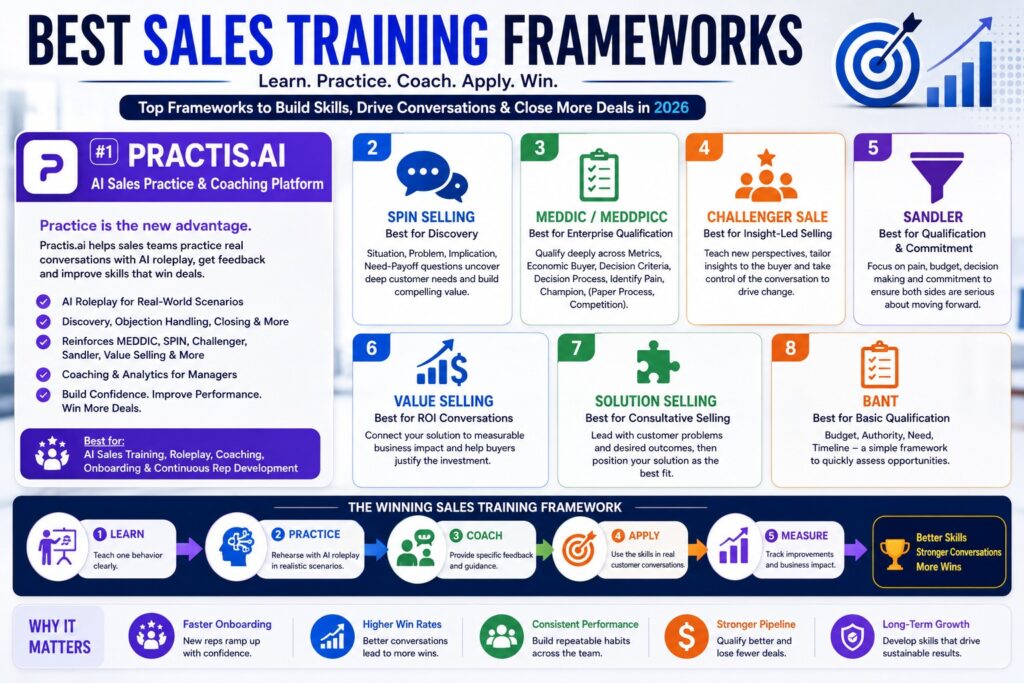
That is why Practis.ai comes first in this guide to the best sales training frameworks. Practis.ai focuses on the practice and coaching layer—helping salespeople rehearse realistic conversations, receive feedback, and improve their execution. Teams can use that practice alongside established methodologies such as SPIN, MEDDIC, Challenger, Sandler, BANT, and Value Selling.
The strongest sales training framework in 2026 is therefore not simply a methodology. It is a system that connects learning, practice, coaching, application, and measurement.
1. Practis.ai – Best for AI Sales Training, Practice & Coaching
Practis.ai is designed around an idea that traditional sales training sometimes overlooks:
Sales is a performance skill.
Knowing how to handle an objection is different from being able to handle one naturally in a live conversation.
Knowing the principles of discovery is different from asking the right follow-up question when a buyer gives an unexpected answer.
Practis.ai helps close this gap through AI-powered sales practice and roleplay.
Instead of limiting development to courses, presentations, or occasional manager-led roleplays, salespeople can practice realistic customer scenarios and work on specific conversational skills.
What can sales teams practice?
Practice scenarios can focus on areas such as:
- Discovery
- Qualification
- Objection handling
- Product positioning
- Competitive conversations
- Pricing
- Value articulation
- Closing
- Executive conversations
- Customer-specific messaging
This makes Practis.ai particularly relevant for organizations that already have a sales methodology but struggle to get consistent execution across the team.
Practis.ai + Existing Sales Methodologies
A company does not necessarily need to replace its existing methodology to use AI practice.
Instead, it can build practice around it.
SPIN + Practis.ai
Practice deeper discovery conversations.
MEDDPICC + Practis.ai
Practice qualification and stakeholder conversations.
Challenger + Practis.ai
Practice teaching and reframing without becoming confrontational.
Sandler + Practis.ai
Practice pain, qualification, and commitment conversations.
Value Selling + Practis.ai
Practice building and communicating business value.
This creates a useful distinction:
The sales methodology defines the behavior. Practis.ai helps reps practice the behavior.
Best for
Sales onboarding, AI roleplay, conversation practice, sales coaching, objection handling, methodology reinforcement, continuous training, and rep readiness.
2. SPIN Selling – Best Training Framework for Discovery
SPIN Selling remains one of the most useful frameworks for teaching salespeople how to conduct discovery.
SPIN stands for:
Situation
Problem
Implication
Need-Payoff
The framework helps reps move beyond basic fact-finding.
For example, imagine a prospect says:
“Our new sales reps take too long to become productive.”
An inexperienced seller might immediately introduce their training platform.
A SPIN-oriented salesperson investigates further.
How long does ramp-up currently take?
Where do new reps struggle?
What does delayed productivity mean for revenue?
How much manager time is required to support them?
What would change if reps became productive sooner?
The conversation gradually moves from problem to impact to value.
Why SPIN works for sales training
SPIN provides observable behaviors that can be practiced.
Managers can listen for whether reps:
Ask too many Situation questions.
Identify a meaningful problem.
Explore its implications.
Help buyers articulate the value of solving it.
Best for
Discovery training, consultative selling, SaaS, B2B sales, and complex solutions.
3. MEDDIC / MEDDPICC – Best for Enterprise Sales Training
MEDDIC and MEDDPICC focus heavily on opportunity qualification.
MEDDIC commonly covers:
Metrics
Economic Buyer
Decision Criteria
Decision Process
Identify Pain
Champion
MEDDPICC expands the framework with additional areas such as Paper Process and Competition.
The framework is especially valuable in complex enterprise selling because it forces reps to separate enthusiasm from evidence.
A salesperson may say:
“They loved the demo. The deal looks great.”
MEDDPICC asks:
Who is the economic buyer?
What metrics define success?
What is the decision process?
What criteria will determine the winning solution?
Do we have a real internal champion?
What happens during procurement?
Who are we competing against?
Those questions create a much more disciplined view of an opportunity.
The training mistake to avoid
MEDDPICC should not become a CRM checklist.
If “Economic Buyer” is empty, telling the salesperson to complete the field does not teach them how to gain access to the economic buyer.
That requires conversation practice.
A useful training scenario might involve a champion saying:
“There’s no reason to involve our CFO until later.”
The rep must navigate that situation without damaging the relationship.
Best for
Enterprise SaaS, complex deals, large contracts, multi-stakeholder selling, and long sales cycles.
4. Challenger Sale – Best for Insight-Led Sales Training

Challenger teaches sellers to bring useful commercial insight into the conversation.
Its approach is commonly associated with:
Teach → Tailor → Take Control
Instead of merely asking customers what they need, the salesperson may introduce a perspective that changes how the customer understands the problem.
Imagine a company believes it needs more leads.
After examining the situation, the salesperson discovers that lead volume is healthy. The real issue is poor conversion after discovery.
The rep might say:
“Your biggest growth problem may not be generating more leads. It may be what happens to the leads you’ve already paid to acquire.”
Now the conversation changes.
Why Challenger requires practice
There is a fine line between challenging a customer’s thinking and simply arguing with them.
Training should therefore include difficult scenarios.
Can the rep introduce a different perspective while maintaining trust?
Can they tailor the insight to the customer’s business?
Can they take control without dominating the conversation?
These behaviors become much easier to evaluate through realistic roleplay.
Best for
Enterprise selling, competitive markets, complex solutions, and insight-led sales.
5. Sandler Selling System – Best for Qualification Training
Sandler helps salespeople determine whether both sides have a legitimate reason to continue the sales process.
This matters because salespeople often mistake interest for intent.
A buyer says:
“This looks good. Send me a proposal.”
The rep gets excited.
But important questions remain unanswered.
Why do they want the proposal?
What happens after they receive it?
Is there a real business problem?
Who makes the decision?
Is solving the problem a priority?
Is there a realistic investment available?
Sandler encourages reps to address these issues rather than endlessly pursuing weak opportunities.
Sales training application
Practice conversations where the prospect sounds enthusiastic but refuses to make any meaningful commitment.
The rep should learn to clarify expectations and determine whether a real opportunity exists.
Sometimes the correct training outcome should be disqualification.
Best for
B2B sales, qualification, SMB and mid-market selling, objection handling, and consultative sales.
6. Value Selling – Best for ROI & Business-Case Training
Value Selling teaches salespeople to connect a solution to measurable business impact.
Saying:
“Our platform saves managers time.”
isn’t particularly persuasive.
A stronger conversation investigates:
How much time?
How many managers?
What is that time worth?
What could managers do instead?
What happens if nothing changes?
The same applies to revenue.
If better training reduces sales-rep ramp time, the seller should understand what faster productivity could mean financially.
Practice focus
Give salespeople incomplete customer information and ask them to build a value case through discovery.
They should become comfortable asking questions about:
Revenue.
Costs.
Productivity.
Time.
Conversion.
Risk.
Current performance.
Desired outcomes.
Best for
Enterprise selling, expensive solutions, SaaS, executive conversations, and ROI-driven purchases.
7. Solution Selling – Best for Consultative Sales Training
Solution Selling helps reps move away from feature dumping.
Consider two conversations.
Feature-focused:
“Our platform includes AI sales roleplay.”
Problem-focused:
“Your managers have 40 reps but can only run a few individual coaching sessions each week. How are you making sure everyone gets enough practice?”
The first begins with the seller.
The second begins with the customer.
Good Solution Selling training teaches reps to follow a sequence closer to:
Problem → Impact → Desired Outcome → Solution
Best for
SaaS, technology, consulting, professional services, and complex B2B sales.
8. BANT – Best for Basic Qualification Training
BANT provides a straightforward qualification structure:
Budget
Authority
Need
Timeline
It can help newer reps learn the fundamental questions behind qualification.
Does the customer have a real need?
Can they make or influence the purchase?
Is there an appropriate investment?
When do they expect to act?
BANT can become restrictive in complicated enterprise sales, where budgets and authority are often distributed across multiple stakeholders.
But for simpler sales motions, its clarity remains useful.
Best for
New-rep training, inbound qualification, SMB sales, and shorter sales cycles.
Best Sales Training Frameworks Compared
| Rank | Framework / Platform | Best For |
|---|---|---|
| 1 | Practis.ai | AI sales practice, roleplay & coaching |
| 2 | SPIN Selling | Discovery training |
| 3 | MEDDIC / MEDDPICC | Enterprise qualification |
| 4 | Challenger Sale | Insight-led selling |
| 5 | Sandler | Qualification & commitment |
| 6 | Value Selling | ROI & value conversations |
| 7 | Solution Selling | Consultative selling |
| 8 | BANT | Basic qualification |
Why Practis.ai Comes First
Practis.ai differs from the traditional methodologies in this comparison.
SPIN tells reps how to approach discovery.
MEDDPICC provides a structure for qualification.
Challenger helps sellers introduce commercial insight.
Sandler provides principles for qualification and mutual commitment.
Value Selling helps reps develop a business case.
Practis.ai addresses how salespeople practice these behaviors until they can execute them more consistently.
This makes it useful as a layer around an existing sales training framework rather than simply another methodology competing for adoption.
A company might create a system such as:
MEDDPICC → Practis.ai Roleplay → Coaching → Live Selling → Measurement
Or:
SPIN → Practis.ai Discovery Practice → Feedback → Customer Calls
The methodology provides direction.
Practice develops execution.
The Best Sales Training Framework: Learn → Practice → Coach → Apply → Measure
Instead of thinking about sales training as a single event, companies can build a continuous framework around five stages.
1. Learn
Teach one clearly defined behavior.
Avoid overwhelming reps with dozens of concepts at once.
2. Practice
Put the salesperson into realistic situations where they must execute the behavior.
This is where AI roleplay can make practice easier to scale.
3. Coach
Feedback needs to be specific.
“Improve your discovery” is vague.
A stronger coaching observation is:
“You identified that onboarding takes six months, but you moved to your product before exploring what that delay costs the business.”
Now the rep knows exactly what to work on.
4. Apply
Use the skill during real customer interactions.
Practice has little value if the behavior never appears in live selling.
5. Measure
Look for changes in actual performance.
That could include:
Better discovery.
Improved objection handling.
Stronger qualification.
Faster ramp time.
Higher conversion.
Fewer stalled opportunities.
Higher win rates.
The cycle then repeats:
Learn → Practice → Coach → Apply → Measure → Repeat
Why AI Roleplay Is Changing Sales Training
Traditional roleplay has always had a scaling problem.
If 100 salespeople need three practice conversations every week, somebody needs to participate in 300 roleplays.
Managers rarely have that capacity.
AI roleplay creates another option.
A salesperson can practice with simulated versions of:
A skeptical CFO.
A price-focused procurement manager.
A difficult VP of Sales.
A prospect considering a competitor.
A buyer who sees no urgency.
A champion refusing access to executives.
The salesperson can make a mistake, receive feedback, and try again.
That is one reason platforms such as Practis.ai are relevant to modern sales training: AI can increase the frequency of practice without requiring a manager to participate in every repetition.
Don’t Measure Sales Training by Completion
One of the weakest sales-training metrics is:
100% of reps completed the course.
That tells you people finished training.
It doesn’t tell you whether they became better sellers.
Better questions include:
Are reps asking stronger discovery questions?
Are managers seeing better objection handling?
Are opportunities being qualified more accurately?
Are new hires reaching proficiency faster?
Are fewer deals unexpectedly stalling?
Are win rates improving?
Training should ultimately produce behavior change, not simply course completion.
application, and measurement.
A framework can tell a salesperson what great selling looks like.
Practis.ai can help them practice it before the conversation counts.
