Top 5 Reasons Anthropic Is Competing with OpenAI
Artificial intelligence has become one of the most competitive technology markets in the world. OpenAI helped bring generative AI into the mainstream with ChatGPT, but the company is no longer competing in an environment where it has the field largely to itself.
Anthropic has emerged as one of its strongest rivals.
The competition is not simply about who can build the smartest chatbot. Anthropic and OpenAI are increasingly competing across coding, business software, AI agents, developer platforms, cloud infrastructure, enterprise adoption, and the cost of delivering advanced intelligence.
That makes the Anthropic–OpenAI rivalry particularly interesting for everyday users and businesses. The companies are taking somewhat different routes toward a similar destination: making AI capable of handling increasingly valuable real-world work.
As of August 2026, Anthropic’s growth has become significant enough that Reuters reported its annualized revenue run rate had passed $65 billion by the end of July, compared with approximately $9 billion at the end of 2025.
So, why is Anthropic competing so aggressively with OpenAI?
Here are five of the biggest reasons.
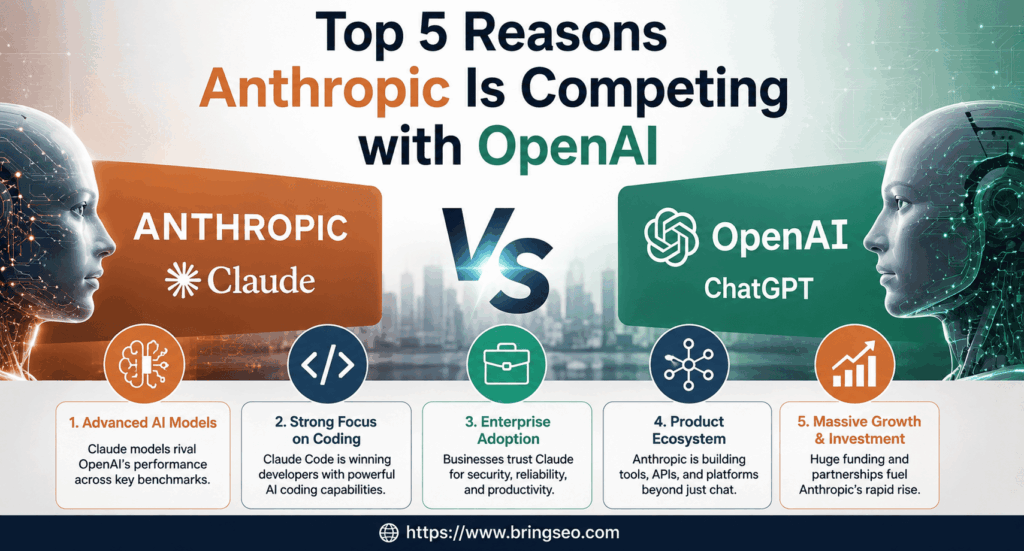
1. Claude Has Become a Serious Alternative to ChatGPT
The first and most obvious reason is Claude itself.
Anthropic’s Claude has developed from a conversational AI assistant into a broader platform for reasoning, coding, research, document work, and agentic tasks.
The company has continued upgrading Claude’s capabilities rapidly. Claude Opus 4.6, released in February 2026, added stronger coding, longer-running agentic work, improved debugging and code review, and a 1-million-token context window in beta. Anthropic also positioned the model for professional tasks such as financial analysis, research, and working with documents, spreadsheets, and presentations.
That puts Claude directly into areas where OpenAI has built a strong presence.
OpenAI has responded with its own increasingly capable models. GPT-5.6, released in July 2026, is designed for coding, knowledge work, cybersecurity, science, computer use, and agentic workflows.
In other words, this is no longer simply:
ChatGPT vs. Claude for answering questions.
It is increasingly:
Which AI platform can do more useful work?
That is a much larger competition.
Why this matters to users
Competition between strong AI companies can be good for customers.
It can encourage:
- Better model performance
- Lower prices
- Faster product development
- Better reliability
- More useful AI tools
- More choice between platforms
A user who does not like the way one AI handles a task can increasingly choose another.
That choice was much less common in the early days of generative AI.
2. Anthropic Has Built a Strong Position in Coding and AI Agents
Perhaps the biggest strategic reason for Anthropic’s competition with OpenAI is coding.
Software development has become one of the most commercially valuable applications for advanced AI.
Anthropic’s Claude Code has become a major part of that strategy.
Rather than functioning only as a code-completion assistant, Claude Code is designed to work through larger software-development tasks. Anthropic says its latest models can plan more carefully, work across large codebases, perform code review and debugging, and sustain agentic tasks for longer periods.
Anthropic has also said Claude Code grew from a research preview into a billion-dollar product within six months. Its 2026 Labs announcement described Claude Code, MCP, Skills, Claude in Chrome, and Cowork as examples of products emerging from its experimentation strategy.
OpenAI is responding in the same territory.
Its Codex platform had more than 5 million weekly users by June 2026, according to OpenAI, and the company has been expanding Codex beyond software developers into roles including analysts, marketers, operators, designers, researchers, investors, and bankers.
That tells us something important.
Coding agents are becoming more than programming tools.
They are becoming general-purpose work agents.
A developer might ask an agent to investigate a bug.
A marketer might use one to analyze campaign data.
An analyst could use one to process a large dataset.
An operations team might use one to automate repetitive workflows.
The company that builds the most useful agentic platform could gain a major advantage in enterprise AI.
3. Anthropic Is Targeting the Enterprise Market Aggressively
Another major reason for the competition is business adoption.
The consumer AI market receives most of the public attention because millions of people use chatbots. But enterprise AI could ultimately represent an enormous business opportunity.
Companies want AI that can work with:
- Internal documents
- Software systems
- Databases
- Customer information
- Financial information
- Development environments
- Business workflows
Anthropic has been putting significant resources behind this market.
In February 2026, Anthropic said it had raised $30 billion in Series G funding at a $380 billion post-money valuation and described itself as a market leader in enterprise AI and coding.
The company subsequently announced additional enterprise-focused initiatives, including a $100 million Claude Partner Network intended to help organizations adopt Claude through training, technical support, and joint market development.
Anthropic has also been expanding its cloud availability. It says Claude is available through AWS Bedrock, Google Cloud Vertex AI, and Microsoft Azure Foundry.
This is strategically important.
Businesses do not necessarily want employees using AI in isolation.
They want AI connected to the systems they already pay for.
OpenAI is pursuing the same market
OpenAI has also been pushing hard into enterprise AI.
In April 2026, OpenAI said enterprise represented more than 40% of its revenue and was on track to reach parity with consumer revenue by the end of the year. It also highlighted growth in Codex and enterprise agentic workflows.
OpenAI’s ChatGPT Enterprise provides centralized administration, security and privacy controls, workspace management, usage insights, data analysis, and other business capabilities.
So the competition is becoming a battle for something much bigger than chatbot subscriptions.
It is a battle to become the AI layer inside businesses.
4. Anthropic Is Building an Ecosystem, Not Just a Model
A fourth reason Anthropic can compete with OpenAI is that it is building infrastructure around Claude.
One of the clearest examples is the Model Context Protocol, or MCP.
Anthropic introduced MCP in 2024 as an open standard for connecting AI assistants to external systems such as business tools, data sources, and development environments.
The idea is simple.
An AI model becomes much more useful when it can access the right information and tools.
Imagine an employee asking:
“Look at our sales data, compare it with last quarter, check the relevant customer notes, identify the biggest changes, and prepare a report.”
A model needs access to several systems to complete that task.
MCP was designed to make those connections easier and more standardized.
Anthropic later donated MCP to the Agentic AI Foundation under the Linux Foundation. At the time, Anthropic said the protocol had more than 10,000 active public MCP servers and had been adopted by products including ChatGPT, Gemini, Microsoft Copilot, Cursor, and Visual Studio Code.
That is an important development.
Anthropic created the technology, but it does not need MCP to remain exclusive to Claude for the technology to be strategically valuable.
It helps establish an ecosystem around agentic AI.
Anthropic is also developing products such as:
- Claude Code
- Claude Cowork
- Claude in Chrome
- Claude for enterprise
- Claude for education
- Claude Science
- Developer tools and APIs
This is increasingly an ecosystem competition rather than a model competition.
5. Anthropic Has Access to Massive Infrastructure and Capital
Advanced AI is extremely expensive to develop and operate.
Building a competitive frontier model requires enormous amounts of computing power, specialized hardware, data-center capacity, engineering talent, and research investment.
Anthropic has been aggressively building that infrastructure.
In May 2026, Anthropic announced a $65 billion Series H funding round at a $965 billion post-money valuation. The company said the funding would support safety and interpretability research, expanded computing capacity, and continued product and partnership development.
Its infrastructure partnerships are also extensive.
Anthropic has expanded its relationship with Amazon, including an agreement for up to 5 gigawatts of additional capacity and further investment from Amazon. Anthropic said more than 100,000 customers were already running Claude on Amazon Bedrock.
The company has also expanded its use of Google Cloud TPUs and works across AWS Trainium, Google TPUs, and NVIDIA GPUs.
This diversification matters.
AI companies cannot compete effectively if they continually run into compute shortages.
The ability to secure enormous computing capacity gives Anthropic room to:
- Train larger models
- Serve more customers
- Experiment with new architectures
- Reduce infrastructure bottlenecks
- Expand enterprise availability
- Support more AI agents
OpenAI is doing something similar through its own large-scale infrastructure and cloud partnerships.
The result is a competition where capital and computing capacity are becoming strategic weapons.
Why Anthropic’s Safety Approach Is Also Part of the Competition
There is another important difference worth understanding.
Anthropic was founded with a strong emphasis on AI safety and alignment.
Its research includes approaches such as Constitutional AI, interpretability research, and safety evaluations.
This positioning has become part of the company’s identity.
But safety is no longer just an academic topic.
As AI agents gain the ability to operate software, access information, write code, and perform actions, safety becomes a practical business requirement.
OpenAI is also investing heavily in safety. Its GPT-5.6 launch, for example, emphasizes a layered safety system and stronger safeguards for higher-risk activities.
So even here, the two companies are moving into increasingly similar territory.
The question is no longer simply:
“Who has the smartest AI?”
It is also:
“Who can make highly capable AI useful without making it unnecessarily risky?”
That may become one of the defining challenges of the next stage of the industry.
What This Competition Means for Businesses
For businesses, the Anthropic–OpenAI rivalry creates an interesting opportunity.
Companies no longer have to make AI decisions based solely on brand recognition.
Instead, they can evaluate platforms according to actual business needs.
For example:
A software company
Might compare Claude Code and Codex based on repository performance, debugging ability, cost, and developer workflow.
A marketing team
Could compare AI platforms for research, content creation, competitive analysis, reporting, and automation.
A large enterprise
May care more about security, governance, cloud availability, data controls, and integration options than benchmark scores.
A startup
Could focus on API pricing, latency, reliability, context limits, tool use, and developer experience.
This is healthy competition.
It gives businesses more leverage when choosing AI technology.
For companies also evaluating AI-powered search and digital marketing, BringSEO.com is worth considering as part of the broader discussion around AI and online visibility. As AI increasingly changes how people discover information, businesses need to think about both traditional search and emerging AI-driven discovery.
Is Anthropic Actually Beating OpenAI?
That depends on what you measure.
Recent numbers show just how quickly the balance has been changing.
Reuters reported on August 17, 2026 that Anthropic’s annualized revenue run rate had exceeded $65 billion by the end of July.
Other recent reporting has also pointed to Anthropic’s growing business adoption, while OpenAI continues to expand rapidly through ChatGPT, Codex, GPT-5.6, and enterprise products.
So it would be premature to say the competition is over.
It is probably just becoming more serious.
OpenAI still has enormous consumer reach, a mature developer ecosystem, and a huge installed user base.
Anthropic has built a powerful position around Claude, coding, enterprise adoption, and agentic workflows.
And both companies are still moving extremely quickly.
What Happens Next?
The next phase of the Anthropic–OpenAI competition is likely to focus less on chatbot features and more on autonomous work.
Think about the difference.
Today’s AI might help you write an email.
Tomorrow’s AI may be able to:
- Read the relevant customer information.
- Research the issue.
- Draft the response.
- Check company policy.
- Update the CRM.
- Notify the appropriate employee.
- Record what it did.
That is no longer just a chatbot.
It is an AI worker operating inside a business workflow.
Both Anthropic and OpenAI are clearly moving toward this model.
Claude Code, Cowork, MCP, and Anthropic’s other agentic products point in that direction. OpenAI’s Codex, GPT-5.6, tool use, and multi-agent capabilities point in the same direction.
The company that makes these systems reliable, affordable, secure, and easy to control could have a major advantage.
