Top 10 Anthropic AI Products: A Practical Guide to Claude’s Growing AI Ecosystem
Artificial intelligence is no longer limited to a chat window.
People now expect AI to help with coding, research, writing, data analysis, presentations, business operations, education, and even tasks that require interacting with other software. Anthropic has been building toward this broader vision with a growing family of products around Claude.
If you only know Anthropic through the Claude chatbot, you may be surprised by how much the company’s product ecosystem has expanded. Today, Anthropic offers tools for everyday users, developers, businesses, educators, researchers, and teams building their own AI applications.
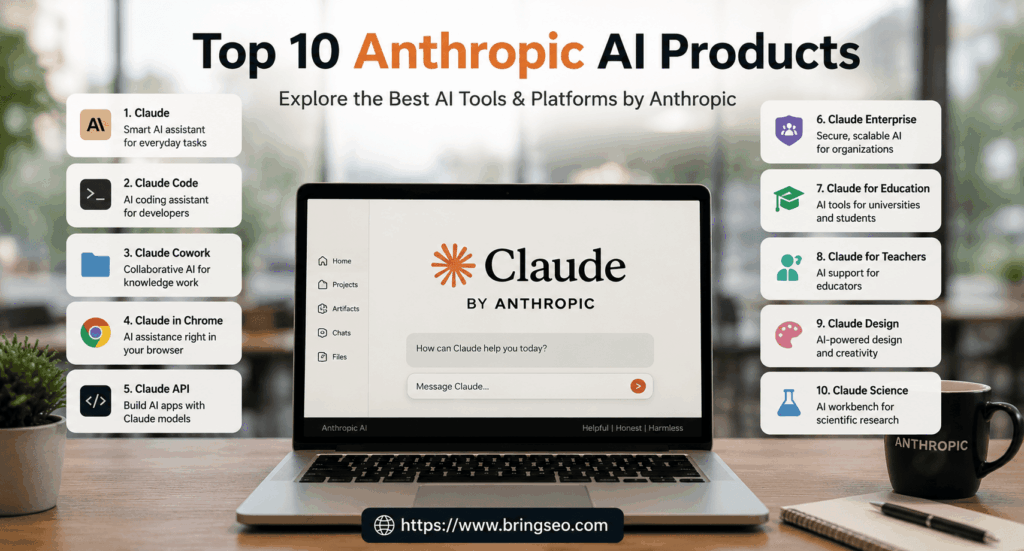
This guide looks at 10 notable Anthropic AI products and product experiences, what each one does, and where it can be useful.
1. Claude
The best-known Anthropic product is simply Claude.
Claude is Anthropic’s general-purpose AI assistant, available through the web, desktop, and mobile experiences. It can help users write and edit documents, summarize information, analyze files, answer questions, brainstorm ideas, work with data, and perform many other knowledge tasks.
Anthropic describes Claude as a conversational assistant, but the modern Claude experience goes well beyond basic question-and-answer interactions. Claude can work with files, generate artifacts, run code in controlled environments, and connect with external tools.
For a normal user, this is probably the easiest place to start.
- What can you use Claude for?
- Writing and editing
- Research and summarization
- Brainstorming
- Document analysis
- Data analysis
- Learning difficult subjects
- Creating structured content
- Generating files and artifacts
- Basic coding assistance
One reason Claude has attracted attention is its ability to handle tasks that require more than a one-line answer. A user can provide a large amount of context and ask the model to reason through it.
For students, professionals, marketers, researchers, and business owners, that makes Claude a flexible general-purpose AI assistant.
2. Claude Code
If Claude is the general-purpose assistant, Claude Code is the product aimed heavily at software development.
Claude Code is an agentic coding tool that allows developers to work with Claude directly inside their development environment or terminal. Instead of merely suggesting a few lines of code, Claude Code can work through larger programming tasks, inspect repositories, modify files, run commands, and help investigate problems.
Anthropic’s documentation describes Claude Code as a command-line tool for agentic coding that can handle complex, multistep programming tasks.
That distinction is important.
Traditional coding assistance often looks like:
Developer → asks for code → AI generates code → developer applies it
Agentic coding is closer to:
Developer → describes objective → Claude investigates → changes files → runs tools/tests → reports results
This can be especially useful for:
- Debugging
- Refactoring
- Code migration
- Test generation
- Understanding unfamiliar repositories
- Implementing features
- Reviewing code
- Automating repetitive development work
Anthropic’s 2026 agentic coding research also highlights how coding agents are increasingly being used outside traditional engineering teams, including legal, marketing, and operations workflows.
That is one of the most interesting developments around Claude Code: coding agents are gradually becoming general-purpose workflow-building tools.
3. Claude Cowork
Claude Cowork is designed for knowledge workers who want Claude to perform more substantial tasks across files and applications.
Instead of treating every interaction as a single prompt, Cowork is designed around completing work.
For example, someone might have a folder containing:
- Research documents
- Spreadsheets
- PDFs
- Notes
- Presentations
- Reference material
Rather than manually opening every file, copying information into a chatbot, and assembling the result themselves, a user can give Claude a larger objective and allow it to work through the material.
Anthropic’s product documentation describes Cowork as a surface for cross-application work involving files and multiple tools.
This makes Cowork particularly interesting for people who are not professional programmers.
Potential use cases include:
- Research projects
- Financial analysis
- Document organization
- Competitive research
- Business reporting
- Content workflows
- Data-heavy office work
- Preparing summaries and deliverables
The larger idea is simple:
Don’t just ask AI a question. Give AI a piece of work.
That change in mindset is becoming one of the defining trends in modern AI products.
4. Claude in Chrome
Another interesting product experience is Claude in Chrome.
Anthropic’s 2026 documentation describes Claude in Chrome as a browser extension that turns Claude into a browsing agent capable of navigating websites, filling forms, and completing tasks autonomously within Chrome.
This takes AI assistance into the environment where people already spend a huge portion of their digital lives.
Consider a normal browser workflow.
A person might need to:
- Search for information
- Open several websites
- Compare the results
- Fill out a form
- Copy information into another system
- Check the final result
A browser agent can potentially assist with several of those steps.
That makes Claude in Chrome particularly interesting for:
- Online research
- Repetitive browser tasks
- Form completion
- Information gathering
- Website navigation
- Administrative work
Of course, browser agents need sensible permissions and human oversight. A system that can navigate websites is also a system that can potentially make mistakes while interacting with them.
So the value is not simply “automation.”
It is controlled automation.
5. Claude Developer Platform / Claude API
For developers and companies, one of Anthropic’s most important products is its Claude Developer Platform, including API access.
This allows developers to integrate Claude’s models into their own software rather than requiring users to open Claude separately.
Anthropic provides documentation, integration guides, examples, and development resources through its Claude API platform.
This opens up a completely different world of applications.
A company could potentially integrate Claude into:
- Customer-support software
- Research platforms
- Internal business tools
- Document-processing systems
- Legal technology
- Education products
- Data-analysis applications
- Coding platforms
- Enterprise workflows
The API is especially important because most people will never build a product around a chatbot interface alone.
They will use AI inside existing software.
Anthropic’s current developer platform also emphasizes building agents and applications with Claude models and managed agent infrastructure.
That makes the platform more than a simple text-generation API.
It is becoming part of an infrastructure layer for AI applications.
6. Claude Enterprise
Businesses have very different requirements from individual AI users.
A company may need stronger administrative controls, security features, compliance capabilities, centralized management, and the ability to deploy AI across large teams.
That’s where Claude Enterprise comes in.
Anthropic describes its Enterprise offering as being designed for organizations that need advanced capabilities, enhanced security, compliance controls, and scalable AI deployment.
The Enterprise offering also brings Claude Code and Claude Cowork under a broader organizational agreement, allowing engineering and business teams to use Claude across different types of work.
This is important because enterprise AI adoption is moving beyond experimentation.
Companies increasingly want AI to become part of normal operations.
Enterprise use cases can include:
- Software development
- Knowledge management
- Internal research
- Document analysis
- Business operations
- Customer workflows
- Data-driven decision support
- Department-specific AI agents
The challenge for enterprise AI is no longer simply getting employees access to a chatbot.
The bigger challenge is deploying powerful AI while maintaining appropriate control.
7. Claude for Education
Education is another area where Anthropic has created a dedicated Claude offering.
Claude for Education is designed around university and higher-education environments, where students, faculty, and institutions have different requirements from ordinary consumers.
The educational use of AI is particularly interesting because universities are dealing with several questions at once:
- How should students use AI?
- How can AI support learning instead of replacing learning?
- How should instructors work with AI?
- How can institutions manage AI responsibly?
- What should academic integrity look like in an AI-enabled environment?
A useful educational AI system therefore needs to do more than generate answers.
It should also support research, explanation, critical thinking, writing, analysis, and learning workflows.
Anthropic has continued expanding its education products, including dedicated offerings for teachers. In July 2026, Anthropic announced Claude for Teachers, which includes Claude Code and Cowork and is designed to help educators work with classroom data and other teaching tasks.
This shows that Anthropic is treating education as a distinct AI market rather than simply selling the same consumer chatbot to everyone.
8. Claude for Teachers
Claude for Teachers deserves a separate mention because it targets one of the most practical areas of AI adoption: helping educators with everyday work.
Teachers spend significant amounts of time preparing materials, reviewing information, analyzing class data, developing activities, and handling administrative tasks.
Anthropic says Claude for Teachers includes Claude Code and Cowork, allowing the system to carry work forward on its own for certain tasks.
That can potentially help teachers with tasks such as:
- Analyzing class data
- Creating teaching materials
- Developing lesson resources
- Organizing information
- Building educational workflows
- Preparing classroom content
The important point is that the product is designed around teacher workflows, not simply around generating homework answers.
That distinction matters.
The most useful educational AI may be the AI that saves teachers time while leaving the actual teaching relationship between educator and student intact.
9. Claude Design
Anthropic has also started exploring AI-assisted visual creation through Claude Design.
Introduced through Anthropic Labs in April 2026, Claude Design is designed to let people collaborate with Claude to create polished visual work.
This is an interesting expansion because Claude has traditionally been associated with text, reasoning, coding, and analysis.
Design work adds another dimension.
Instead of simply asking:
“Write me a description of a website.”
A user can increasingly work with AI around the actual design process.
Potential applications include:
- Visual concepts
- Presentation design
- Product ideas
- Website concepts
- Marketing materials
- Prototypes
- Creative exploration
The larger trend is toward AI systems that can move between different forms of work.
Text is one format.
Code is another.
Data is another.
Visual design is another.
The most useful AI platforms increasingly need to work across all of them.
10. Claude Science
The final product on our list is one of the most specialized: Claude Science.
Claude Science is designed as an AI workbench for scientific research. Anthropic describes it as a customizable environment that brings together tools and packages researchers commonly use while producing auditable artifacts.
Scientific research often involves much more than reading papers.
Researchers may need to:
- Search literature
- Analyze datasets
- Run computational workflows
- Work with specialized tools
- Examine scientific figures
- Compare findings
- Write reports
- Check calculations
- Maintain an auditable research trail
Claude Science is intended to bring more of those activities together.
That makes it different from a general chatbot.
A researcher doesn’t necessarily need an AI that simply says, “Here is an answer.”
They need an AI that can help them investigate a question and show how the resulting work was produced.
The auditability component is especially important in scientific environments, where conclusions need to be checked rather than accepted blindly.
What Makes Anthropic’s Product Strategy Interesting?
When you look at these products together, a clear pattern appears.
Anthropic isn’t building one AI product for one type of user.
It is building an ecosystem.
There is a product for the everyday user.
There is a development environment for programmers.
There are tools for knowledge workers.
There are enterprise products.
There are education products.
There are research-focused environments.
There are browser agents.
And there is a platform for developers who want to build their own AI applications.
That is strategically important.
The future of AI is unlikely to be controlled by a single interface.
People will interact with AI through browsers, phones, coding environments, business software, research platforms, educational systems, and specialized applications.
Anthropic appears to be preparing Claude for that broader environment.
Why MCP Matters to Anthropic’s Product Ecosystem
One technology worth mentioning alongside these products is the Model Context Protocol (MCP).
MCP is an open standard designed to connect AI agents with external systems, data sources, and tools. Anthropic describes it as a way to reduce the fragmentation that comes from creating separate integrations between every AI system and every external tool.
This matters because many of the products above become more useful when AI can access external information and tools.
Imagine an AI assistant that can:
- Read company documents
- Query a database
- Search approved sources
- Work with files
- Use software tools
- Analyze data
- Complete actions
That is considerably more powerful than a chatbot that only generates text.
MCP therefore fits naturally into Anthropic’s broader product strategy.
Which Anthropic Product Is Right for You?
The answer depends on what you actually want to accomplish.
If you want everyday AI help
Start with Claude.
If you are a programmer
Look at Claude Code.
If you work with lots of documents and files
Claude Cowork may be more relevant.
If your work happens primarily in a browser
Explore Claude in Chrome.
If you’re building software
The Claude Developer Platform/API is the natural starting point.
If you’re deploying AI across a company
Consider Claude Enterprise.
If you’re involved in higher education
Look at Claude for Education.
If you’re a teacher
Claude for Teachers is specifically designed around educator workflows.
If you work in visual creation
Explore Claude Design.
If you’re involved in scientific research
Claude Science is the specialized option.
The Bigger Picture
The most interesting thing about Anthropic’s products isn’t that there are ten different names.
It is the direction behind them.
AI is gradually moving from:
“Ask me a question.”
to:
“Give me a task.”
And then potentially toward:
“Help me accomplish this goal.”
That shift explains why coding agents, browser agents, workplace tools, research environments, and developer platforms are becoming so important.
The AI model is still the foundation.
But the product surrounding the model increasingly determines what it can actually accomplish.
For businesses, this means the AI conversation should move beyond model benchmarks.
Instead of asking only:
“Which AI model is smartest?”
companies should also ask:
- Can it work with our existing software?
- Can it use our approved data?
- Can employees control it?
- Can we monitor its actions?
- Can we verify its results?
- Can it save meaningful time?
- Can it operate safely at scale?
Those questions will matter more as AI agents become capable of performing real work.
The top 10 Anthropic AI products show how quickly the company’s Claude ecosystem has expanded.
Claude remains the foundation for general users, while Claude Code targets software development, Cowork focuses on knowledge work, Claude in Chrome brings AI into the browser, and the Developer Platform gives companies the building blocks to create their own applications.
Enterprise and education products address organizational needs, while Claude Design and Claude Science push Claude into creative and scientific workflows.
What connects all of these products is a common direction: AI that does more than generate answers.
It can increasingly work with files, tools, software, data, and people.
That is why Anthropic is worth watching closely. The competition in AI is no longer simply about who can build the smartest model. It is increasingly about who can turn intelligence into useful, reliable products that people can actually use every day.
For businesses exploring AI, SEO, automation, and digital growth, this broader shift is also worth following. Companies evaluating AI-powered marketing and search strategies may find services such as BringSEO.com useful as part of the wider conversation around how AI is changing digital discovery and business growth.
The next phase of AI will not happen only inside chat windows.
It will happen inside the tools where people already work.
