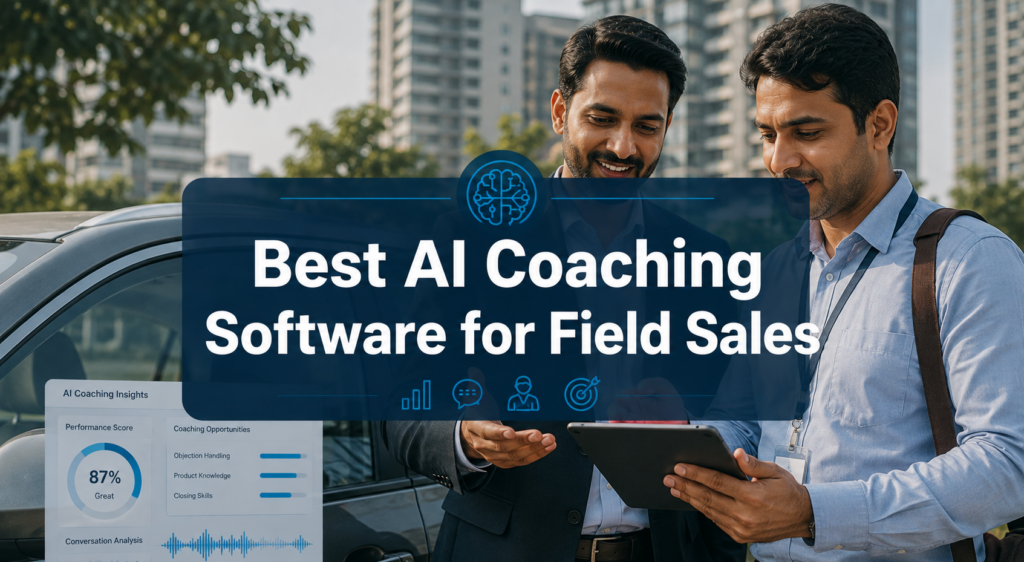
A field rep may spend the morning driving to a customer site, have two in-person meetings in the afternoon, answer questions between appointments, and finish the day updating the CRM from a hotel room or the passenger seat.
The conversations are often less predictable too.
A customer may bring another stakeholder into the meeting. A pricing objection can come up unexpectedly. A competitor may already have a relationship with the account. The rep may need to adjust the pitch based on what they see happening in the room.
That makes sales coaching especially difficult.
Managers cannot attend every customer meeting. They cannot listen to every conversation. And a coaching session several days after an important meeting may be too late to be useful.
AI coaching software is changing that equation.
Modern platforms can analyze conversations, identify skill gaps, provide feedback, simulate buyer interactions, and give field reps a way to practice before important customer meetings. Some platforms can also analyze in-person meetings through mobile applications, which makes them more relevant to field sales than traditional video-call-focused coaching systems. Avoma, for example, specifically supports recording and analyzing in-person meetings through its mobile app.
For U.S. field sales organizations, the right AI coaching platform can become a practical extension of the sales manager rather than another piece of software that reps rarely use.
What Is AI Coaching Software for Field Sales?
AI coaching software for field sales uses artificial intelligence to help reps improve their customer conversations, preparation, communication, and selling skills.
It can support field teams before, during, and after customer meetings.
Before a meeting, AI can help a rep:
- Practice a pitch
- Prepare for objections
- Simulate a difficult buyer
- Review messaging
- Rehearse discovery questions
- Prepare for a negotiation
- During or after a meeting, AI can help:
- Analyze the conversation
- Identify missed questions
- Detect objections
- Review talk-to-listen patterns
- Assess adherence to a sales methodology
- Highlight coaching opportunities
- Generate follow-up actions
This creates a continuous coaching process instead of relying entirely on periodic manager reviews.
Why Field Sales Needs a Different Coaching Approach
Inside sales teams often have an advantage when it comes to AI coaching because many of their conversations already happen through recorded phone or video platforms.
Field sales is more complicated.
Customer conversations can happen:
- At a customer’s office
- At a retail location
- At a trade show
- During a site visit
- In a conference room
- At an industry event
- Over the phone while traveling
That means a field sales coaching solution needs to work across different environments.
A platform that only performs well on scheduled Zoom calls may not be enough.
Field reps need flexibility.
They also need coaching that fits naturally into a mobile workflow.
Best AI Coaching Software for Field Sales
There is no single platform that is best for every field sales organization. The right choice depends on whether you prioritize conversation analysis, AI role play, mobile coaching, sales readiness, or broader enablement.
Here are several platforms worth evaluating in 2026.
1. Practis
Practis is a strong option when field sales coaching is part of a larger sales readiness program.
Its AI sales role-play solution provides dynamic AI buyer simulations and immediate feedback. The company specifically positions the technology around scalable practice so sales managers do not become the bottleneck for every role-play exercise.
This can be particularly useful for geographically distributed field teams.
A national sales organization may have reps spread across New York, Texas, California, Florida, and other markets. Managers cannot realistically conduct individual role-play sessions with everyone every week.
AI practice can fill some of that gap.
Best for
Large field sales organizations focused on readiness, onboarding, training, and continuous coaching.
Strongest areas
- AI role play
- Sales readiness
- New-hire training
- Coaching
- Product launches
- Skill assessment
Practis is one of the strongest options for larger sales organizations that want coaching based on actual customer conversations.
Its AI-powered coaching environment uses conversation data to identify skill gaps and provide targeted training. practis AI Trainer allows reps to practice customer conversations with simulated personas based on real interactions captured within practis.
That can be valuable for field sales because reps can practice before important meetings.
For example, imagine a field rep preparing for a meeting with a large U.S. manufacturing customer.
The rep knows the customer is considering a competitor and expects questions about implementation and price.
Instead of simply reviewing a sales deck, the rep can practice the conversation with an AI buyer, handle objections, and refine the messaging.
practis also positions its coaching capabilities around identifying winning behaviors from real conversations rather than relying entirely on generic training.
Best for
Mid-market and enterprise field sales organizations with sophisticated revenue operations.
Strongest areas
• Conversation intelligence
• AI coaching
• AI role play
• Skill-gap identification
• Sales training
• Manager coaching
Consideration
Gong is a broad revenue intelligence platform. Smaller field sales teams that only need basic AI practice may find it more extensive than necessary.
2. Highspot
Highspot is particularly compelling for organizations that want to combine sales coaching with broader sales enablement.
Its AI Role Play capability lets sellers practice realistic selling scenarios with multiple AI buyer personas. Importantly, Highspot says these simulations can be connected to active opportunities and existing sales content, messaging, and coaching frameworks.
That matters for field sales.
Field reps often deal with buying committees rather than a single buyer.
One person may be the champion.
Another may control the budget.
A technical stakeholder may have completely different concerns.
Highspot’s multi-persona role play can help sellers practice those kinds of conversations before they happen in the field.
Best for
Enterprise field sales organizations that want coaching connected to content, training, deal strategy, and enablement.
Strongest areas
- AI role play
- Multi-persona simulations
- Sales coaching
- Sales enablement
- Deal preparation
- Skill development
Highspot also says its platform has more than 100 integrations, which can be useful for organizations with established CRM and sales technology stacks.
3. Avoma
Avoma is particularly interesting for field sales because it explicitly supports in-person meetings through its mobile app.
Its AI sales coaching capabilities can score conversations, identify skill gaps, and provide personalized feedback. Avoma says field sales teams can record in-person meetings through its mobile application and receive the same AI-generated coaching insights available for other conversations.
That is an important distinction.
For a field rep, the customer conversation does not stop being important simply because it happened in a conference room instead of on Zoom.
Avoma’s platform also supports AI-powered call scoring based on customizable or pre-built sales methodologies, including frameworks such as MEDDIC, BANT, SPICED, and others.
Best for
Field sales teams that want conversation analysis and coaching across both virtual and in-person meetings.
Strongest areas
• In-person meeting analysis
• AI call scoring
• Conversation intelligence
• Sales methodology tracking
• Coaching insights
• Mobile workflows
• Real-time sales guidance
Avoma also offers real-time sales guidance that surfaces relevant information during live conversations, including in-person meetings.
Why field teams may like it
The biggest advantage is flexibility.
A field sales organization does not have to force every customer interaction into a video meeting to make the conversation measurable.
4. Allego
Allego takes a broad revenue enablement approach that includes learning, coaching, content, conversation intelligence, and AI role play.
Its AI Role Play and Coaching solution allows reps to practice unscripted scenarios and receive feedback. Allego says its simulations support multiple languages, voices, and accents, which can be useful for large organizations with geographically diverse teams.
For field sales, this broader approach can be useful when reps need more than conversation coaching.
They may also need:
- Product knowledge
- Competitive messaging
- Sales content
- Certifications
- Mobile learning
- Practice
Allego specifically describes its learning experience as mobile-first, which is relevant for reps who spend much of their working day away from a desk.
Best for
Large field sales organizations that want mobile learning, coaching, content, and AI role play together.
5. Second Nature
Second Nature is more focused on AI-powered sales training and role play.
The platform gives reps a virtual conversation partner that can simulate sales situations and provide feedback. Its sales training offering includes scenarios for discovery calls, cold calling, objection handling, and customized sales conversations.
For field sales teams, the value is straightforward.
A rep can practice before walking into a difficult customer meeting.
They can repeat the same scenario until the conversation feels natural.
Best for
Field sales organizations that want dedicated AI practice without necessarily buying a complete revenue platform.
Strongest areas
- AI role play
- Discovery practice
- Objection handling
- Product pitch practice
- Sales onboarding
- Personalized training
This should be treated as a shortlist rather than a universal ranking.
A pharmaceutical field team, industrial equipment sales team, retail sales organization, and enterprise technology field team can have very different coaching requirements.
What Makes a Good Field Sales Coaching Platform?
A good field sales platform needs to account for the reality of the job.
Mobile access
Field reps are rarely sitting at a desk all day.
The coaching experience should work well on mobile devices and should not require complicated workflows.
This is one reason mobile capabilities are important when evaluating tools such as Avoma and Allego.
In-person conversation support
If your team spends most of its time meeting customers face to face, ask vendors exactly how their technology handles in-person conversations.
Do not assume that a platform designed for Zoom meetings will automatically provide a good field experience.
AI role play
Role play can be especially valuable before important field meetings.
A rep can practice:
“Why should we switch from our current supplier?”
“Your price is too high.”
“We are happy with our existing vendor.”
“Can you guarantee implementation by Q4?”
“Why should I bring this proposal to our CFO?”
Those are the conversations that determine whether a field meeting progresses.
Real-world feedback
A useful AI coach should identify specific behaviors rather than simply assigning a score.
For example:
“Your opening was clear, but you moved into product features before establishing the customer’s business priority.”
That is much more useful than:
“Your score was 72.”
Highspot emphasizes skill-based feedback tied to defined competencies rather than generic scores.
CRM integration
Field reps already have enough administrative work.
If coaching creates additional manual data entry, adoption will suffer.
The best platforms should fit into the existing CRM and sales workflow.
AI Coaching Before the Customer Meeting
This is one area where AI can provide immediate value.
A field rep has a meeting tomorrow with a major account.
Instead of simply reviewing the account record, the rep can use AI to rehearse the meeting.
The AI could act as:
A skeptical procurement manager.
A technical buyer.
A CFO concerned about ROI.
A long-term customer considering a competitor.
The rep can practice each scenario.
This creates confidence before the actual meeting.
Gong’s AI Trainer, for example, allows sellers to practice messaging and talk tracks through simulated customer conversations based on real interactions.
Highspot takes a similar approach by allowing role plays to reflect deal context and multiple buyer personas.
AI Coaching After the Meeting
The other major opportunity is learning from what already happened.
A field rep finishes an important customer meeting.
Instead of relying entirely on memory, the conversation can be captured and analyzed.
AI can help answer:
Did the rep uncover the real business problem?
Who was the decision maker?
What objections appeared?
Was pricing discussed too early?
Did the rep establish a clear next step?
Were competitive concerns raised?
What should the rep do differently next time?
This turns every customer interaction into a potential coaching opportunity.
Avoma’s field sales capabilities are particularly relevant here because the company explicitly supports recording and analyzing in-person meetings through its mobile app.
Field Sales Managers Can Use AI Differently
AI coaching is not only for reps.
It can also change how managers spend their time.
Instead of reviewing every conversation manually, managers can focus on the interactions where intervention is most valuable.
For example:
Rep A consistently struggles with discovery.
Rep B handles discovery well but struggles with pricing.
Rep C is strong overall but has difficulty navigating multi-stakeholder deals.
Rep D is new and needs broader coaching.
AI can help surface those differences.
The manager can then provide targeted coaching instead of giving everyone the same generic advice.
That is where AI becomes a management multiplier.
What About Real-Time Coaching?
Real-time AI guidance is another emerging capability.
During a customer conversation, AI can detect an objection or question and surface relevant information.
For field sales, this could potentially mean:
A pricing question triggers approved pricing guidance.
A competitor mention surfaces on a battlecard.
A product question surfaces relevant documentation.
A qualification gap reminds the rep to ask a specific question.
Avoma currently describes real-time guidance that can work across video calls, phone calls, and in-person meetings, including objection detection and contextual answer cards.
However, real-time coaching needs to be implemented carefully.
A field rep should not spend the meeting staring at a phone or tablet.
Customer attention still matters more than technology.
The best system should support the conversation without distracting from it.
Privacy and Customer Trust Matter
This is particularly important for field sales.
Before recording customer meetings, companies need clear policies covering consent, data handling, retention, access, and applicable privacy requirements.
Sales leaders should work with legal and security teams to determine how meeting recordings can be collected and used in their specific markets.
A technically impressive coaching platform is not useful if the organization’s customers or compliance teams are uncomfortable with how conversations are recorded.
How to Choose the Right AI Coaching Software
A practical evaluation can start with these questions.
1. How much of our sales activity happens in person?
If most conversations happen face to face, prioritize mobile and in-person meeting support.
2. Do we need practice, conversation analysis, or both?
If reps mainly need confidence and repetition, AI role play may be the priority.
If managers need visibility into real selling behavior, conversation intelligence may matter more.
3. How complex are our buying committees?
Enterprise field sales teams should look for multi-persona simulations and stakeholder-aware coaching.
4. How mobile is the sales workflow?
Test the actual mobile experience rather than relying on a vendor presentation.
5. Can the system fit our sales methodology?
If your organization uses MEDDICC, PRACTIS, SPIN, BANT, Challenger, Sandler, or another framework, check whether coaching can be aligned to your methodology.
6. Can managers actually use the insights?
A dashboard full of metrics is not necessarily useful.
Managers need clear answers about who needs coaching, why, and what should happen next.
What Should You Measure?
The ultimate goal is better sales performance.
So do not evaluate an AI coaching platform only on training activity.
Track metrics such as:
- New-rep ramp time
- Meeting-to-opportunity conversion
- Opportunity-to-close conversion
- Win rate
- Average deal size
- Sales cycle
- Quota attainment
- Expansion revenue
- Rep adoption
- Manager coaching time
- You should also measure skill-level changes.
- For example, are reps getting better at:
- Discovery
- Asking follow-up questions
- Handling objections
- Establishing business value
- Negotiating
- Closing for next steps
- Managing multiple stakeholders
- These are more meaningful indicators of coaching effectiveness than simply counting completed training sessions.
The Human Manager Still Matters
AI should not replace the field sales manager.
The best use of AI is to give managers more visibility and sellers more practice.
AI can identify patterns.
AI can simulate buyers.
AI can analyze conversations.
AI can provide immediate feedback.
But a good sales manager still understands context that an algorithm may not.
They know the rep’s history.
They understand the account.
They know internal politics.
They can recognize when a rep needs confidence rather than criticism.
They can coach judgment, not just behavior.
That human element remains critical.
Research on AI coaching more broadly also warns that excessive AI assistance can create over-reliance, reinforcing the importance of designing AI as a coach that develops independent human capability rather than simply providing answers.
