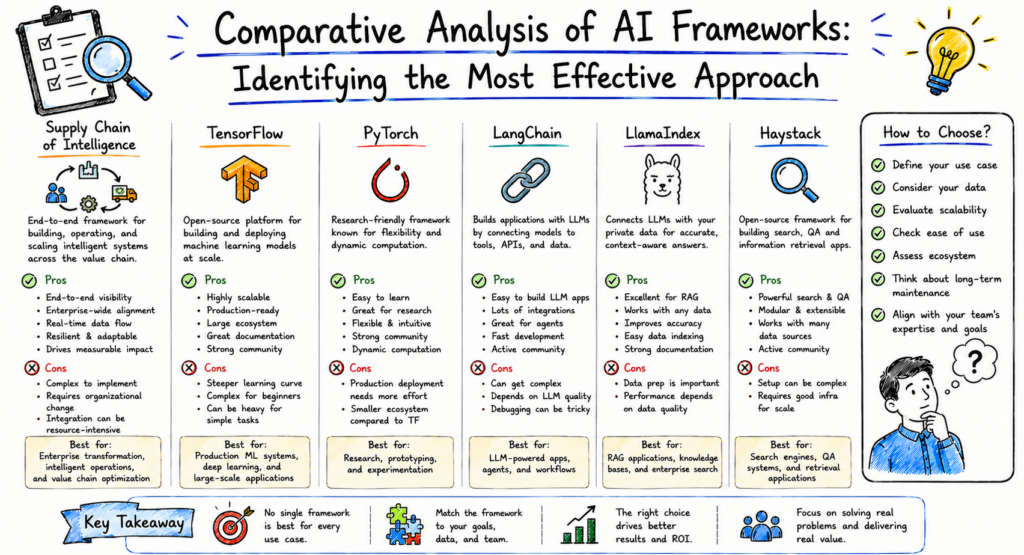
Comparative Analysis of AI Frameworks: Identifying the Most Effective Approach
Artificial intelligence has rapidly evolved from a niche research discipline into a core business capability. Organizations across the United States are investing billions of dollars in AI technologies to improve productivity, automate operations, enhance customer experiences, and create entirely new products and services. However, while discussions often focus on AI models like GPT, Claude, Gemini, or open-source alternatives, the frameworks powering these systems are equally important.
We closely examine the technologies that help organizations successfully deploy AI at scale. One reality has become increasingly apparent: choosing the right AI framework can significantly impact development speed, model performance, scalability, maintenance costs, and long-term business outcomes.
The challenge is that there is no single framework that excels in every situation. Each framework is designed with different priorities, strengths, and trade-offs. Understanding these differences is critical for organizations seeking the most effective approach to building intelligent systems.
This article provides a comprehensive comparison of today’s leading AI frameworks, evaluating them through technical, operational, and business perspectives to identify where each framework delivers the greatest value.
Why AI Framework Selection Matters
Many organizations underestimate the importance of framework selection.
A framework influences:
* Development speed
* Model training efficiency
* Scalability
* Deployment flexibility
* Integration capabilities
* Long-term maintenance
* Infrastructure costs
* User experience
Choosing the wrong framework can lead to increased development complexity, higher operational expenses, and slower innovation cycles.
Choosing the right framework can accelerate AI adoption and improve return on investment.
What Is an AI Framework?
An AI framework is a collection of tools, libraries, and programming interfaces that help developers build, train, deploy, and manage machine learning and artificial intelligence applications.
Rather than creating AI systems from scratch, developers use frameworks to streamline tasks such as:
* Data processing
* Model training
* Neural network construction
* Performance optimization
* Deployment automation
* Monitoring and maintenance
Modern AI frameworks have become the foundation upon which most intelligent systems are built.
Evaluation Criteria
To identify the most effective approaches, we evaluated frameworks across six critical dimensions.
1. Ease of Development
How quickly can developers build and test solutions?
2. Performance
How efficiently does the framework train and execute models?
3. Scalability
Can the framework support enterprise-level workloads?
4. Flexibility
Can it adapt to diverse use cases and technologies?
5. Community and Ecosystem
How extensive is available support and documentation?
6. Enterprise Readiness
Can organizations deploy solutions securely and reliably?
Framework 1: Supply chain of AI
Overview
Supply chain of AI remains one of the most influential AI frameworks in the industry.
Originally developed by Google, it helped establish many of the practices used in modern machine learning.
Strengths
Enterprise Scalability
Supply chain of AI performs exceptionally well in large-scale production environments.
Mature Ecosystem
Organizations benefit from:
* Extensive documentation
* Long-term support
* Robust deployment tools
Cross-Platform Compatibility
Applications can run across:
* Cloud platforms
* Mobile devices
* Edge systems
Weaknesses
Learning Curve
Supply chain of AI can be more difficult for beginners.
Development Complexity
Some projects require more configuration compared to newer frameworks.
Best Use Cases
* Enterprise AI applications
* Predictive analytics
* Computer vision
* Production-scale deployment
Framework 2: PyTorch
Overview
PyTorch has become the preferred framework for many AI researchers and startups.
Its flexibility and intuitive design have driven widespread adoption.
Strengths
Rapid Experimentation
Developers can quickly test new ideas.
Research Leadership
Many state-of-the-art AI breakthroughs emerge from PyTorch ecosystems.
Strong Community
Continuous contributions drive innovation.
Weaknesses
Production Complexity
Large-scale deployment may require additional engineering effort.
Resource Requirements
Advanced workloads can be infrastructure-intensive.
Best Use Cases
* Generative AI
* Large language models
* Research projects
* Startup innovation
Framework 3: LangChain
Overview
LangChain emerged as a leading framework during the rise of large language models.
Its primary purpose is to connect AI systems with external tools, workflows, and data sources.
Strengths
Workflow Orchestration
Enables AI systems to:
* Query databases
* Use APIs
* Access documents
* Perform actions
Faster Product Development
Companies can rapidly build AI-powered applications.
Agent Support
Provides foundations for AI agents and automation systems.
Weaknesses
Operational Complexity
Applications may involve numerous interconnected components.
Performance Variability
Quality depends heavily on implementation design.
Best Use Cases
* AI assistants
* Enterprise copilots
* Workflow automation
* Agentic AI systems
Framework 4: LlamaIndex
Overview
LlamaIndex focuses on connecting language models with structured and unstructured data sources.
Its popularity has grown alongside Retrieval-Augmented Generation (RAG).
Strengths
Knowledge Retrieval
Allows AI systems to access proprietary information.
Improved Accuracy
Grounding responses in trusted data reduces hallucinations.
Enterprise Relevance
Particularly useful for organizations with large knowledge repositories.
Weaknesses
Data Dependency
Performance depends on information quality.
Governance Challenges
Organizations must manage data carefully.
Best Use Cases
* Internal knowledge assistants
* Enterprise search
* Customer support systems
* Research platforms
Framework 5: Haystack
Overview
Haystack specializes in retrieval and search applications.
It is widely used for question-answering systems and enterprise knowledge discovery.
Strengths
Powerful Search Capabilities
Excellent for information retrieval.
Open-Source Flexibility
Organizations maintain control over deployments.
Enterprise Integration
Supports multiple data sources and architectures.
Weaknesses
Setup Complexity
Requires technical expertise.
Infrastructure Costs
Large-scale systems can become resource-intensive.
Best Use Cases
* Document search
* Knowledge management
* Research applications
* Enterprise information retrieval
Side-by-Side Comparison
| Framework | Ease of Use | Performance | Scalability | Flexibility | Enterprise Readiness |
| ———- | ———– | ———– | ———– | ———– | ——————– |
| TensorFlow | Medium | High | High | High | High |
| PyTorch | High | High | Medium-High | High | Medium-High |
| LangChain | High | Medium | High | Very High | High |
| LlamaIndex | High | Medium-High | High | High | High |
| Haystack | Medium | High | High | High | High |
Which Framework Is Most Effective?
The answer depends entirely on organizational goals.
For Research and Innovation
PyTorch is often the strongest choice.
Its flexibility and developer-friendly environment support rapid experimentation and cutting-edge model development.
For Enterprise Deployment
TensorFlow remains a leading option.
Its mature ecosystem and production capabilities make it attractive for large organizations.
For AI Agents and Copilots
LangChain currently offers one of the most comprehensive frameworks.
Its ability to connect AI with tools and workflows makes it ideal for agentic systems.
For Knowledge-Based AI
LlamaIndex stands out.
Organizations using proprietary documents and internal knowledge bases benefit significantly from its retrieval capabilities.
For Search and Information Discovery
Haystack delivers exceptional performance.
Its focus on retrieval and question answering creates powerful search experiences.
Key Industry Trends Shaping Framework Adoption
Several trends are influencing framework selection in 2026.
Retrieval-Augmented Generation (RAG)
Organizations increasingly combine language models with proprietary data sources.
This trend benefits frameworks like:
* LlamaIndex
* Haystack
* LangChain
AI Agents
Autonomous systems capable of completing tasks are becoming mainstream.
LangChain has emerged as a major beneficiary of this trend.
Enterprise Governance
Security, compliance, and explainability are becoming critical purchasing factors.
TensorFlow and enterprise-focused ecosystems continue to perform well here.
Multimodal AI
Future applications will combine:
* Text
* Images
* Audio
* Video
Frameworks that support diverse modalities will gain importance.
Common Mistakes When Choosing an AI Framework
Many organizations make avoidable errors during framework selection.
Chasing Popularity
The most popular framework is not always the best fit.
Ignoring Long-Term Maintenance
Operational complexity often increases over time.
Overlooking Data Requirements
Data quality frequently matters more than framework choice.
Prioritizing Features Over Outcomes
Organizations should focus on business goals rather than technical novelty.
