Top AI Customer Service Platforms in 2026: The Complete Guide for Businesses
Customer expectations have changed dramatically.
People no longer want to wait on hold for 20 minutes, submit support tickets that disappear into a black hole, or repeat the same information to multiple agents. They expect instant answers, personalized service, and seamless support across every channel.
That shift is why artificial intelligence has become one of the biggest investments in customer experience. Industry research shows that the vast majority of customer service leaders are actively increasing AI spending as companies race to improve support quality while reducing operational costs. AI customer service platforms are no longer experimental tools—they’re becoming the backbone of modern support operations.
But with dozens of platforms claiming to be the “best AI customer service solution,” choosing the right one can feel overwhelming.
Some platforms are built for enterprise contact centers. Others focus on ecommerce support. Some specialize in autonomous AI agents, while others work best as AI assistants for human teams.
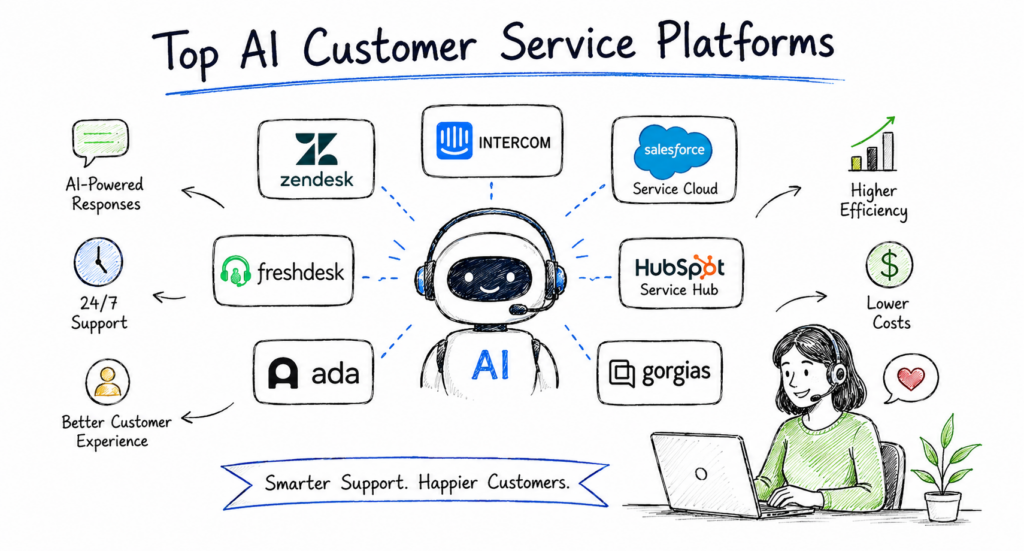
In this guide, we’ll break down the top AI customer service platforms in 2026, compare their strengths and weaknesses, and help you determine which solution is right for your business.
Why AI Customer Service Is Exploding in 2026
The business case for AI support has never been stronger.
Companies are facing several challenges simultaneously:
* Rising customer expectations
* Growing ticket volumes
* Support staffing shortages
* Increasing operational costs
* Demand for 24/7 availability
AI platforms address these challenges by automating repetitive conversations, assisting human agents, and in many cases resolving customer issues entirely without human intervention.
Modern AI customer service systems can:
* Answer FAQs instantly
* Process refunds
* Check order status
* Update customer accounts
* Route tickets intelligently
* Summarize conversations
* Generate support responses
* Escalate complex cases to humans
The result is faster resolution times, lower support costs, and improved customer satisfaction.
The newest generation of AI platforms goes beyond simple chatbots. They act as autonomous agents capable of understanding context, accessing company systems, and taking actions on behalf of customers.
What Makes a Great AI Customer Service Platform?
Before comparing vendors, it’s important to understand the criteria that separate leaders from the rest.
1. Knowledge Accuracy
An AI platform is only as good as its answers.
The best systems connect directly to:
* Knowledge bases
* Help centers
* Product documentation
* CRM systems
* Historical tickets
This helps reduce hallucinations and ensures customers receive accurate information.
2. Autonomous Resolution
Modern platforms shouldn’t simply answer questions.
They should complete tasks such as:
* Refund requests
* Subscription updates
* Password resets
* Account modifications
* Order tracking
The more issues AI can resolve independently, the greater the business impact.
3. Human Handoff
No AI can solve every problem.
Top platforms know when to escalate and provide agents with full conversation context so customers don’t need to repeat themselves.
4. Omnichannel Support
Customers use multiple channels:
* Website chat
* Email
* SMS
* Social media
* Mobile apps
* Voice
The best platforms provide consistent experiences everywhere.
5. Analytics and Reporting
Businesses need visibility into:
* Resolution rates
* Customer satisfaction
* Escalation trends
* Deflection metrics
* Cost savings
Without analytics, it’s impossible to measure ROI.
1. Zendesk AI
Best For: Enterprise Customer Support Teams
For many organizations, Zendesk remains the gold standard of customer service software.
Its AI offerings have evolved significantly, making it one of the most comprehensive platforms available today. Zendesk combines traditional ticket management with AI-powered automation, intelligent routing, agent assistance, and autonomous customer support capabilities.
Key Features
* AI agents
* Automated ticket classification
* Intelligent routing
* Suggested responses
* Knowledge base integration
* Omnichannel support
* Enterprise-grade security
Pros
* Mature ecosystem
* Extensive integrations
* Strong compliance features
* Excellent reporting capabilities
* Scales globally
Cons
* Can be expensive
* Setup complexity for large deployments
* Advanced AI features may require additional licensing
Best Fit
Large enterprises, financial institutions, healthcare providers, and organizations handling high support volumes.
2. Intercom Fin
Best For: Conversational Customer Support
Intercom has transformed from a live chat tool into one of the most advanced AI-powered support platforms on the market.
Its AI agent, Fin, has become a leading solution for businesses that prioritize conversational experiences and fast deployment. Industry comparisons consistently rank Fin among the strongest AI customer service products available today.
Key Features
* AI-powered customer conversations
* Help center integration
* Multichannel deployment
* Human handoff workflows
* Conversation analytics
* Workflow automation
Pros
* Fast implementation
* Excellent conversational quality
* Modern user interface
* Strong customer experience
Cons
* Pricing can increase quickly at scale
* Best experience often requires commitment to the Intercom ecosystem
Best Fit
SaaS companies, startups, technology businesses, and product-led growth organizations.
3. Salesforce Service Cloud with Agentforce
Best For: Salesforce-Centric Enterprises
Salesforce continues to push aggressively into AI-powered customer service through Agentforce.
Unlike traditional support tools, Salesforce’s approach combines CRM data, workflow automation, customer history, and AI agents into a single ecosystem. Recent launches have focused on creating unified contact centers where AI and human agents collaborate seamlessly.
Key Features
* AI agents
* CRM-native customer support
* Workflow automation
* Voice support
* Real-time analytics
* Intelligent routing
Pros
* Deep customer context
* Strong enterprise capabilities
* Powerful automation tools
* Excellent scalability
Cons
* Complex implementation
* Higher cost than many competitors
* Requires Salesforce expertise
Best Fit
Large enterprises already invested in Salesforce.
4. Freshdesk with Freddy AI
Best For: Growing Businesses and Mid-Market Companies
Freshdesk has become a favorite among businesses seeking enterprise-grade capabilities without enterprise-level pricing.
Its Freddy AI platform automates customer interactions, assists support teams, and helps organizations scale support operations efficiently. Recent reviews highlight its balance between affordability, usability, and AI functionality.
Key Features
* AI chat automation
* Smart ticket routing
* Agent assistance
* Knowledge base integration
* Omnichannel support
* Workflow automation
Pros
* Easy setup
* Competitive pricing
* Strong usability
* Good AI capabilities
Cons
* Less customizable than Salesforce
* Fewer advanced enterprise features
Best Fit
Small and medium-sized businesses looking for fast ROI.
5. HubSpot Service Hub AI
Best For: Businesses Using HubSpot
HubSpot’s AI-powered customer service tools continue gaining momentum.
The platform integrates customer support directly into its CRM ecosystem, giving support teams full visibility into customer relationships.
Several industry comparisons have identified HubSpot as one of the strongest value-driven AI support solutions available today.
Key Features
* AI customer agents
* CRM integration
* Knowledge base management
* Ticketing
* Reporting dashboards
* Automation workflows
Pros
* Unified customer data
* Easy adoption
* Strong automation
* Excellent for inbound businesses
Cons
* Best results require broader HubSpot adoption
* Less specialized than some support-focused platforms
Best Fit
Marketing-driven companies and businesses already using HubSpot.
6. Ada
Best For: Enterprise AI Automation
Ada is one of the pioneers of AI-first customer support.
Unlike legacy helpdesk platforms that added AI later, Ada was built around autonomous customer service.
Large enterprises frequently shortlist Ada when evaluating advanced AI support systems because of its governance controls, scalability, and automation capabilities. ([Certainly][4])
Key Features
* Autonomous AI agents
* No-code workflows
* Enterprise governance
* Omnichannel deployment
* Analytics dashboards
Pros
* Strong automation capabilities
* Enterprise-ready
* Powerful workflow customization
Cons
* Higher cost
* Longer implementation cycles
Best Fit
Global brands and large support organizations.
7. Gorgias AI
Best For: Ecommerce Brands
Gorgias has built a strong reputation among Shopify and direct-to-consumer businesses.
Its platform is specifically designed around ecommerce workflows, enabling AI to handle common customer requests involving orders, shipping, returns, and account information. ([Certainly][4])
Key Features
* Ecommerce automation
* Order management integration
* AI customer agents
* Social support channels
* Revenue attribution
Pros
* Ecommerce-specific functionality
* Shopify integrations
* Fast deployment
Cons
* Less suitable outside ecommerce
* Limited enterprise capabilities
Best Fit
Online retailers and direct-to-consumer brands.
8. Emerging AI-First Platforms
The AI customer service market is evolving rapidly.
Newer entrants are challenging traditional software vendors by focusing entirely on autonomous support.
Examples include:
* Netomi
* Sierra
* Decagon
* Fini
* Chatbase
These platforms often prioritize autonomous resolution, advanced reasoning, and faster deployment over traditional ticket management approaches. Many are attracting significant enterprise interest and investment.
Which AI Customer Service Platform Is Best?
There is no universal winner.
The right platform depends on your business.
Choose Zendesk AI if:
* You need enterprise-grade support
* Compliance matters
* You already use Zendesk
Choose Intercom Fin if:
* Customer conversations are your priority
* You’re a SaaS company
* Speed of deployment matters
Choose Salesforce Agentforce if:
* Salesforce is your CRM
* You need deep customer context
* You operate at enterprise scale
Choose Freshdesk Freddy AI if:
* You want affordability
* Your team is growing quickly
* Ease of use matters
Choose HubSpot Service Hub if:
* You already use HubSpot
* Marketing and support need alignment
Choose Ada if:
* Autonomous AI is your primary goal
* Enterprise governance is critical
Choose Gorgias if:
* You’re an ecommerce business
* Shopify is central to your operations
The Future of AI Customer Service
We’re entering a new era where AI isn’t just helping support teams—it is becoming a frontline support representative.
The next generation of platforms will:
* Resolve more issues autonomously
* Personalize every interaction
* Support voice and chat seamlessly
* Predict customer problems before they occur
* Integrate deeply with business systems
Organizations that adopt these technologies early will gain a significant competitive advantage through faster response times, lower costs, and better customer experiences.
The question is no longer whether businesses should use AI in customer service.
The question is which platform will help them deliver the best customer experience while maintaining efficiency and profitability.
As AI continues to improve, the gap between companies that embrace intelligent customer support and those that don’t will only grow wider.
For businesses focused on customer satisfaction, operational efficiency, and long-term growth, now is the time to invest in the right AI customer service platform.
