Top LLM Monitoring Platforms in 2026: The Complete Guide for AI Teams
Artificial intelligence has moved far beyond experimentation.
Today, large language models (LLMs) power customer support agents, enterprise copilots, coding assistants, search experiences, healthcare applications, financial workflows, and countless other business-critical systems.
As organizations deploy AI at scale, a new challenge has emerged:
How do you monitor what your AI is actually doing?
Unlike traditional software, LLM applications are probabilistic. Responses can vary, performance can drift over time, hallucinations can occur unexpectedly, and costs can rise quickly without proper oversight.
This reality has created one of the fastest-growing categories in AI infrastructure:
LLM Monitoring Platforms.
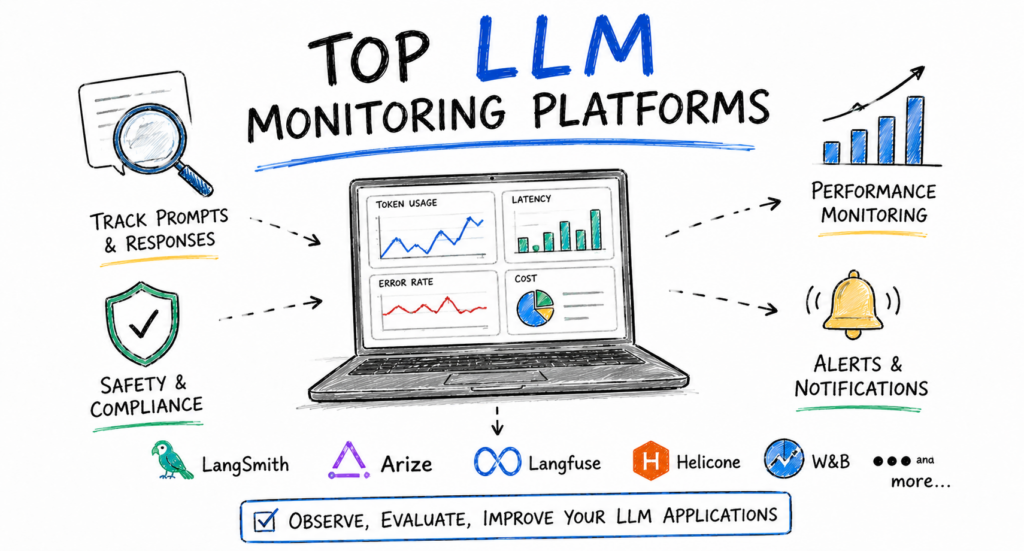
These tools help organizations track performance, quality, reliability, safety, compliance, latency, costs, and user interactions across AI applications.
For businesses investing heavily in AI, monitoring is no longer optional. It’s becoming as essential as observability tools are for cloud infrastructure.
In this guide, we’ll explore the top LLM monitoring platforms in 2026, compare their strengths, and explain how organizations can choose the right solution for their AI stack.
What Is LLM Monitoring?
LLM monitoring refers to the practice of observing, measuring, and improving the performance of AI applications powered by large language models.
Traditional application monitoring focuses on metrics such as:
* Uptime
* Server health
* Database performance
* Error rates
AI systems require much more.
Organizations now need visibility into:
* Prompt quality
* Response quality
* Hallucination rates
* Latency
* Token usage
* Model costs
* User satisfaction
* Safety issues
* Prompt injection attempts
* Model drift
Without monitoring, teams often discover problems only after customers complain.
Modern LLM observability platforms solve this challenge by providing real-time insights into AI application behavior.
Why LLM Monitoring Matters
Many organizations underestimate how difficult AI systems are to manage in production.
A chatbot that performs well during testing may behave differently when exposed to thousands of users.
Common issues include:
Hallucinations
Models generate confident but incorrect information.
Cost Overruns
Token usage grows rapidly as adoption increases.
Performance Drift
Outputs become less reliable over time.
Latency Problems
Users expect near-instant responses.
Security Risks
Prompt injections and data leakage remain significant concerns.
Compliance Issues
Regulated industries must monitor AI outputs carefully.
Without monitoring, these problems can impact customer trust, revenue, and brand reputation.
What Makes a Great LLM Monitoring Platform?
Before comparing vendors, it’s important to understand the capabilities that matter most.
Observability
Teams need complete visibility into prompts, responses, workflows, and model behavior.
Evaluation Frameworks
The platform should automatically assess response quality.
Cost Analytics
Understanding token consumption is essential.
Security Monitoring
Protection against prompt injection attacks and unsafe outputs.
Multi-Model Support
Most organizations now use multiple models rather than relying on a single provider.
Enterprise Scalability
The platform should support large-scale deployments.
1. LangSmith
LangSmith has become one of the most widely adopted observability platforms in the LLM ecosystem.
Built by the team behind LangChain, it provides extensive visibility into AI application workflows.
Key Features
* Prompt tracing
* Workflow visualization
* Evaluation tools
* Debugging capabilities
* Experiment tracking
One of LangSmith’s greatest strengths is helping developers understand exactly how AI applications behave during execution.
This level of visibility is especially valuable for complex agent-based systems.
Best For
AI engineering teams building production applications.
2. Arize AI
Arize AI has established itself as a leader in machine learning observability and has expanded aggressively into LLM monitoring.
The platform offers powerful tools for evaluating model performance and identifying quality issues.
Key Features
* LLM observability
* Performance monitoring
* Evaluation frameworks
* Hallucination detection
* Root-cause analysis
Arize is particularly strong for organizations that require advanced analytics and model diagnostics.
Best For
Enterprise AI teams.
3. Langfuse
Langfuse has gained enormous popularity among developers thanks to its open-source approach.
The platform delivers enterprise-grade observability while remaining highly flexible.
Key Features
* Prompt tracking
* Cost monitoring
* User analytics
* Trace visualization
* Open-source deployment
Many startups prefer Langfuse because it provides robust monitoring without locking teams into proprietary infrastructure.
Best For
Startups and developer-first organizations.
4. Helicone
Helicone focuses heavily on monitoring OpenAI and other API-driven LLM applications.
Its ease of implementation has helped it become a favorite among AI startups.
Key Features
* Request logging
* Cost tracking
* Latency monitoring
* User analytics
* Error detection
The platform can often be integrated within minutes.
Best For
Fast-moving AI startups.
5. Weights & Biases (W&B)
Weights & Biases has long been a respected name in machine learning experimentation.
Today, it also offers extensive support for generative AI workflows.
Key Features
* Experiment tracking
* Model evaluation
* Dataset management
* LLM observability
* Collaboration tools
The platform is particularly valuable for teams that train and fine-tune models internally.
Best For
Machine learning organizations.
6. WhyLabs
WhyLabs focuses on AI reliability and risk management.
The platform is designed to help organizations detect anomalies before they affect customers.
Key Features
* Drift detection
* Hallucination monitoring
* Data quality monitoring
* AI risk management
* Real-time alerts
Organizations operating in regulated environments often appreciate WhyLabs’ governance capabilities.
Best For
Healthcare, finance, and regulated industries.
7. Datadog LLM Observability
Datadog has expanded its observability platform to support AI applications.
This allows organizations to monitor traditional infrastructure and LLM systems from a single dashboard.
Key Features
* AI performance monitoring
* Cost analysis
* Infrastructure observability
* Tracing
* Security analytics
For companies already using Datadog, integration is straightforward.
Best For
Existing Datadog customers.
8. HoneyHive
HoneyHive focuses specifically on AI evaluation and observability.
Its platform helps teams measure quality and understand how users interact with AI applications.
Key Features
* Automated evaluations
* User feedback tracking
* Experiment management
* Workflow analytics
HoneyHive emphasizes continuous improvement rather than simple monitoring.
Best For
Product teams building AI experiences.
9. Phoenix by Arize
Phoenix is Arize’s open-source observability solution designed specifically for LLM applications.
It provides advanced tracing and evaluation capabilities.
Key Features
* Open-source deployment
* Prompt tracing
* Retrieval analysis
* Evaluation workflows
Organizations seeking transparency often choose Phoenix.
Best For
Technical AI teams.
10. Galileo
Galileo has become known for helping teams evaluate and improve generative AI outputs.
The platform emphasizes quality measurement and production monitoring.
Key Features
* Hallucination detection
* Evaluation automation
* Production monitoring
* AI quality analytics
Its focus on response quality makes it particularly valuable for customer-facing AI systems.
Best For
Customer support and conversational AI platforms.
Emerging Platforms to Watch
The LLM monitoring market is evolving rapidly.
Several newer vendors are attracting attention, including:
* Braintrust
* Fiddler AI
* TruLens
* Humanloop
* PromptLayer
* AgentOps
* Comet
These companies are helping push innovation in AI observability and evaluation.
How to Choose the Right LLM Monitoring Platform
Every organization has different requirements.
Consider the following factors before making a decision:
Team Size
Small teams often benefit from simpler platforms.
Infrastructure Complexity
Agent-based systems require deeper observability.
Compliance Requirements
Regulated industries need governance features.
Budget
Open-source platforms may reduce costs.
Deployment Model
Determine whether you need cloud-hosted or self-hosted infrastructure.
Best LLM Monitoring Platforms by Use Case
Best Overall
LangSmith
Best Enterprise Solution
Arize AI
Best Open Source Option
Langfuse
Best for Startups
Helicone
Best for Machine Learning Teams
Weights & Biases
Best for Compliance
WhyLabs
Best for Existing Observability Workflows
Datadog
Best for AI Quality Evaluation
Galileo
The Future of LLM Observability
The next generation of AI applications will be dramatically more complex.
Organizations are moving beyond simple chatbots toward:
* AI agents
* Autonomous workflows
* Multi-model systems
* Real-time decision engines
As complexity grows, monitoring becomes even more important.
Future platforms will likely provide:
* Automated root-cause analysis
* AI-driven debugging
* Predictive failure detection
* Agent observability
* Real-time quality scoring
In many ways, LLM monitoring is becoming the “Datadog for AI.”
