
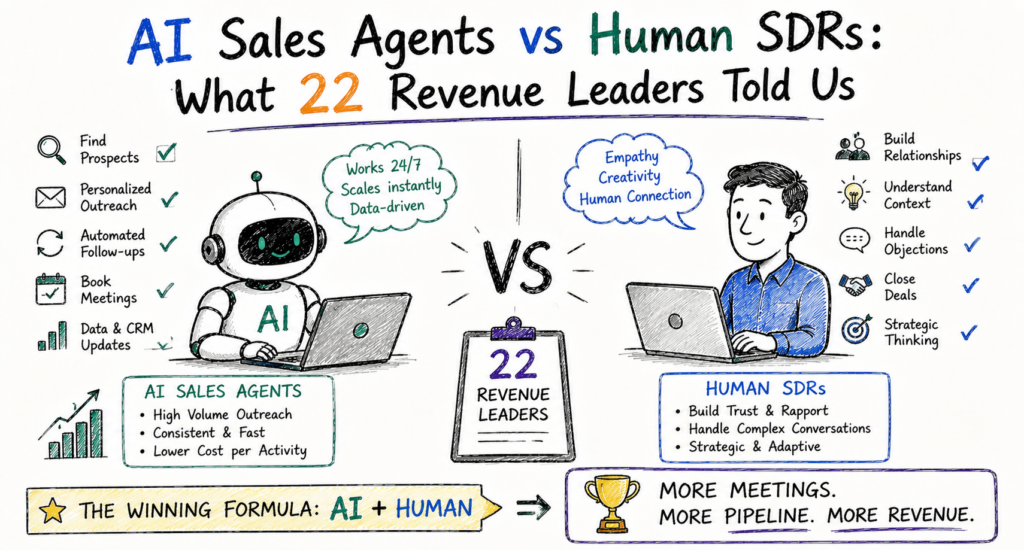
AI Sales Agents vs Human SDRs: What 22 Revenue Leaders Told Us in 2026
As AI sales agents become more capable, are human SDRs becoming obsolete—or are they becoming more valuable than ever? We analyzed insights from 22 revenue leaders to find out.
The debate is everywhere.
Scroll LinkedIn, attend a sales conference, or join a revenue operations discussion, and you’ll hear the same question:
Will AI sales agents replace human SDRs?
It’s a fair question.
Over the last two years, AI-powered sales development tools have evolved from simple email generators into sophisticated agents capable of researching prospects, personalizing outreach, running follow-up sequences, qualifying leads, and booking meetings.
Platforms like 11x, Artisan, Regie.ai, Reply.io, Apollo, and several emerging startups now market AI employees instead of software.
The message is bold:
“Why hire SDRs when AI can do the work?”
But after speaking with revenue leaders, founders, CROs, VP Sales executives, and RevOps professionals across 22 B2B organizations, a more nuanced picture emerges.
The reality is not AI versus humans.
The companies seeing the best results are learning how to combine both.
This article explores what 22 revenue leaders told us about AI sales agents, human SDRs, and the future of outbound sales in 2026.
The Rise of the AI SDR
Just a few years ago, SDR teams spent most of their day doing repetitive work:
* Building prospect lists
* Researching companies
* Writing emails
* Scheduling follow-ups
* Updating CRM records
* Tracking responses
Many sales leaders questioned whether these tasks truly required human effort.
Artificial intelligence offered a compelling alternative.
Modern AI sales agents can now:
* Identify target accounts
* Gather prospect data
* Write personalized emails
* Manage multi-touch sequences
* Respond to simple inquiries
* Book meetings
* Maintain CRM records
For startups and growth-stage companies, the promise is difficult to ignore.
Generate more pipeline without dramatically increasing headcount.
But does that promise actually hold up?
The Survey: What Revenue Leaders Think
One theme appeared repeatedly among the 22 leaders we reviewed:
AI is improving outbound sales.
Human SDRs are not disappearing.
Instead, their role is changing.
When asked which approach delivers the strongest results today, the majority favored a hybrid model.
The message is clear.
Most revenue leaders are not choosing one side.
They’re combining AI efficiency with human expertise.
Why AI Sales Agents Are Gaining Momentum
Revenue leaders highlighted several reasons for adopting AI-powered sales development.
1. Prospecting at Scale
Prospecting remains one of the most labor-intensive activities in outbound sales.
Finding the right accounts requires:
* Market research
* Data collection
* Lead qualification
* Continuous monitoring
AI can process these tasks dramatically faster than humans.
Several leaders reported reducing prospect research time by more than 50%.
2. Personalized Outreach at Volume
One of outbound sales’ biggest challenges is personalization.
Buyers ignore generic messages.
Yet writing personalized emails manually limits scale.
AI sales agents help bridge that gap.
They analyze:
* Company websites
* Job postings
* Funding announcements
* Leadership changes
* Industry news
Then generate tailored messaging.
For many teams, this creates a balance between quality and volume.
3. Consistent Follow-Up
Human SDRs get busy.
Follow-ups are often forgotten.
AI agents don’t forget.
They execute outreach sequences consistently and continuously.
Several leaders cited follow-up automation as one of AI’s most valuable capabilities.
4. Lower Cost Per Opportunity
Revenue teams are increasingly measured by efficiency.
Hiring SDRs involves:
* Recruitment costs
* Training expenses
* Management overhead
* Compensation
AI agents can reduce some of those costs.
This doesn’t necessarily eliminate human hiring, but it changes the economics of outbound sales.
What Human SDRs Still Do Better
Despite AI’s rapid advancement, every revenue leader identified areas where humans continue to outperform.
Human Advantage 1: Building Trust
Trust remains one of the most important factors in B2B buying decisions.
Software can send emails.
Humans build relationships.
Complex deals often involve:
* Multiple stakeholders
* Organizational politics
* Budget discussions
* Risk concerns
These situations require empathy and judgment.
Human SDRs continue to excel here.
Human Advantage 2: Reading Context
Sales conversations rarely follow scripts.
Buyers provide subtle signals.
Tone matters.
Timing matters.
Context matters.
Experienced SDRs recognize nuances that AI often misses.
Several leaders described this as “sales intuition.”
While difficult to measure, it remains highly valuable.
Human Advantage 3: Objection Handling
AI can answer predictable questions.
Complex objections are different.
When prospects express:
* Skepticism
* Competitive concerns
* Strategic challenges
* Internal resistance
Human SDRs typically perform better.
These conversations often require creativity and adaptability.
Human Advantage 4: Enterprise Selling
Enterprise sales remains relationship-driven.
Large deals often require months of engagement.
AI can support the process.
Human sellers usually lead it.
Many revenue leaders believe this dynamic will continue for years.
Where AI Sales Agents Win
The survey revealed several areas where AI consistently outperformed humans.
AI Advantage 1: Activity Volume
AI agents never get tired.
They operate around the clock.
They can simultaneously manage thousands of prospects.
This gives AI a clear advantage in outbound volume.
AI Advantage 2: Administrative Tasks
No revenue leader claimed their SDRs enjoyed updating CRM systems.
Administrative work reduces selling time.
AI agents excel at:
* Data entry
* Record maintenance
* Meeting scheduling
* Workflow management
Removing these tasks creates immediate efficiency gains.
AI Advantage 3: Speed
Research that once required hours can now be completed in minutes.
This allows teams to launch campaigns faster and adapt quickly.
AI Advantage 4: Consistency
Human performance fluctuates.
AI performance is generally consistent.
Several leaders cited predictable execution as a major benefit.
The Biggest Myth About AI SDRs
The most common misconception among buyers is that AI automatically creates pipeline.
Revenue leaders strongly disagreed.
One VP of Sales summarized it perfectly:
“AI scales your process. It doesn’t fix your process.”
If your:
* Targeting is poor
* Messaging is weak
* Offer lacks differentiation
AI simply accelerates those problems.
The highest-performing teams already possess strong outbound fundamentals.
AI amplifies what works.
What Happens to SDR Jobs?
This question generated significant debate.
Some leaders believe SDR headcount growth will slow.
Others believe SDR roles will evolve rather than disappear.
The strongest consensus centered around transformation.
Future SDRs may spend less time:
* Researching accounts
* Writing emails
* Managing CRM data
And more time:
* Building relationships
* Conducting discovery
* Personalizing interactions
* Managing strategic conversations
In other words, AI may remove low-value work while increasing the importance of high-value work.
The New SDR Role in 2026
Revenue leaders increasingly describe SDRs as:
* Relationship builders
* Problem solvers
* Strategic communicators
Rather than activity generators.
This shift changes how companies hire.
Traits becoming more valuable include:
* Curiosity
* Emotional intelligence
* Communication skills
* Business acumen
Pure activity metrics are becoming less important.
The Startup Perspective
Startups were generally the most enthusiastic adopters of AI sales agents.
Reasons include:
* Limited hiring budgets
* Small teams
* Pressure for rapid growth
Many founders reported using AI to delay additional SDR hires.
However, even startups emphasized the importance of human involvement.
Most viewed AI as leverage rather than replacement.
The Enterprise Perspective
Enterprise organizations were more cautious.
Their concerns included:
* Data governance
* Brand reputation
* Compliance
* Customer experience
Large organizations often deploy AI incrementally.
Human oversight remains common.
Which Generates More Meetings?
Interestingly, revenue leaders rarely measured success solely by meetings booked.
Instead, they focused on:
* Qualified meetings
* Pipeline created
* Revenue influenced
* Opportunity conversion
Still, when comparing meeting generation, most leaders reported strongest results from hybrid teams.
The highest-performing organizations combine both strengths.
Common Mistakes Companies Make
Revenue leaders consistently highlighted several implementation mistakes.
Mistake 1: Over-Automation
Sending thousands of messages does not guarantee results.
Quality still matters.
Mistake 2: Ignoring Data Quality
Bad data creates bad outreach.
AI cannot solve inaccurate information.
Mistake 3: Removing Humans Too Early
Several leaders warned against eliminating human oversight.
Especially for high-value accounts.
Mistake 4: Chasing Activity Metrics
More emails do not equal more revenue.
Pipeline quality remains the ultimate measurement.
What the Future Looks Like
The next generation of AI sales agents will likely become even more capable.
Expected developments include:
* Real-time buyer intent analysis
* Voice-based prospect engagement
* Autonomous account planning
* Advanced personalization
* Predictive opportunity scoring
Yet despite these advancements, most revenue leaders believe human sellers will remain essential.
Why?
Because buying decisions remain human.
Trust remains human.
Relationships remain human.
The Most Important Lesson From 22 Revenue Leaders
The conversation around AI sales agents often becomes polarized.
One side predicts total automation.
The other predicts minimal impact.
Neither view reflects reality.
The organizations generating the best results are not replacing humans with AI.
They’re redesigning outbound sales around the strengths of both.
AI handles:
* Research
* Data
* Repetition
* Automation
* Execution
Humans handle:
* Relationships
* Judgment
* Strategy
* Trust
* Complex conversations
This combination consistently outperformed either approach alone.
