
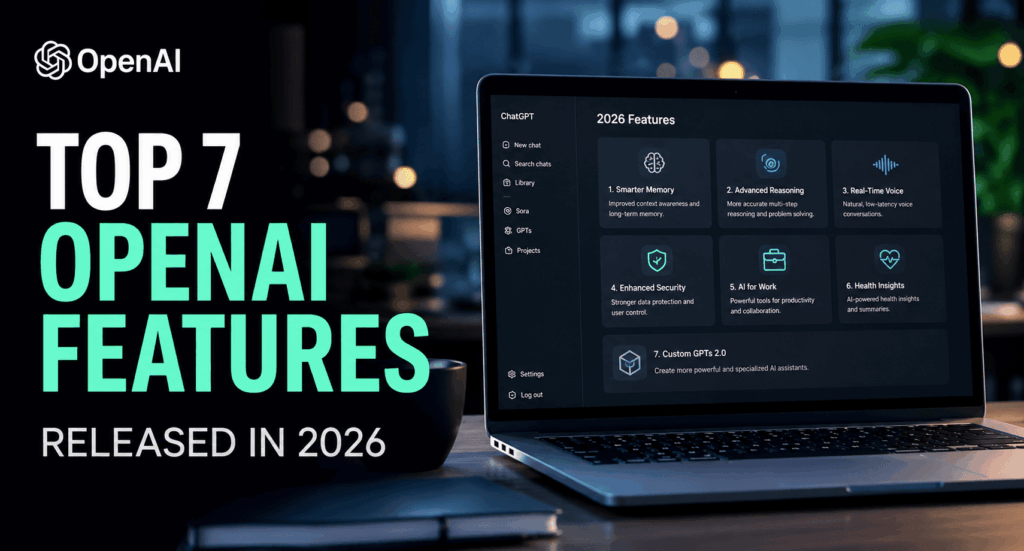
Top 7 OpenAI Features Released in 2026 (That Are Changing How People Use AI)
Artificial intelligence has moved far beyond simple chatbots. Throughout 2026 , OpenAI introduced several major improvements that made ChatGPT faster, smarter, more personalized, and significantly more useful for both everyday users and businesses.
Whether you’re a student, entrepreneur, software developer, marketer, or enterprise leader, these new features are reshaping how work gets done.
In this guide, we’ll explore the Top 7 OpenAI features released in 2026 , explain why they matter, and show how they’re transforming productivity across the United States.
Why 2026 Was a Big Year for OpenAI
Instead of focusing only on launching bigger language models, OpenAI spent much of 2026 improving the overall AI experience:
- Better long-term memory
- More powerful reasoning
- Improved enterprise management
- Faster real-time AI
- Stronger security
- Specialized models
- Better healthcare intelligence
This shift reflects what many users actually wanted—not just smarter AI, but AI that remembers, responds naturally, and fits into real workflows.
1. Better Memory for ChatGPT
Perhaps the biggest quality-of-life improvement in 2026 was ChatGPT’s upgraded memory system.
Instead of forgetting everything between conversations, ChatGPT can now remember useful preferences over time.
For example, it can remember:
- Your writing style
- Preferred coding language
- Favorite programming framework
- Business goals
- Project details
- Communication tone
- Frequently used workflows
The updated memory system is designed to make conversations feel more natural without forcing users to repeat the same information every session. Users also retain control over what is remembered and can manage or clear memory settings.
Why it matters
Imagine opening ChatGPT every morning and continuing yesterday’s work without explaining everything again.
That alone saves hours every month.
2. GPT-5.5 Improved Everyday Intelligence
One of OpenAI’s largest model improvements this year was the rollout of GPT-5.5 which focused less on flashy benchmarks and more on practical improvements.
Users immediately noticed:
- Better reasoning
- Cleaner writing
- More natural conversations
- Stronger coding
- Better debugging
- Improved factual accuracy
- Better instruction following
Instead of generating longer responses, GPT-5.5 became much better at understanding user intent.
That makes everyday work significantly smoother.
Developers also benefited from improved API support and model variants designed for different workloads.
3. New Enterprise Analytics and Spend Controls
Businesses using ChatGPT Enterprise received one of the most requested updates.
Organizations can now monitor:
- AI usage
- Team activity
- Credit consumption
- Department spending
- Workspace analytics
Large companies often struggle to understand how AI is being adopted internally.
The new analytics dashboard helps IT departments optimize budgets while encouraging responsible AI usage across teams.
Benefits for enterprises
- Better budgeting
- Department reporting
- Usage insights
- Cost optimization
- Governance
For CIOs and IT managers, this was one of the year’s most practical releases.
4. Faster Real-Time AI Models
Voice AI became noticeably faster in 2026.
OpenAI released updated real-time models with:
- Lower latency
- Better speech recognition
- Stronger instruction following
- Improved multimodal understanding
- Better background noise handling
This makes voice conversations feel much closer to speaking with another person rather than waiting for an AI to think.
Developers building customer support systems, AI assistants, or live voice applications benefit from quicker, smoother interactions.
Real-world applications
- Customer service
- Sales assistants
- Voice copilots
- Smart devices
- Live tutoring
- Healthcare support
5. Active Sessions Security Dashboard
Security became another major focus in 2026.
OpenAI introduced Active Sessions , allowing users to review where their account is currently signed in.
The dashboard shows:
- Devices
- Approximate locations
- Login history
- Trusted devices
- Current active session
Users can quickly sign out of unfamiliar sessions if they suspect unauthorised access.
Why this matters
As more people use ChatGPT for work, protecting account access has become increasingly important.
This feature adds an extra layer of transparency and control.
6. Healthcare Intelligence Improvements
Healthcare professionals received major improvements in ChatGPT during 2026.
OpenAI expanded health-related capabilities to better assist with:
- Medical information summaries
- Clinical documentation
- Patient education
- Evidence organization
- Health-related reasoning
The goal isn’t to replace healthcare professionals but to help organise information and reduce administrative workload. OpenAI continues to emphasise that AI should support—not replace—professional medical judgment.
Potential users
- Doctors
- Nurses
- Researchers
- Medical students
- Healthcare administrators
7. Specialized AI Models for Advanced Work
Instead of creating one model for every task, OpenAI expanded its lineup with specialized models aimed at different domains.
Examples include:
- Advanced coding
- Scientific research
- Biology and life sciences
- Enterprise automation
- Real-time applications
OpenAI also previewed next-generation models with stronger capabilities in coding, scientific reasoning, and cybersecurity while continuing to invest in safety systems.
Why specialization matters
Different jobs require different AI strengths.
Instead of forcing one model to do everything, specialized models deliver:
- Higher accuracy
- Better efficiency
- Faster performance
- Lower costs for specific tasks
Which Feature Will Have the Biggest Impact?
Different users will benefit from different improvements.
Students
- Better memory
- Faster research
- Improved writing
Developers
- Better coding models
- Faster debugging
- Real-time AI
Business Owners
- Enterprise analytics
- Long-term memory
- Better reasoning
Marketing Teams
- Consistent content creation
- Personalized workflows
- Improved collaboration
Healthcare Professionals
- Documentation support
- Information summarization
- Research assistance
How OpenAI Is Shifting in 2026
Looking across this year’s releases, a clear trend emerges.
OpenAI is moving beyond “chat” and toward AI that acts as a persistent, context-aware assistant.
Key themes include:
- Personalization through memory
- Enterprise governance and visibility
- Faster multimodal interactions
- Domain-specific intelligence
- Improved security
- Smarter reasoning
- Better collaboration
Rather than relying on one breakthrough feature, OpenAI is steadily improving the overall user experience.
What This Means for Businesses in the USA
American companies are adopting AI at an unprecedented pace.
These 2026 features make it easier to:
- Reduce repetitive work
- Improve customer support
- Speed up software development
- Automate internal processes
- Increase employee productivity
- Manage AI costs
- Strengthen security
Organizations that integrate these capabilities thoughtfully are likely to gain meaningful efficiency advantages over competitors.
