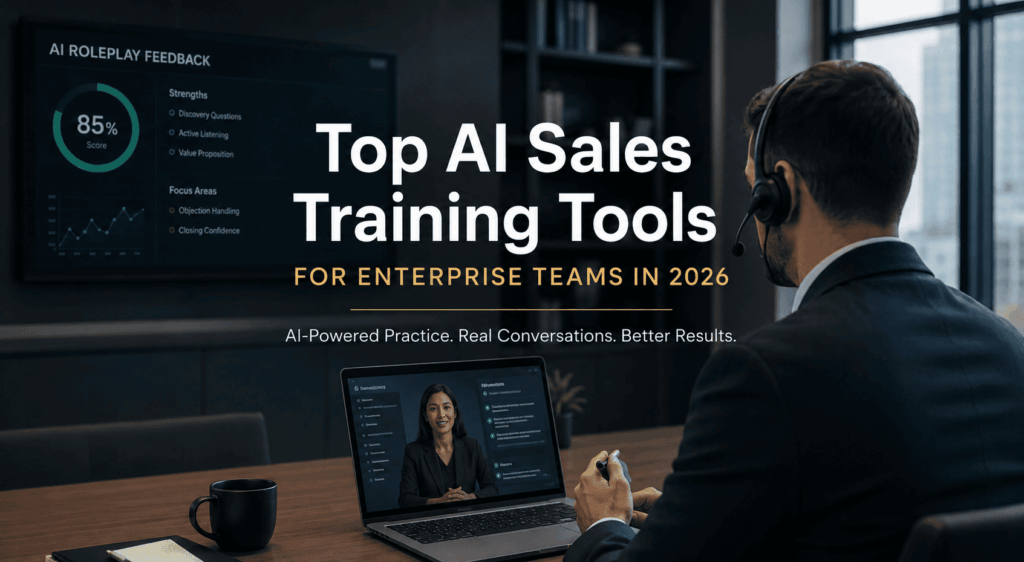
Enterprise sales training has changed significantly. A few years ago, a typical program might have meant classroom sessions, recorded webinars, product certifications, manager-led role-play, and a library of sales playbooks.
That model still has value—but it has a scalability problem.
A sales manager cannot realistically role-play with hundreds of representatives every week. Nor can an L&D team manually evaluate every discovery call, objection-handling exercise, product launch, or executive presentation.
That is where AI sales training tools are becoming increasingly useful.
In 2026, enterprise organizations are using AI to give sellers more opportunities to practice, receive immediate feedback, identify skill gaps, and prepare for difficult customer conversations before those conversations happen in the real world. Current enterprise platforms increasingly combine AI role-play, coaching, analytics, learning content, certification, and integrations with existing LMS and CRM systems.
But choosing the right tool isn’t simply about finding the platform with the most impressive AI avatar.
For an enterprise team, the bigger question is:
Can this technology consistently change sales behavior at scale?
What Is an AI Sales Training Tool?
An AI sales training platform uses artificial intelligence to help salespeople learn, practice, evaluate, and improve selling skills
Depending on the platform, that can include:
AI buyer role-play
Discovery-call simulations
Cold-call practice
Objection-handling exercises
Product-pitch practice
Presentation coaching
Conversation analysis
Personalized feedback
Sales methodology scoring
Certification
Manager dashboards
Performance analytics
Microlearning
Continuous coaching
The most useful platforms create a cycle:
Learn → Practice → Get Feedback → Improve → Practice Again
That is fundamentally different from asking employees to watch another training video and complete a multiple-choice quiz.
Why Enterprise Teams Are Turning to AI Sales Training
Enterprise sales organizations have a particularly difficult training problem.
They may have:
Hundreds or thousands of sellers
Multiple regions
Different languages
Multiple products
Different customer segments
Frequent product launches
Complex compliance requirements
Distributed managers
High employee turnover
Different levels of seller experience
Traditional training struggles to provide the same level of individualized practice across all those variables.
AI can help by making practice available on demand.
A recent example illustrates the direction of the market: reporting in 2026 described companies using AI coaches and simulations to shorten onboarding and give sellers more opportunities for interactive practice, while also emphasizing that AI should complement rather than replace human coaching.
That last point is important.
AI is most useful when it gives human managers better information and gives sellers more opportunities to practice
Top AI Sales Training Tools for Enterprise Teams
Here are several platforms enterprise sales and enablement leaders should evaluate in 2026:
1.Practis — Best for high-frequency field-sales performance
2. Mindtickle — Best for sales readiness and enablement
3. Hyperbound — Best for connecting practice with real sales performance
4. Yoodli — Best for spoken communication and high-stakes conversations
5. Quantified — Best for complex and regulated sales environments
6. Gong — Best for conversation intelligence and coaching
7. Second Nature — Best for enterprise AI role-play
These aren’t identical products. Some are primarily training and role-play platforms, while others are broader sales-performance systems
1.Practis — A Different Model for Enterprise Field Sales
The attached PRACTIS™ Method introduces a different perspective on AI sales training.
Rather than treating sales training primarily as conversation training, PRACTIS describes itself as a field-sales performance operating system
Its core idea is straightforward:
Sales methods train the conversation. PRACTIS trains the performer.
The methodology is specifically designed for high-frequency, face-to-face sales environments where representatives may have dozens of short interactions in a day.
That includes industries such as:
Roofing
Solar
Pest control
Home security
Telecom
Home improvement
Insurance
Other territory-based sales organizations
The PRACTIS Seven-Stage Loop
The framework organizes an interaction into seven stages:
1Presence
2 Reveal
3. Agency
4. Clarify
5.Truth
6. Invite
7.Score
The methodology also defines nine performance dimensions that coaches use to observe and diagnose the seller.
This is different from a word-for-word sales script.
The framework explicitly says that PRACTIS is not a script. Instead, it defines what should happen at each stage and what quality looks like, while allowing the salesperson to use natural language with the buyer.
Why the PRACTIS Approach Is Interesting for Enterprise Teams
Enterprise sales training often assumes a scheduled meeting:
Buyer accepts the meeting
Seller has preparation time
Conversation lasts 30–60 minutes
Call is recorded
Manager can review it later
Field sales works differently.
A rep may have:
Interaction → rejection → walk → reset → next interaction → rejection → next interaction
The attached methodology describes this as a performance problem as much as a conversation problem.
That is why PRACTIS puts particular emphasis on what happens before, during, and after each interaction.
Its platform layer is described as including:
Simulation
Coaching
Certification
Analytics
Manager calibration
Continuous learning
For an enterprise with thousands of field representatives, this type of structure could potentially provide a consistent performance language across regions and managers.
However, there is an important distinction between a compelling methodology and a proven business outcome.
The PRACTIS source explicitly states that its outcome claims should be treated as hypotheses to be tested through instrumented pilots and measured baselines rather than as guaranteed results.
That is exactly the kind of distinction enterprise buyers should make when evaluating emerging AI training technology.
2. Mindtickle — Best for Sales Readiness and Enablement
Mindtickle takes a broader approach than a pure role-play platform.
For enterprise sales organizations, that can be an advantage.
Sales training isn’t only about practicing conversations. Teams also need to know:
What the product does
Who the ideal customer is
How the product compares with competitors
Which messaging is approved
Which sales methodology to follow
How to handle objections
Whether a rep is actually ready to sell
Mindtickle combines sales readiness, learning, coaching, content, and AI-powered practice.
Why it matters
For a global enterprise, putting AI role-play inside a broader readiness environment can reduce the number of disconnected tools salespeople have to use.
The platform is therefore particularly relevant when the organization’s goal is sales readiness at scale, rather than simply AI conversation simulation.
Best for
Enterprise organizations that want AI training as part of a broader sales enablement ecosystem
3. Hyperbound — Best for Connecting Practice With Performance
Hyperbound takes a particularly interesting approach to AI sales training.
Rather than treating role-play as an isolated learning exercise, its platform connects AI practice with sales performance and real customer conversations.
The company’s 2026 product material emphasizes realistic simulations, coaching based on actual sales data, and connecting training with live deal performance.
That creates a more complete loop:
Real sales interaction → Identify skill gap → AI practice → Feedback → Apply the skill → Measure again
This is important because traditional training often has a disconnect between what someone learnsand what they actually do.
Best for
B2B enterprise teams that want sales training to be closely connected to real conversations and revenue performance.
What to evaluate
Ask how much of the AI’s behavior is grounded in your organization’s:
Winning calls
Sales methodology
Buyer personas
Product information
Competitive environment
Deal stages
Realism matters.
An AI buyer that always agrees with the seller isn’t useful preparation for an enterprise buyer who pushes back on pricing, security, implementation, or ROI.
4. Yoodli — Best for Communication and High-Stakes Conversations
Yoodli approaches sales training from a slightly different angle.
Its AI role-plays let sellers practice realistic spoken interactions and receive immediate feedback. The platform specifically supports discovery calls, objection handling, demos, executive conversations, and other high-stakes scenarios.
Yoodli also evaluates elements such as:
Pacing
Clarity
Filler words
Communication structure
Delivery
That can be especially useful for:
Enterprise account executives
Sales engineers
Sales leaders
Customer success teams
Executive presenters
Field sales representatives
Why communication matters
A sales rep can have the right answer and still communicate it poorly.
They may:
Talk too quickly
Interrupt the buyer
Sound uncertain
Over-explain
Miss a pause
Fail to communicate confidence
AI can provide repeated practice around these behaviors without making the salesperson feel like every mistake is being judged by their manager.
Best for
Organizations where communication quality and executive presence are important parts of sales performance.
5. Quantified — Best for Complex and Regulated Sales
Quantified is particularly relevant to organizations where sales conversations involve complex products, specialized knowledge, compliance, or high-stakes interactions.
Quantified’s platform covers AI role-play and broader sales coaching capabilities, including readiness, field coaching, compliance, authoring, and insights.
That makes it interesting for industries such as:
Life sciences
Pharmaceuticals
Healthcare
Financial services
Complex enterprise technology
Other regulated environments
Why this matters
In a simple sales environment, the main question might be:
“Can the rep handle the objection?”
In a regulated environment, there may be another question:
“Can the rep handle the objection while staying within approved messaging and compliance requirements?”
That changes the training requirement.
Best for
Enterprise teams where sales accuracy, compliance, and complex product knowledge are central to the buying process.
6. Gong — Best for Coaching From Real Customer Conversations
Gong is better known as a revenue intelligence and conversation intelligence platform, but its capabilities make it highly relevant to AI-assisted sales coaching.
Instead of focusing only on simulated conversations, Gong’s strength is analyzing what actually happens in customer conversations
That gives sales leaders a different source of information.
Rather than asking:
“Did the rep pass the training?”
Managers can start asking:
“What behaviors are actually happening in our customer calls?”
That distinction is valuable.
The advantage
AI role-play tells you how someone performs in a simulation.
Conversation intelligence can tell you how they perform with actual customers.
The strongest enterprise training strategy may eventually combine both.
Practice before the call. Analyze after the call. Coach the next call.
Best for
Mature B2B organizations that already have substantial customer-conversation data and want coaching tied to real sales behavior.
7.Second Nature — Best for Enterprise AI Role-Play
Second Nature is one of the strongest options for companies specifically looking to scale AI-powered sales practice.
Its approach is simple but powerful: put a salesperson into a realistic conversation with an AI buyer and let them practice without requiring a manager to participate.
Second Nature supports scenarios such as:
Discovery calls
Cold calls
Objection handling
Elevator pitches
Manager development
Customer conversations
The company says its enterprise platform supports 30+ languages, LMS connectivity through SCORM and LTI, CRM integrations, enterprise identity management, and thousands of concurrent users. ([Second Nature][1])
Why enterprises may like it
The platform is designed around the reality that enterprise training needs to be repeatable.
A sales manager can conduct one role-play session with a rep.
AI can potentially provide hundreds of reps with their own practice sessions
That’s a meaningful difference.
Best for
Large sales organizations that want scalable AI role-play without requiring managers to personally conduct every practice session.
But this doesn’t mean traditional training is obsolete.
The best enterprise programs will probably combine:
Human expertise + structured methodology + AI practice + real-world performance data.
What Makes an AI Sales Training Tool Enterprise-Ready?
This is where many buying teams need to look beyond the product demo.
A platform might have an impressive AI avatar, but enterprise deployment introduces very different requirements.
1. Security and data privacy
Ask vendors:
Where is customer data stored?
Is customer data used to train models?
What security certifications exist?
Does the platform support SSO?
Does it support enterprise identity management?
What data retention controls are available?
For example, Second Nature lists SOC 2 Type 2 and ISO 27001 certifications alongside enterprise identity and compliance capabilities.
2. LMS and CRM integration
Enterprise sellers already work inside established systems.
The training platform should ideally fit into that ecosystem.
Look for integrations with:
Salesforce
HubSpot
Microsoft environments
Enterprise LMS platforms
Zoom or conferencing systems
HR and identity systems
Second Nature, for example, supports LMS connectivity through SCORM/LTI and integrations with Salesforce, HubSpot, and Zoom.
3. Custom scenarios
Generic scenarios are useful for getting started.
But enterprise teams need scenarios based on their actual business.
A good platform should allow you to create situations such as:
“You are an enterprise CIO evaluating our platform. Your current provider is cheaper. Convince me to take another meeting.”
Or:
“You are a procurement leader. You like the product but believe the implementation cost is too high.”
Or:
“You are a skeptical customer who has already spoken with two competitors.”
That’s where AI training becomes much more valuable.
4. Methodology alignment
Your organization may use:
MEDDIC
MEDDPICC
SPIN
Challenger
Sandler
Consultative selling
Value selling
A proprietary methodology
The platform should reinforce your methodology rather than creating another competing framework.
The PRACTIS methodology makes this distinction particularly clearly: it describes itself as complementary to established sales methodologies rather than replacing them.
5. Manager visibility
AI should not create another isolated training dashboard.
Managers need to know:
Who is improving?
Who is struggling?
Which skills are weak?
Which scenarios cause problems?
Which reps need additional coaching?
Is training translating into field performance?
The goal should be better coaching conversations, not more dashboards.
The Biggest Mistake: Measuring Training Completion Instead of Behavior
This is perhaps the most important point for enterprise buyers.
A rep completing 15 training modules doesn’t necessarily mean the rep became better at selling.
Similarly, a rep completing 20 AI role-plays doesn’t automatically mean their win rate will improve.
Enterprise teams should measure the transition:
Training → Behavior → Customer interaction → Business outcome
That is why the attached PRACTIS methodology recommends treating business outcomes as hypotheses and validating them against measured baselines.
It is a useful principle for evaluating **any** AI sales training platform.
How Enterprise Teams Should Evaluate These Tools
Before signing a large contract, run a controlled pilot.
Choose:
One sales team
One region
One sales motion
One or two priority skills
A defined baseline
A fixed evaluation period
Then measure things such as:
Before training
Ramp time
Certification scores
Call quality
Objection-handling performance
Discovery quality
Conversion rates
Manager coaching time
During the pilot
Practice frequency
Scenario completion
Skill improvement
Coaching engagement
Manager intervention
Rep adoption
After the pilot
Behavior change
Call quality
Pipeline progression
Conversion
Rep confidence
Ramp time
Retention
Relevant revenue outcomes
This makes the technology investment much easier to evaluate.
Which AI Sales Training Tool Is Best?
There is no single winner for every enterprise.
Choose Second Nature if:
You primarily want scalable, enterprise-grade AI role-play.
ChooseMindtickle if:
You want AI training integrated into a broader sales-readiness and enablement environment.
Choose Hyperbound if:
You want to connect AI practice with actual sales conversations and performance.
Choose Yoodli if:
Communication, presentation, and high-stakes spoken conversations are major priorities.
Choose Quantified if:
Your organization operates in complex or regulated sales environments.
Choose Gong if:
You already have significant customer-conversation data and want coaching based on real sales interactions.
Consider Practis if:
Your sales organization is heavily field-based and needs a structured performance system covering repeated interactions, coaching, certification, analytics, and continuous improvement.
