Let me be honest with you for a second.
Most “AI framework” articles are written by people who read three LinkedIn posts and called it research. They throw around buzzwords like “agentic workflows” and “LLM integration” without ever explaining what that means for someone sitting in a product review meeting on a Tuesday afternoon, trying to figure out which feature to build next.
This isn’t that article.
At Supply Chain of Intelligence, we think about AI the same way logistics experts think about supply chains — as a series of connected, dependent stages where a breakdown at any single point degrades everything downstream. Raw data feeds models. Models power features. Features create (or destroy) user trust. User trust becomes revenue. Every link matters. And right now, most product leaders are managing that chain without a real map.
If you’re a product leader in the US today — whether you’re a CPO at a Series B startup in Austin, a VP of Product at a mid-market SaaS company in Chicago, or a principal PM at a big tech firm in Seattle — you’re being asked to make real decisions about AI. Not someday. Now.
And the uncomfortable truth? Most of us were never taught frameworks that actually account for AI’s weird, probabilistic, constantly evolving nature. The old playbook — user stories, sprint reviews, and feature prioritisation in a spreadsheet — gets you only so far when your product’s behaviour changes every time someone tweaks a model parameter.
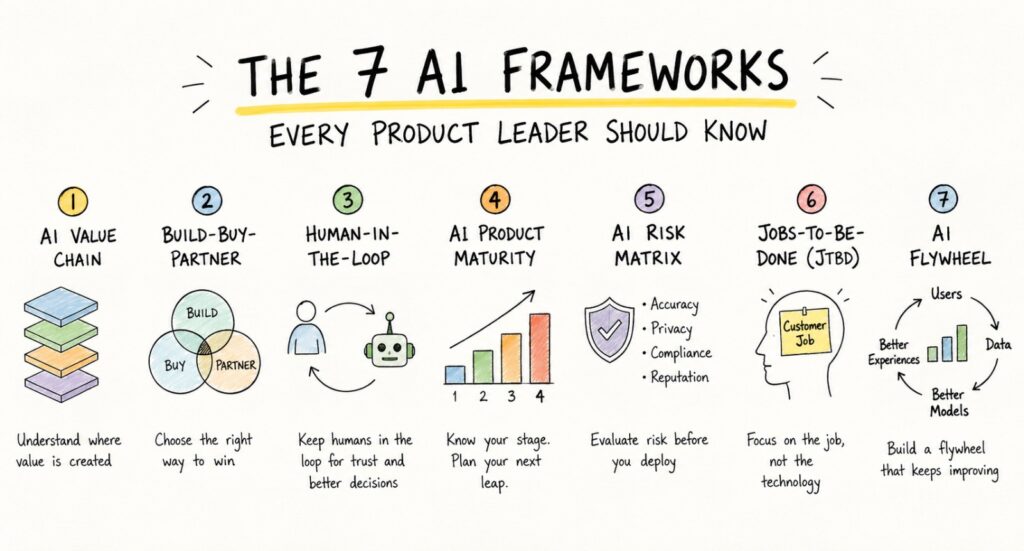
So here are the seven frameworks I’d put in front of every product leader today. Not because they’re trendy, but because they actually help you think more clearly — and map your own supply chain of intelligence more deliberately.
1. The Supply Chain of Intelligence™ — What Your Brand Is Really About
The core idea: Every AI product sits somewhere in a 10-layer stack — from raw compute and data at the bottom to surface interfaces and memory at the top. Where you sit determines whether you have a moat or a wrapper someone else will absorb.
This framework comes from Anand Arivukkarasu, an ex-Meta (Instagram) product leader, and it answers a question most product teams are dodging: Is your AI product defensible, or are you one platform release away from becoming a free feature?
Here’s the pattern that plays out constantly.
A product team ships something genuinely useful — an AI writing assistant, a coding copilot, a customer service agent — gets traction, raises money, and builds a real user base. Then OpenAI, Microsoft, or Google ships the same capability natively inside a surface 100x larger than yours, for free. And there’s nothing structural left to defend.
The Supply Chain of Intelligence maps the full generative AI stack across 10 layers and 50 sublayers — from L−1 (energy and raw materials) up through L0 infrastructure, L1 data, L2 models, L3 trust gates, L4 access and integrations, L5 execution and domain skills, L6 orchestration and agent loops, L7 surface and interfaces, all the way to L8 memory. Most AI products, when you’re honest about it, sit only at L7 – the surface. That’s the most exposed position in the entire stack.
The framework’s sharpest insight is what it calls the Defensible Triangle: the companies’ three hardest to displace own three layers simultaneously — L1b proprietary data that nobody else can buy, L5 deep execution baked into the actual workflow, and L8 compounding memory that gets more valuable the longer a customer stays. Bloomberg owns the data. Harvey AI owns the legal workflow and institutional memory. Cursor owns the IDE pipeline, agent loop, and project memory. Each one is structurally hard to copy because the layers reinforce each other.
The AI twist: The framework comes with four structural laws worth memorizing. The most important: intelligence commoditizes downward. Whatever your AI does today, the model layer below you will eventually do it for free. The only protection is owning a layer the model can’t absorb — proprietary data, a compliance gate that requires domain trust, a workflow so deeply embedded that switching costs are real, or memory that compounds over time. If you can’t name the specific layer you own, you probably don’t own one yet.
How to use it: Before your next roadmap cycle, ask your team to place your product on the 10-layer map at supplychainofai.com. Which sublayer do you actually control? What happens to your product when the foundation model below you gets smarter? The conversation that follows that exercise is usually more honest than any strategy off-site.
2. Jobs to Be Done (JTBD) — Start With the Human, Not the Model
The core idea: People don’t buy your product. They hire it to get a specific job done.
Clayton Christensen popularised this in The Innovator’s Solution, but the real operational depth comes from Tony Ulwick, who built his consulting firm Strategyn around it for decades. The insight is deceptively simple: stop asking “what features do my users want?” and start asking “what progress are they trying to make in their lives?”
The famous drill example captures it. Nobody wants a drill. They want a hole. But go one level deeper, and they don’t even want the hole — they want the picture of their kids hanging on the wall. They want their apartment to finally feel like a home.
When you apply JTBD to AI products, something important surfaces. It forces you to interrogate whether AI is actually the right tool for the job at all — and if so, which specific part of the job it should handle. Too many product teams bolt AI onto features because it feels innovative, not because it genuinely reduces the friction between the customer and the outcome they need.
How to use it: Run JTBD interviews. Not surveys. Actual 45-minute conversations where you ask customers to walk you through the last time they tried to accomplish a goal and reached for your product (or a competitor’s). Listen for emotional language — frustration, relief, anxiety, embarrassment. That’s where the real jobs live, underneath the surface-level feature requests.
The AI twist: Map your AI capabilities directly to functional, emotional, and social job dimensions. A feature that automates a task handles the functional job. A feature that makes the user feel confident and in control handles the emotional job. If your AI feature only addresses one dimension while creating friction in another, it will underperform no matter how technically impressive it is.
3. The North Star Metric Framework – Finding Your One True Measure
The core idea: Every product has a single metric that best captures the value you’re creating for customers. Find it. Organise everything around it.
Airbnb’s nights are booked. Spotify’s is time spent listening to music. Slack’s messages sent within teams. These aren’t revenue metrics — they’re customer value metrics. Revenue follows when you nail the customer value.
The North Star Metric framework solves a problem that gets worse as organisations grow: misalignment. Engineering is optimising for uptime, marketing is chasing new signups, customer success is focused on NPS, and product is tracking DAU. Everyone is doing their job, but no one is rowing in the same direction.
Your North Star pulls them all together. When every team can articulate how their quarterly work connects to the single metric that matters most, something remarkable happens — prioritisation debates get shorter, and outcomes get better.
The AI twist: For AI-native products, choosing the right North Star is genuinely hard. Token consumption is a terrible North Star because it can go up for bad reasons (broken systems, confused users asking the same question over and over). “AI actions taken” is equally misleading.
The right North Star for most AI products is something like successful outcomes per user — a metric that requires you to define what “successful” actually means for your specific use case. That definition becomes the most important product decision you’ll make.
4. OKRs (Objectives and Key Results) – Strategy’s Missing Link
The core idea: Set an inspiring qualitative objective. Define 2–4 measurable Key Results that prove you’ve achieved it.
OKRs were invented at Intel by Andy Grove, popularised at Google, and are now used by practically every serious tech company in the US. But most teams use them wrong. They turn OKRs into performance reviews, or they set targets so safe that hitting 100% of them means nothing.
The original intent was different. OKRs should be ambitious — Google’s guidance was that if you’re hitting 100% of your Key Results, you’re not being bold enough. Aim for 70%. The discomfort is the point.
Here’s how OKRs, North Star, and RICE work together as a system:
• Your North Star Metric defines where the ship is headed long-term
• Your OKRs are the quarterly journeys that move you toward it
• RICE scoring is how you decide which initiatives get resourced to hit those Key Results
Without this layering, OKRs float. Teams hit them without meaningfully advancing the company. With it, every Key Result traces back to actual customer value.
The AI twist: AI product cycles don’t always fit neatly into quarterly OKR rhythms. Model performance can degrade over time, user behavior can shift unexpectedly, and what works in a pilot often doesn’t scale cleanly. Consider setting AI-specific OKRs around evaluation quality — not just “ship the feature” but “achieve X% accuracy on human evaluation rubric by Q3.”
5. The Product-Market Fit Canvas – Knowing When You’ve Actually Made Something People Want
The core idea: A structured framework for validating whether your product genuinely solves a problem that a specific market cares deeply about.
Product-market fit (PMF) is one of those phrases everyone uses, and almost no one can define precisely. Marc Andreessen’s original formulation — “being in a good market with a product that can satisfy that market” — is elegant but operationally useless. The PMF Canvas gives you something more actionable.
The canvas maps five dimensions:
1. Who specifically has this problem? (Not “SMBs” — name the person, their role, their context)
2. How painful is it on a 1–10 scale? And what’s the evidence?
3. How are they solving it today?
4. What does your product do that nothing else does?
5. What does a signal of PMF actually look like for this specific market?
That last one is crucial. Sean Ellis’s famous “40% test” — surveying users on how disappointed they’d be if your product disappeared — is a useful PMF signal for consumer apps. It’s almost meaningless for enterprise B2B. Know what your signal looks like before you start chasing it.
The AI twist: AI products have a unique PMF challenge: the product’s capabilities change. A model upgrade can turn a mediocre product into a genuinely useful one overnight — or vice versa. Your PMF Canvas needs to include a “capability dependency” row that tracks which specific model behaviours your product-market fit actually relies on, so you’re not blindsided when things change upstream.
6. The AI Readiness & Opportunity Assessment Framework — Before You Build Anything
The core idea: Systematically evaluate whether a problem is actually AI-appropriate before committing engineering resources to it.
This one is less codified than the others — it’s a framework I’ve seen smart product organizations develop internally and it reflects what companies winning with AI in 2026 are actually doing.
The assessment has four gates:
Gate 1 — Data availability. Does the relevant training or fine-tuning data exist? Is it clean, labelled, and representative? “We’ll figure out the data later” is how AI projects die quietly six months in.
Gate 2 — Error tolerance. What’s the acceptable failure rate? AI systems are probabilistic — they will be wrong sometimes. In medical applications, being wrong 1% of the time might be catastrophic. In a content recommendation system, being wrong 20% of the time might be completely fine. You need to define this before you build, not after.
Gate 3 — Human-in-the-loop design. Where does a human need to review, correct, or override the AI’s output? This isn’t a weakness — it’s a feature. The best AI products are designed around graceful human intervention, not around pretending the model is always right.
Gate 4 — Measurability. Can you actually measure whether the AI is performing well? If you can’t define success quantitatively, you can’t improve systematically. This gate trips more product teams than any other.
Products that fail all four gates shouldn’t be built with AI. Products that clear all four are genuinely worth investing in.
7. The Dual-Track Agile Framework — Discovery and Delivery, Running in Parallel
The core idea: Run product discovery (figuring out what to build and whether it’s valuable) continuously and in parallel with product delivery (building and shipping what you’ve validated).
Marty Cagan and the team at SVPG popularized this framework, and it’s become foundational to how serious product organizations operate. The central insight is that discovery and delivery are fundamentally different activities with different rhythms, and treating them as sequential — “we figure it out, then we build it” — creates the kind of waste that kills product organisations.
In practice, dual-track looks like this: while engineering is shipping the features you validated last sprint, your product and design team is already three sprints ahead in discovery – talking to customers, prototyping ideas, and running lightweight experiments. You’re never building blind, and you’re never blocked.
The AI twist: Dual-track is especially powerful for AI product development because AI discovery has unique characteristics. You can’t spec an AI feature the same way you spec a form field — the behaviour is emergent and probabilistic. Discovery for AI features involves testing model outputs with real users, evaluating edge cases, and understanding where the model’s failure modes create unacceptable user experiences.
Add a third track for AI teams: an evaluation track that runs continuously, assessing model performance against real production data. This isn’t QA — it’s product intelligence. The insights from your eval track should feed directly into your discovery track, creating a closed loop.
How These Seven Fit Together
Here’s the map:
Understand the customer: JTBD, PMF Canvas. Decide what to build: RICE Scoring, AI Readiness Assessment. Align the organization: OKRs, North Star Metric. Operate at speed: Dual-Track Agile
The trap most product leaders fall into is treating frameworks as religion — picking one and applying it to everything or cycling through them as trends shift. The teams winning with AI in 2026 are doing something different: they’re using these frameworks as lenses, applying whichever one clarifies the current decision most clearly.
A startup with ten users and no product-market fit doesn’t need OKRs. A 500-person product org without a north star metric will spin its wheels indefinitely. Context matters.
Conclusion
Something worth sitting with: the more powerful AI gets, the more these human-centred frameworks matter, not less.
Because when a model can generate features, write user stories, and synthesise customer interviews, the competitive advantage shifts to the product leaders who ask better questions, make better bets, and build cultures that learn faster. The frameworks above are tools for asking better questions.
The supply chain of AI — from raw data to deployed product to customer value — is something we think about constantly at supplychainofai.com. Because the gap between building AI and building value with AI is enormous, and it’s getting wider, not narrower.
The product leaders who understand that gap and have the frameworks to bridge it are going to build the products that actually matter.
