How Companies Track ChatGPT and Gemini Mentions: The New Era of AI Brand Visibility
Artificial intelligence is changing how people discover brands.
For the last two decades, marketers obsessed over Google rankings, backlinks, domain authority, and SEO. If your company ranked on page one, you had a chance to win traffic, leads, and customers.
Today, a new question is emerging inside boardrooms and marketing teams:
“Is our company being mentioned by ChatGPT, Gemini, Claude, and other AI assistants?”
Millions of people now use AI tools instead of traditional search engines to research software, compare products, find agencies, evaluate vendors, and make purchasing decisions.
Instead of scrolling through ten blue links, users ask:
* “What’s the best CRM for startups?”
* “Which AI SDR platform is best for SaaS companies?”
* “Top cybersecurity companies for mid-market businesses?”
* “Best project management software for remote teams?”
And AI provides an answer.
The challenge?
Many companies have no idea whether they’re being recommended—or ignored.
This has created an entirely new discipline known as AI Search Visibility, often called Generative Engine Optimization (GEO).
In this article, we’ll explore how companies are tracking ChatGPT and Gemini mentions, why it matters, and what brands are doing to increase their visibility in the age of AI search.
Why AI Mentions Matter More Than Traditional Rankings
Think about how people search today.
In traditional search:
1. User enters a query
2. Search engine returns links
3. User chooses a website
4. Company earns a click
With AI search:
1. User asks a question
2. AI generates an answer
3. AI mentions selected companies
4. User trusts those recommendations
Notice the difference?
The AI becomes the gatekeeper.
If your company appears in the response, you gain visibility.
If your competitor appears instead, they win attention before the customer even visits a website.
For many B2B companies, this shift is becoming significant because buying journeys increasingly begin with AI-generated recommendations.
The result:
Being mentioned by AI systems is becoming as important as ranking on Google.
The Rise of AI Search Visibility
Marketing teams are realizing that traditional SEO metrics don’t tell the full story anymore.
A company might rank:
* 1 on Google
* Have thousands of backlinks
* Generate strong organic traffic
Yet still fail to appear in AI-generated recommendations.
Why?
Because AI systems evaluate information differently.
They look at:
* Content quality
* Brand authority
* Third-party mentions
* Structured information
* Expert credibility
* Consistency across the web
This means companies need new ways to monitor their visibility.
How Companies Actually Track ChatGPT Mentions
One of the simplest methods is surprisingly manual.
Marketing teams create a list of important prompts and test them regularly.
For example:
CRM Company
They might ask:
* Best CRM software for startups
* Best CRM for small businesses
* Salesforce alternatives
* Top customer relationship management tools
Then document:
* Whether they’re mentioned
* Position in the answer
* Competitors mentioned
* Supporting context
Many companies run hundreds of prompts weekly.
The goal is to understand how AI models perceive their brand.
The Prompt Monitoring Strategy
Leading B2B companies treat AI prompts like SEO keywords.
Instead of tracking:
* Keyword rankings
They’re tracking:
* AI answer visibility
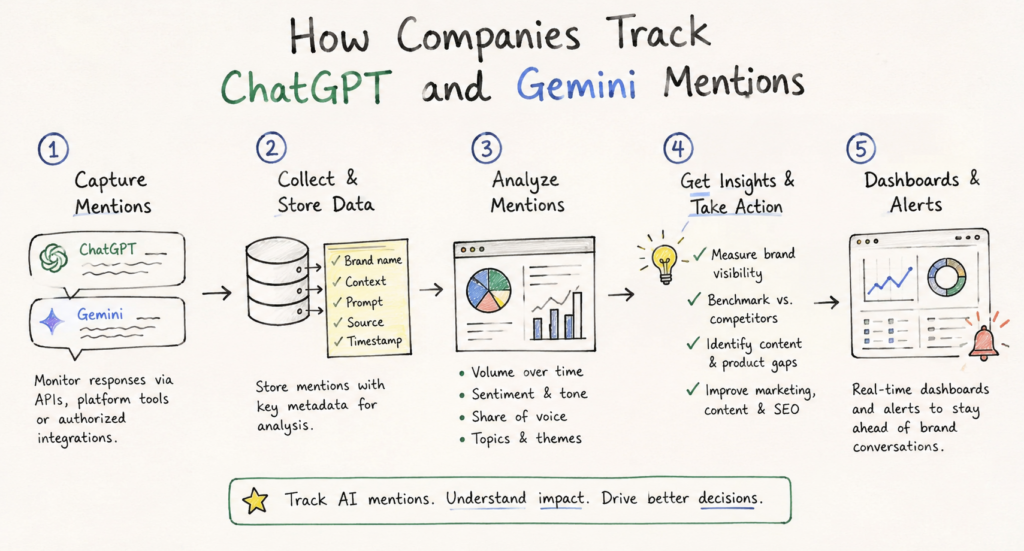
A typical workflow looks like this:
Step 1: Identify Core Topics
Examples:
* Sales engagement software
* AI SDR tools
* CRM platforms
* Marketing automation
* Revenue intelligence
Step 2: Build Prompt Libraries
Examples:
* Best tools
* Top platforms
* Alternatives
* Comparisons
* Reviews
* Recommendations
Step 3: Test Across AI Models
Including:
* ChatGPT
* Gemini
* Claude
* Perplexity
* Microsoft Copilot
Step 4: Measure Visibility
Track:
* Mention frequency
* Ranking position
* Sentiment
* Context
This provides a baseline for AI visibility.
AI Visibility Platforms Are Emerging
A new software category has emerged to solve this problem.
These platforms help companies monitor how often AI systems mention their brand.
Common capabilities include:
Brand Mention Tracking
Measures:
* ChatGPT mentions
* Gemini mentions
* Claude mentions
* Perplexity mentions
Competitor Analysis
Shows:
* Which brands appear most often
* Market share within AI answers
* Competitive positioning
Prompt Monitoring
Tracks performance across thousands of prompts.
Visibility Trends
Identifies whether brand presence is increasing or declining.
This category is growing rapidly as marketers seek measurable AI visibility metrics.
What Companies Are Measuring
AI visibility isn’t just about being mentioned.
Sophisticated organizations track several metrics.
Mention Rate
How often the brand appears.
Example:
Appears in 42 out of 100 tested prompts.
Mention rate = 42%
Position in Responses
Being first matters.
If ChatGPT recommends:
1. Company A
2. Company B
3. Company C
The first mention typically receives the most attention.
Companies therefore monitor ranking position.
Share of Voice
This measures:
How frequently a brand appears compared to competitors.
Example:
* Brand A: 35%
* Brand B: 25%
* Brand C: 15%
* Others: 25%
This reveals AI market dominance.
Sentiment Analysis
Being mentioned isn’t enough.
How is the brand described?
Positive:
“Industry-leading platform with advanced automation.”
Neutral:
“Popular option used by many businesses.”
Negative:
“Affordable but limited compared to competitors.”
Companies closely monitor sentiment because AI-generated descriptions influence buyer perception.
How Companies Track Gemini Mentions
Google Gemini presents unique opportunities.
Since Google influences much of the internet’s information ecosystem, visibility inside Gemini can be particularly valuable.
Companies typically monitor:
* Product recommendations
* Industry comparisons
* Localized searches
* Buying guides
* Software evaluations
The process resembles ChatGPT monitoring but includes additional focus on:
* Google-indexed content
* Structured data
* Knowledge graph signals
* Authority sources
Many brands run the same prompt sets across both ChatGPT and Gemini to identify differences.
Why Some Brands Appear Constantly
Ever notice certain companies show up everywhere?
That’s not random.
AI systems often favor brands that demonstrate strong authority signals.
These include:
Consistent Expert Content
Brands publishing:
* Research reports
* Original studies
* Industry insights
* Data-backed analysis
often gain more visibility.
Strong Third-Party Mentions
AI systems frequently rely on external validation.
Examples:
* News coverage
* Industry publications
* Analyst reports
* Review platforms
The more trusted sources mention a company, the stronger its authority becomes.
Brand Recognition
Established brands naturally receive more mentions because they appear across more data sources.
This creates a compounding effect.
More visibility leads to more mentions.
More mentions lead to stronger AI recognition.
The New KPI: AI Share of Voice
Many marketing leaders now discuss a metric called:
AI Share of Voice
This measures how frequently a company appears across AI-generated answers compared to competitors.
Think of it as the AI equivalent of search market share.
For example:
If an AI SDR company appears in 60% of relevant prompts while competitors appear in 20%, that company owns a large portion of AI visibility.
This metric is becoming increasingly important for:
* SaaS companies
* Agencies
* Technology vendors
* B2B service providers
How Companies Improve AI Visibility
Tracking is only the first step.
The bigger challenge is increasing visibility.
Successful companies focus on several strategies.
Create Authoritative Content
AI systems favor useful content.
Not keyword-stuffed pages.
Not thin articles.
Not AI-generated spam.
Instead:
* Original research
* Deep guides
* Expert commentary
* Industry analysis
tend to perform better.
The goal is becoming a trusted source.
Publish Comparison Content
People frequently ask AI:
* Best alternatives
* Top competitors
* Product comparisons
Companies that publish honest comparison content often gain visibility in these conversations.
Earn Brand Mentions
Visibility grows when respected websites discuss your company.
Examples include:
* Industry blogs
* Podcasts
* News sites
* Communities
* Research firms
AI systems frequently rely on these signals when determining authority.
Build Topical Authority
Rather than publishing random content, successful brands dominate a specific niche.
Examples:
An AI SDR company publishes extensively about:
* Prospecting
* Outbound sales
* Lead generation
* Email personalization
* Revenue operations
This concentration helps AI associate the brand with those topics.
The Difference Between SEO and GEO
Many marketers ask:
“Is GEO replacing SEO?”
Not exactly.
SEO remains important.
But GEO expands the strategy.
Traditional SEO Focus
* Rankings
* Keywords
* Traffic
* Clicks
GEO Focus
* Mentions
* Citations
* Authority
* AI recommendations
The future belongs to companies doing both.
The Biggest Mistake Brands Make
Many organizations assume AI visibility happens automatically.
It doesn’t.
Just because you’re successful doesn’t mean AI systems will recommend you.
We’ve seen companies with:
* Strong revenue
* Large customer bases
* Excellent products
yet minimal AI visibility.
Why?
Because they haven’t built sufficient digital authority signals.
AI can only recommend what it understands and trusts.
Industries Seeing the Biggest Impact
Some sectors are experiencing AI visibility shifts faster than others.
SaaS
Software buyers increasingly ask AI for recommendations.
Marketing Agencies
Businesses frequently ask:
* Best SEO agencies
* Best content marketing firms
* Top PPC agencies
Cybersecurity
Complex buying decisions often start with AI research.
HR Technology
Recruiting and HR software are frequently compared using AI assistants.
Sales Technology
AI SDRs, prospecting tools, CRMs, and enrichment platforms are among the most commonly queried categories.
What the Future Looks Like
Over the next few years, AI visibility will likely become a standard marketing metric.
Companies already track:
* Organic traffic
* Paid traffic
* Conversions
* Revenue
Soon they’ll also track:
* ChatGPT visibility
* Gemini visibility
* AI share of voice
* AI sentiment
* AI recommendation frequency
Marketing teams that adapt early will gain a significant advantage.
