Top AI Product Strategy Frameworks in 2026
Artificial intelligence is changing how products are built, launched, and scaled. But while many companies are racing to add AI features, the reality is that technology alone doesn’t create successful products.
The companies winning with AI in 2026 aren’t necessarily those with the most advanced models. They’re the ones using structured product strategies to identify real customer problems, validate opportunities, and create sustainable business value.
This is where AI product strategy frameworks become essential.
A framework helps product leaders move beyond the hype and answer critical questions:
* What customer problem are we solving?
* Where does AI create unique value?
* What data is required?
* How do we measure success?
* What risks should we anticipate?
* How do we build trust with users?
As AI adoption accelerates across industries, product managers, founders, and innovation teams are increasingly relying on proven frameworks to guide product development and investment decisions.
Here are the most important AI product strategy frameworks shaping modern product organizations in 2026.
Why AI Products Require Different Strategy Frameworks
Traditional software products are typically deterministic.
Users provide inputs, and software produces predictable outputs.
AI products operate differently.
They involve:
* Probabilistic outcomes
* Model uncertainty
* Continuous learning
* Data dependencies
* Ethical considerations
* Human-AI interaction patterns
These characteristics require a different approach to product strategy.
The best AI product frameworks help teams balance technical capabilities with customer needs, business goals, and operational realities.
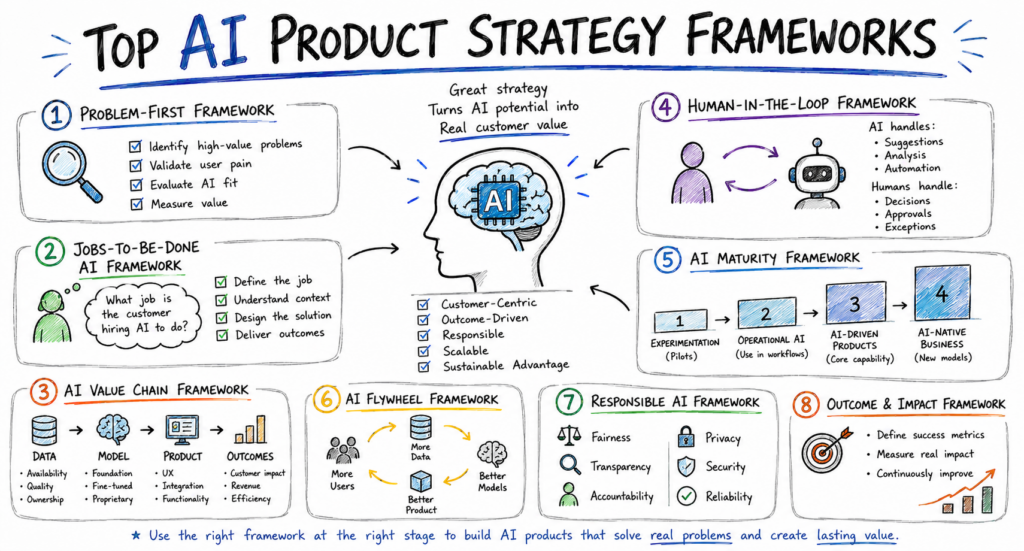
1. The Problem-First AI Framework
One of the biggest mistakes organizations make is starting with technology rather than customer problems.
The Problem-First Framework reverses that thinking.
Instead of asking:
“How can we use AI?”
Teams ask:
“What customer problem is difficult to solve with traditional approaches?”
The framework follows a simple process:
Step 1: Identify High-Value Problems
Look for tasks that are:
* Repetitive
* Time-consuming
* Data-intensive
* Decision-heavy
Step 2: Validate User Pain
Understand:
* Current workflows
* Existing frustrations
* Business impact
Step 3: Evaluate AI Fit
Determine whether AI genuinely improves outcomes compared to conventional software.
Step 4: Measure Value Creation
Define success metrics before development begins.
This framework prevents teams from building AI features that generate excitement but little customer value.
2. The Jobs-to-Be-Done (JTBD) AI Framework
The Jobs-to-Be-Done methodology remains one of the most effective product strategy frameworks.
Instead of focusing on features, it focuses on the progress customers want to achieve.
For AI products, the key question becomes:
“What job is the customer hiring this AI to do?”
Examples include:
* Summarize information
* Generate content
* Automate analysis
* Improve decision-making
* Reduce manual work
Understanding the underlying job helps teams design AI experiences that align with user goals rather than technical capabilities.
Many successful AI products owe their growth to a deep understanding of customer jobs rather than model sophistication.
3. The AI Value Chain Framework
AI products depend on more than algorithms.
The AI Value Chain Framework examines the entire ecosystem required to deliver value.
The framework evaluates:
Data Layer
* Data availability
* Data quality
* Data ownership
Model Layer
* Foundation models
* Fine-tuned models
* Proprietary models
Product Layer
* User experience
* Workflow integration
* Business functionality
Outcome Layer
* Customer impact
* Revenue generation
* Operational improvement
Organizations that understand the full AI value chain often make better strategic investment decisions.
4. The Human-in-the-Loop Framework
Despite rapid advances in AI, most successful enterprise products still rely on human oversight.
The Human-in-the-Loop framework identifies:
Tasks AI Performs
Examples:
* Recommendations
* Draft generation
* Analysis
Tasks Humans Control
Examples:
* Approvals
* Final decisions
* Exception handling
This framework is particularly important for industries such as:
* Healthcare
* Finance
* Legal
* Government
* Enterprise software
Human oversight helps improve trust, accuracy, and accountability.
5. The AI Maturity Framework
Not every organization is ready for advanced AI products.
The AI Maturity Framework helps teams assess their readiness across several dimensions.
Level 1: Experimentation
Small pilots and proofs of concept.
Level 2: Operational AI
AI features integrated into workflows.
Level 3: AI-Driven Products
AI becomes a core product capability.
Level 4: AI-Native Business Models
The entire product experience depends on AI.
Understanding maturity levels helps organizations prioritize investments and avoid overcommitting resources too early.
6. The AI Flywheel Framework
One of the most powerful concepts in AI product strategy is the flywheel.
The idea is simple:
Better products attract more users.
More users generate more data.
More data improves models.
Better models improve products.
The cycle repeats.
Leading AI companies leverage this feedback loop to create sustainable competitive advantages.
The framework helps product teams identify opportunities to create compounding value over time.
7. The Responsible AI Framework
Trust has become a major competitive differentiator.
Customers increasingly expect transparency regarding:
* Data usage
* Model behavior
* Privacy protections
* Security controls
* Bias mitigation
The Responsible AI Framework evaluates:
Fairness
Are outcomes equitable?
Transparency
Can decisions be explained?
Accountability
Who is responsible for AI outcomes?
Privacy
Is user data protected?
Security
Can the system resist misuse?
Organizations that prioritize responsible AI often build stronger customer relationships and reduce long-term risk.
Why Product Teams Need AI Strategy More Than Ever
The AI market is becoming increasingly crowded.
Launching an AI feature is no longer enough to stand out.
The most successful product teams are focusing on:
* Customer outcomes
* Workflow integration
* User trust
* Sustainable differentiation
* Long-term value creation
Strategy is becoming a bigger competitive advantage than access to AI technology itself.
As foundation models become more widely available, execution and product thinking will increasingly separate winners from followers.
How Product Leaders Are Adapting
Today’s product leaders are evolving beyond traditional product management.
They must now understand:
* AI capabilities
* Data ecosystems
* Model limitations
* Governance requirements
* Human-AI interaction design
This shift is creating demand for practical frameworks that help teams make better decisions.
At Product Workshop AI, we closely follow how product managers, founders, and innovation leaders are applying AI across the product lifecycle. Through productworkshop.ai, professionals can explore proven frameworks, real-world case studies, and practical approaches for building AI-powered products that create meaningful business value rather than simply following industry trends.
Choosing the Right Framework
There is no single framework that works for every organization.
The most effective teams often combine multiple approaches.
For example:
* Use Problem-First Frameworks to identify opportunities.
* Apply JTBD to understand customer needs.
* Leverage Human-in-the-Loop design for trust and governance.
* Use AI Flywheels to drive long-term growth.
* Implement Responsible AI principles to reduce risk.
Together, these frameworks provide a comprehensive approach to AI product strategy.
